
Forget Password

View News
Apostille and Attestation-Complete Guide for CS
Apostille and Attestation: The Complete Guide for Company Secretaries
Introduction: Why Apostille Matters
Imagine it is the year 1961, and sending an Indian document abroad is a maze of bureaucracy. Every country had its own rules, and an Indian document often had to go through local authorities, state verification, central government legalisation, and finally the foreign embassy. The process could take weeks or months depending on the country. To simplify this, countries came together and adopted the Hague Convention Abolishing the Requirement of Legalisation for Foreign Public Documents. Today, over 120 countries are part of this Convention, and the solution to international document recognition is a small certificate called an Apostille. Once the Ministry of External Affairs in India apostilles a document, it is recognised automatically in all Hague Convention countries without embassy attestation. The Apostille verifies the signature and authority of the official who signed the document, but not the content of the document itself. This distinction is crucial for Company Secretaries who handle international transactions and cross-border company setups.
Notarisation and Apostille: Understanding the Difference
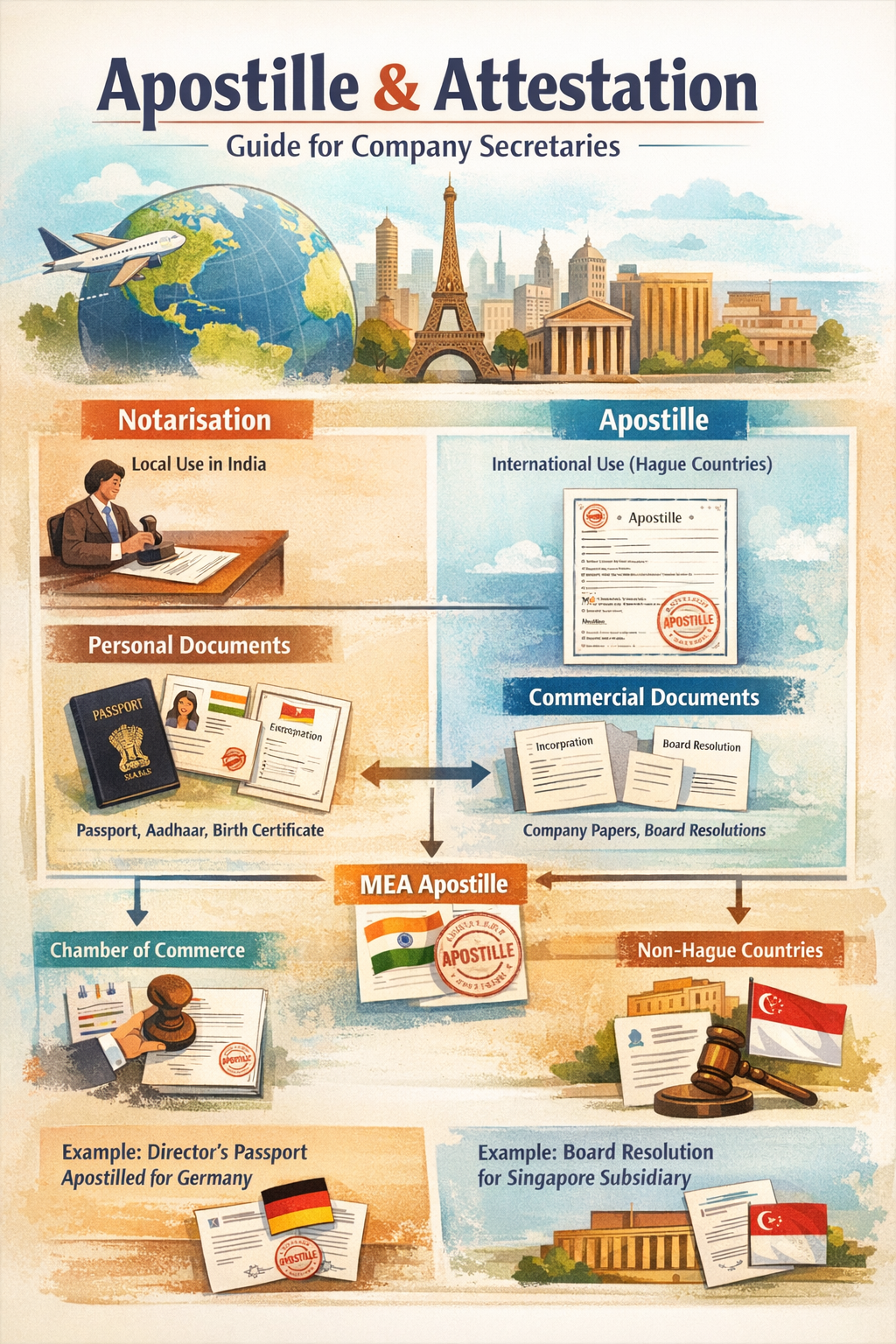
Notarisation and Apostille are often confused, but they serve different purposes. Notarisation is performed by a Notary Public in India. When a person visits a Notary Public with a document and identity proofs such as Aadhaar and PAN, the Notary confirms the person’s identity, witnesses the signing, and then stamps and signs the document. This certifies that the person signed the document in the Notary’s presence. However, notarisation does not verify the facts in the document, does not confirm company resolutions, and does not make the document internationally acceptable. Notarised documents are primarily for use within India, such as affidavits, self-attested copies, domestic powers of attorney, and personal declarations.
Apostille, in contrast, is about international use. It is required whenever a document is to be used in a foreign country that is a member of the Hague Convention. Once the MEA apostilles a document, it is automatically recognised in all Hague countries. Embassy attestation is not required in such cases. For countries outside the Hague Convention, including UAE, Saudi Arabia, China, and Kuwait, documents must be attested by the MEA and legalised by the foreign embassy or consulate, and sometimes additionally attested by the Ministry of Foreign Affairs of the destination country.
Personal Documents versus Commercial Documents
Company Secretaries must distinguish between personal and commercial documents, as the authentication process differs for each. Personal documents belong to an individual and include items such as passport photocopies, Aadhaar cards, PAN cards, birth certificates, or personal affidavits. For example, if a Director of a company wants to submit a passport copy to an overseas bank in Singapore, the process is straightforward. The Director first provides a self-attested copy, which is then notarised by a Notary Public and submitted to the MEA for Apostille. No Chamber of Commerce verification is needed, as it is a personal document.
Commercial or company documents, such as Board resolutions, powers of attorney executed on behalf of a company, authorisation letters, and incorporation documents, follow a more complex process. These documents often require verification by the Chamber of Commerce, which confirms the company’s credentials and authorised signatories. State-level authentication may follow, such as Mantralaya attestation in Maharashtra, before submitting the document to the MEA for Apostille or attestation. For countries outside the Hague Convention, embassy legalisation is also required.
Step-by-Step Process for Personal Documents
For personal documents, the first step is to identify where the document will be used. Once it is clear that it is for a Hague Convention country, the process is simple. The individual first self-attests the document, then gets it notarised by a Notary Public, and finally submits it to the MEA for Apostille. Example: Mr. Anil Sharma wants to use his birth certificate for higher studies in Germany. He provides a self-attested copy, gets it notarised, and submits it to the MEA. The Apostille makes the certificate valid for German authorities. No embassy attestation is required. If the destination country is not part of the Hague Convention, the document must be attested by the MEA and then legalised by the embassy of the country where it will be used.
Step-by-Step Process for Commercial Documents
Commercial documents require additional verification. The process begins with correct execution by the company. If the document is a Board resolution approving the appointment of a foreign consultant, it must first be signed by the authorised signatory of the company. The document is then submitted to the Chamber of Commerce for verification. Example: Qualitek Labs Limited prepares a Board resolution for opening a subsidiary in Singapore. The resolution is signed by the Managing Director and submitted to the Bombay Chamber of Commerce. The Chamber verifies the company’s credentials and the authority of the signatory, confirming that it is a commercial document. In Maharashtra, the next step is state-level authentication at Mantralaya, followed by submission to the MEA for Apostille. For countries outside the Hague Convention, embassy legalisation is required after MEA attestation.
Examples of Distinguishing Personal and Commercial Documents
It is important to note that the same type of document can be personal or commercial depending on the context. Example: A Director executes a Power of Attorney in a personal capacity to authorise a family member for personal property matters. This is a personal document. However, if the same Director executes a Power of Attorney on behalf of the company for overseas operations, it is a commercial document. This distinction determines whether the Chamber of Commerce and state authentication are involved.
State-Specific Variations and Modern Reforms
Different states in India have slight procedural differences. For instance, in Delhi, commercial documents are verified by local Chambers or designated authorities notified by the Delhi government. In Karnataka, the appropriate chamber and state-level authorities handle the verification. The underlying principles remain the same: the type of document and the destination country determine the authentication process. Modern reforms such as decentralised apostille services at Regional Passport Offices and digital platforms like E-Sanad for online verification of educational documents have made the process faster and more efficient. Documents can now be submitted through authorised service providers, reducing the time spent at the MEA counter and improving accessibility for applicants across India.
Key Takeaways for Company Secretaries
For Company Secretaries, clarity at the start is critical. Always ask where the document will be used, whether it is personal or commercial, and whether the destination country is a Hague Convention member. Personal documents typically follow the Notary Public and MEA Apostille route for Hague countries. Commercial documents require Chamber of Commerce verification, state authentication, MEA Apostille or attestation, and embassy legalisation if the country is not a Hague member. Following this process carefully saves time, reduces costs, and ensures professional reputation is maintained. Apostille is sufficient for Hague countries, while MEA attestation plus embassy legalisation is required for non-Hague countries. Understanding the distinction between personal and commercial documents, and correctly identifying the destination country, is a core professional judgment that every Company Secretary must master. Proper execution of this process ensures that cross-border transactions, company incorporations, and other international business operations proceed smoothly without unnecessary delays or confusion.
"Unlock the Potential of Legal Expertise with LegalMantra.net - Your Trusted Legal Consultancy Partner”
Disclaimer: Every effort has been made to avoid errors or omissions in this material in spite of this, errors may creep in. Any mistake, error or discrepancy noted may be brought to our notice which shall be taken care of in the next edition In no event the author shall be liable for any direct indirect, special or incidental damage resulting from or arising out of or in connection with the use of this information Many sources have been considered including Newspapers, Journals, Bare Acts, Case Materials , Charted Secretary, Research Papers etc
Mayank Garg
LegalMantra.net team