
Forget Password

View News
Appointment of Independent Director in a Private Company: Optional Does Not Mean Exempt
Appointment of Independent Director in a Private Company: Optional Does Not Mean Exempt
An Analysis of the ROC Order in the matter of M/s Clean Max Enviro Energy Solutions Ltd.
Introduction
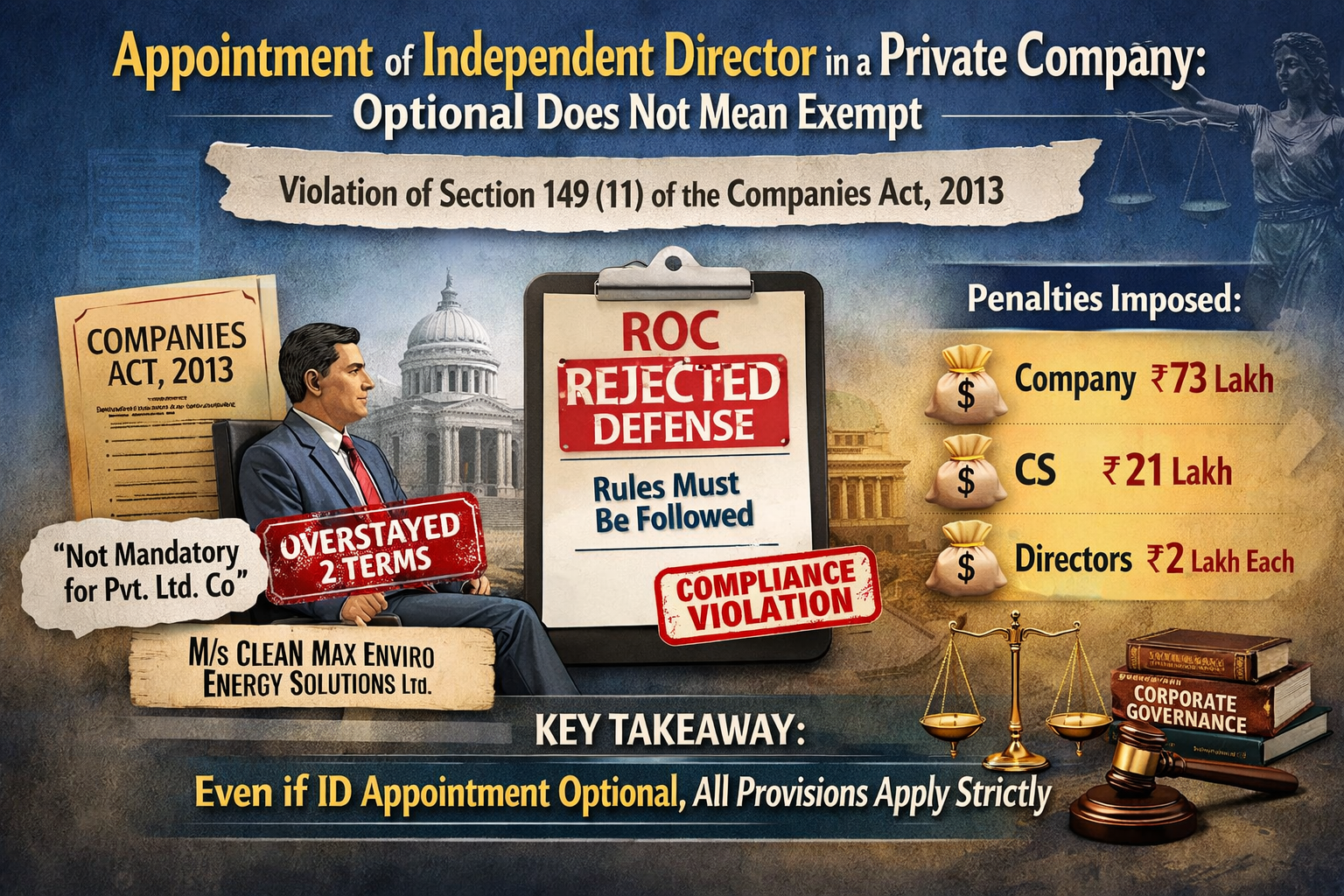
The framework of corporate governance under the Companies Act, 2013 assigns a vital role to Independent Directors in safeguarding the interests of stakeholders and ensuring balanced decision-making at the board level. Although the statutory requirement to appoint Independent Directors is limited to listed companies and certain classes of public companies, a recent adjudication order passed by the Registrar of Companies has clarified a crucial compliance principle. The order reiterates that once a company, even a private limited company, voluntarily appoints an Independent Director, it becomes mandatorily bound by all provisions applicable to such appointment under the Companies Act, 2013. This principle has been emphatically affirmed in the matter of M/s Clean Max Enviro Energy Solutions Ltd., where significant penalties were imposed on the company, its directors, and the Company Secretary.
Background and Facts of the Case
M/s Clean Max Enviro Energy Solutions Ltd. is a private limited company which had appointed an Independent Director on its Board. While such an appointment is not mandatory for a private company under Section 149(4) of the Companies Act, 2013, the company continued the tenure of the Independent Director beyond the maximum permissible limit prescribed under Section 149(11). During scrutiny, the Registrar of Companies observed that the Independent Director had held office for more than two consecutive terms without observing the mandatory cooling-off period of three years.
In response to the show cause notice, the company contended that since the appointment of an Independent Director is not mandatory for a private limited company, the restrictions relating to tenure and re-appointment under Section 149 should not apply to it. The ROC, however, rejected this argument and held that the law does not permit selective compliance once a statutory designation such as “Independent Director” is adopted.
Statutory Framework Governing Independent Directors
Section 149(4) of the Companies Act, 2013 mandates the appointment of Independent Directors only for listed companies and such classes of public companies as may be prescribed. Private companies are not included within the mandatory ambit of this provision. However, the absence of a mandatory requirement does not amount to an exemption from the law when a private company voluntarily chooses to appoint an Independent Director.
Section 149(11) clearly lays down the maximum tenure of an Independent Director by providing that no Independent Director shall hold office for more than two consecutive terms, each term being up to five consecutive years. The provision further mandates a cooling-off period of three years after completion of two consecutive terms, during which the individual shall not be associated with the company in any capacity, either directly or indirectly. The language of Section 149(11) is absolute in nature and does not carve out any exception for private companies or voluntary appointments.
Further, Section 149(12) establishes the circumstances under which Independent Directors can be held liable for acts of omission or commission. It provides that liability arises where such acts occurred with the knowledge of the director, attributable through board processes, or with their consent or connivance. This provision reinforces accountability and was relied upon to assess the responsibility of the directors involved in the present matter.
Since the Companies Act does not prescribe a specific penalty for violation of Section 149(11), the ROC invoked Section 172, which provides for penalties where no specific punishment is prescribed elsewhere in the Act. Accordingly, penalties were imposed on the company and every officer in default.
Findings and Reasoning of the Registrar of Companies
The Registrar of Companies categorically held that the Companies Act, 2013 does not distinguish between mandatory and voluntary appointments once the designation of “Independent Director” is used. The ROC observed that permitting companies to escape compliance on the ground that the appointment was optional would defeat the very objective of introducing Independent Directors as a governance mechanism.
The adjudicating authority emphasized that compliance obligations are triggered by the nature of appointment and designation, not by the category of the company. Once a person is appointed as an Independent Director, the company is legally bound to comply with all conditions, limitations, and safeguards prescribed under Section 149 and Schedule IV of the Act. Any other interpretation would allow companies to circumvent statutory safeguards under the guise of voluntary governance practices.
Penalties Imposed
Based on the above findings, the Registrar of Companies imposed substantial monetary penalties. A penalty of ?73 lakh was levied on the company for contravention of the provisions of the Companies Act. The Company Secretary was penalized ?21 lakh, reflecting the critical responsibility of the compliance officer in monitoring board composition, director tenure, and statutory limits. In addition, penalties of ?2 lakh each were imposed on the directors concerned.
The imposition of a significant penalty on the Company Secretary underscores the regulatory expectation that Key Managerial Personnel must exercise due diligence and proactively prevent statutory violations, especially those relating to corporate governance.
Key Compliance Implications
This order establishes that the appointment of an Independent Director, even where not mandated by law, brings with it a complete set of statutory obligations. Companies cannot adopt a selective approach by enjoying the perceived governance benefits of an Independent Director while disregarding statutory restrictions on tenure and re-appointment.
The case also highlights the importance of robust compliance tracking mechanisms, particularly with respect to director tenure, cooling-off periods, and board re-constitution. For Company Secretaries, the order serves as a cautionary precedent emphasizing that lapses in advisory and monitoring functions can result in severe personal financial consequences.
Conclusion
The adjudication order in the matter of M/s Clean Max Enviro Energy Solutions Ltd. reinforces the principle that corporate governance provisions under the Companies Act, 2013 are based on substance rather than form. The law does not permit partial compliance merely because an appointment is voluntary. Once a company chooses to appoint an Independent Director, it must adhere strictly to the statutory framework governing such appointments.
This case stands as a significant compliance reminder for private companies, directors, and Company Secretaries alike that voluntary governance measures cannot operate outside the boundaries of law and that statutory designations carry mandatory legal consequences.
"Unlock the Potential of Legal Expertise with LegalMantra.net - Your Trusted Legal Consultancy Partner”
Disclaimer: Every effort has been made to avoid errors or omissions in this material in spite of this, errors may creep in. Any mistake, error or discrepancy noted may be brought to our notice which shall be taken care of in the next edition In no event the author shall be liable for any direct indirect, special or incidental damage resulting from or arising out of or in connection with the use of this information Many sources have been considered including Newspapers, Journals, Bare Acts, Case Materials , Charted Secretary, Research Papers etc
Mayank Garg
LegalMantra.net team