
Forget Password

View News
Can Arbitral Awards Be Modified in Setting-Aside Proceedings
Can Arbitral Awards Be Modified in Setting-Aside Proceedings?
1. Introduction
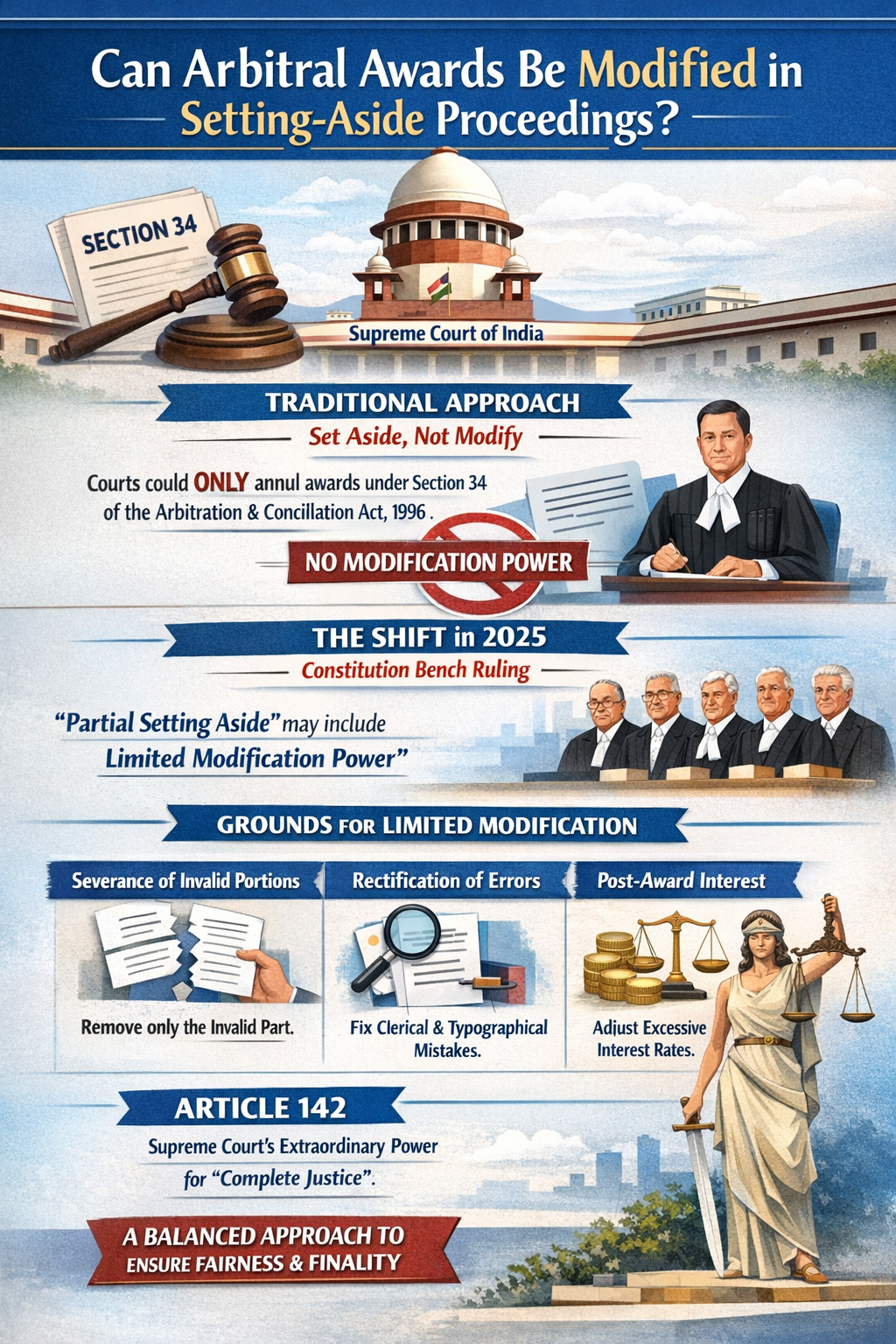
The extent of judicial intervention in arbitral awards has consistently been a subject of legal scrutiny under Indian arbitration jurisprudence. One of the most debated issues in this context is whether courts, while exercising jurisdiction under Section 34 of the Arbitration and Conciliation Act, 1996, possess the authority to modify an arbitral award or whether their powers are strictly confined to setting it aside. Traditionally, the statutory framework and judicial interpretation have leaned in favor of minimal interference, thereby preserving the autonomy and finality of arbitral proceedings. However, recent judicial developments, particularly a Constitution Bench ruling of the Supreme Court of India in 2025, indicate a gradual shift towards recognizing a limited power of modification in specific circumstances.
2. Traditional Position: Restriction to Setting Aside
The classical interpretation of Section 34 of the Act has been that it provides only a limited recourse against arbitral awards by way of setting them aside on specific grounds. These grounds generally relate to the validity of the arbitration agreement, procedural irregularities, lack of jurisdiction, improper constitution of the arbitral tribunal, decisions beyond the scope of submission, and conflict with public policy. Courts have historically emphasized that the provision does not confer appellate powers and, therefore, does not permit a re-examination of the merits of the case.
In line with this interpretation, judicial precedents have consistently held that courts cannot correct, vary, or modify an arbitral award. The role of the court has been understood as supervisory rather than adjudicatory, ensuring that the arbitral process adheres to legal standards without substituting the court’s view for that of the arbitral tribunal. This approach aligns with the broader objective of the Act, which is to promote finality and efficiency in dispute resolution by minimizing judicial interference.
3. Emerging Judicial Approach: Limited Recognition of Modification
A significant development in this area emerged through a Constitution Bench judgment delivered in May 2025 by the Supreme Court. The majority opinion marked a nuanced departure from the traditional view by recognizing that the power to partially set aside an arbitral award may, in certain circumstances, include the power to effectively modify it. The Court reasoned that when an invalid portion of an award is capable of being severed from the valid portion, setting aside only that part would result in the survival of the remaining award in a modified form.
This reasoning is grounded in the principle that the greater power to set aside an award entirely necessarily includes the lesser power to set aside it in part. However, the Court was careful to clarify that such modification does not amount to an appellate review on merits but is instead a limited and incidental consequence of the power of severance.
4. Situations Where Limited Modification is Permissible
The Supreme Court has delineated specific circumstances under which a limited form of modification may be permissible. One such situation arises where an arbitral award deals with matters that fall outside the scope of the arbitration agreement. If these matters are separable from the issues that were validly referred to arbitration, the court may set aside only the offending portion. In doing so, the remaining portion continues to operate, thereby resulting in a modified award.
Another situation pertains to the correction of manifest errors. Courts have acknowledged that computational mistakes, clerical errors, typographical inaccuracies, or similar inadvertent omissions may be corrected without disturbing the substantive findings of the arbitral tribunal. This approach is consistent with the principles embodied in Section 152 of the Code of Civil Procedure, 1908, which allows courts to rectify accidental slips or omissions in judgments and decrees.
A further instance where modification may be considered relates to post-award interest. In cases where the rate of interest awarded is found to be excessive, unreasonable, or contrary to law, courts may adjust the rate instead of setting aside the entire award. This ensures that the defect is addressed without undermining the validity of the award as a whole.
Additionally, the Supreme Court retains extraordinary powers under Article 142 of the Constitution of India to do complete justice between the parties. While this power is not confined by statutory limitations, the Court has emphasized that it must be exercised sparingly and in exceptional cases so as not to dilute the fundamental principles governing arbitration.
5. The Dissenting Perspective
Despite the majority’s progressive interpretation, the Constitution Bench also witnessed a strong dissenting opinion. The dissent emphasized that the statutory framework does not expressly provide for any power of modification and that such power cannot be implied. It argued that the authority to set aside an award, whether wholly or partially, is distinct from the authority to modify it. According to this view, permitting modification risks transforming Section 34 proceedings into an appellate mechanism, thereby undermining the finality and autonomy of arbitral awards. The dissent thus advocates for a strict and literal interpretation of the statute, confining judicial intervention to either setting aside the award or upholding it.
6. Conclusion
In conclusion, while the annulment of arbitral awards remains the principal remedy under Section 34 of the Arbitration and Conciliation Act, 1996, Indian arbitration law is witnessing a gradual evolution towards recognizing a limited power of modification. This power is not general or unfettered but is confined to narrowly defined circumstances such as severability of invalid portions, correction of manifest errors, and adjustment of post-award interest. The Supreme Court’s constitutional authority further supplements this framework in exceptional cases to ensure complete justice.
The emerging jurisprudence reflects an attempt to strike a careful balance between preserving the finality and efficiency of arbitration and ensuring that justice is not compromised due to technical or severable defects. As courts continue to interpret and apply these principles, the contours of permissible modification in setting-aside proceedings will become more clearly defined, contributing to the development of a more nuanced and pragmatic arbitration regime in India.
Unlock the Potential of Legal Expertise with LegalMantra.net – Your Trusted Legal Consultancy Partner
Disclaimer
Every effort has been made to ensure accuracy in this material. However, inadvertent errors or omissions may occur. Any discrepancies brought to the author’s notice will be rectified in subsequent editions. The author shall not be liable for any direct, indirect, incidental, or consequential damages arising from the use of this material. This article is based on various sources including statutory enactments, judicial decisions, academic research papers, professional journals, and publicly available legal materials.
Prerna Yadav
LegalMantra.net Team