
Forget Password

View News
Article 43 of the Constitution of India: Constitutional Vision of Living Wage and Economic Democracy
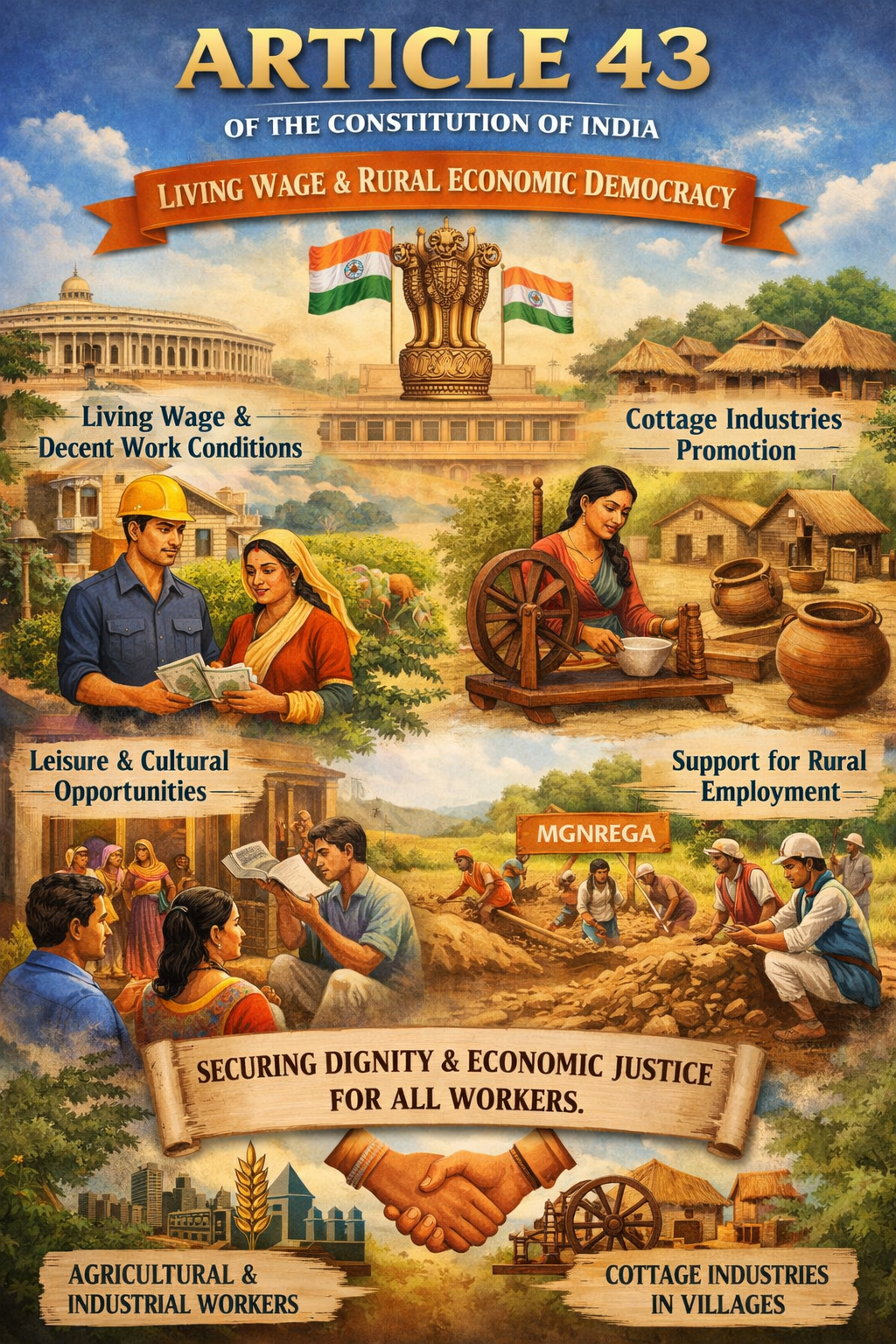
Article 43 of the Constitution of India: Constitutional Vision of Living Wage and Economic Democracy
Article 43 of the Constitution of India forms an integral part of the Directive Principles of State Policy contained in Part IV of the Constitution. It reflects the deep concern of the framers for achieving economic democracy and ensuring that political freedom is supported by social and economic justice. The provision was adopted in the year 1950 after detailed deliberations in the Constituent Assembly on 23 November 1948, when it was introduced as Draft Article 34. The debates reveal that the framers were conscious of India’s socio-economic realities, particularly widespread poverty, rural distress, and exploitation of labour, and therefore envisaged a constitutional obligation upon the State to secure dignified living conditions for workers.
Article 43 directs the State to endeavour, through legislation, economic organisation, or other suitable measures, to secure for all workers, whether agricultural, industrial, or engaged in any other occupation, adequate employment opportunities, a living wage, decent conditions of work, and full enjoyment of leisure and social and cultural opportunities. In addition to these labour-oriented guarantees, the Article specifically mandates the promotion of cottage industries in rural areas, either on an individual basis or through cooperative organisation. This dual focus on labour welfare and rural economic development distinguishes Article 43 from other Directive Principles.
Evolution from Draft Article 34 to Article 43
The final form of Article 43 is broader and more inclusive than its original draft. Draft Article 34 primarily addressed industrial labour and wage security, whereas the adopted Article 43 expressly included agricultural workers and other categories of labour. This expansion was a direct response to concerns raised in the Constituent Assembly regarding the vulnerability of rural and agrarian workers and the increasing imbalance between urban industrial growth and village economies. The emphasis on cottage industries was introduced to strengthen rural livelihoods, prevent distress migration to cities, and preserve traditional forms of production.
| Aspect | Draft Article 34 (1948) | Article 43 (1950) |
|---|---|---|
| Scope of workers | Mainly industrial workers | Agricultural, industrial and all other workers |
| Rural focus | Limited | Explicit promotion of rural cottage industries |
| Economic approach | Wage protection | Balanced rural–urban economic development |
| Methods | Legislative measures | Legislative, economic and organisational measures |
Philosophical Basis and Economic Democracy
Article 43 is rooted in the idea that democracy cannot be sustained merely through political rights without ensuring economic security to citizens. Members of the Constituent Assembly repeatedly emphasised that workers living in poverty cannot meaningfully participate in democratic governance. The Article therefore seeks to integrate economic justice with social dignity by guaranteeing not only employment and wages but also leisure and cultural development. The preference for cottage industries and cooperative structures reflects the framers’ inclination towards decentralised economic models, collective ownership, and equitable distribution of resources, particularly in rural India.
Judicial Interpretation and Constitutional Relevance
Although Article 43 is non-justiciable, it has played a significant role in shaping judicial interpretation of labour rights. Courts have consistently relied upon this Directive Principle to interpret fundamental rights relating to life, dignity, and livelihood in a purposive manner. Judicial decisions have linked fair wages, humane working conditions, and employment security with constitutional values, thereby giving indirect enforceability to the objectives of Article 43.
| Case | Judicial Observation | Constitutional Link |
|---|---|---|
| Bijay Cotton Mills v. State of Ajmer | Minimum wage legislation upheld | Living wage as constitutional goal |
| Sanjit Roy v. State of Rajasthan | Payment below minimum wage violates dignity | Decent living standards |
| PUDR v. Union of India | Non-payment of minimum wages unconstitutional | Humane work conditions |
| Olga Tellis v. BMC | Livelihood part of right to life | Employment protection |
| M.C. Mehta v. State of Tamil Nadu | Emphasis on humane labour conditions | Dignity of labour |
Through these rulings, the judiciary has harmonised Article 43 with Article 21, reinforcing the idea that the right to life includes the right to live with dignity.
Significance of Article 43
Article 43 is significant because it introduces the concept of a living wage, which goes beyond mere subsistence and aims to provide workers with the ability to maintain health, educate their children, enjoy reasonable comfort, and secure their future. By extending its scope to agricultural and informal workers, the Article acknowledges the realities of India’s largely unorganised workforce. Its recognition of leisure and cultural participation as components of human dignity reflects a progressive understanding of labour welfare.
Equally important is the focus on rural cottage industries, which serves as a constitutional response to regional inequality and rural unemployment. By encouraging cooperative organisation, the Article promotes collective economic activity and discourages concentration of wealth, thereby advancing the broader vision of economic democracy.
Legislative and Policy Measures Reflecting Article 43
The objectives of Article 43 have been operationalised through various labour laws, welfare legislations, and rural development programmes enacted over the years.
| Law / Scheme | Contribution to Article 43 Objectives |
|---|---|
| Minimum Wages Act, 1948 | Statutory wage protection |
| Payment of Wages Act, 1936 | Timely and fair wage payment |
| Industrial Disputes Act, 1947 | Industrial harmony and fair conditions |
| Factories Act, 1948 | Health, safety and welfare of workers |
| Employees’ State Insurance Act, 1948 | Social security and medical benefits |
| Code on Wages, 2019 | Coverage of unorganised sector |
| MGNREGA, 2005 | Rural employment and wage security |
| KVIC initiatives | Promotion of cottage industries |
| SFURTI | Regeneration of traditional industries |
| NRLM | Cooperative and self-help livelihoods |
These measures collectively translate the constitutional vision of Article 43 into practical governance and policy action.
Conclusion
Article 43 of the Constitution of India represents a comprehensive constitutional commitment to labour welfare, rural development, and economic democracy. It recognises that employment must ensure dignity, security, and holistic development rather than mere survival. By integrating living wages, decent working conditions, leisure, and rural cottage industries, the Article addresses both social justice and balanced economic growth. Despite being non-justiciable, Article 43 continues to guide legislative policy and judicial interpretation, reaffirming the framers’ belief that political democracy can endure only when supported by economic justice and human dignity.
Unlock the Potential of Legal Expertise with LegalMantra.net – Your Trusted Legal Consultancy Partner
Disclaimer
Every effort has been made to ensure accuracy in this material. However, inadvertent errors or omissions may occur. Any discrepancies brought to the author’s notice will be rectified in subsequent editions. The author shall not be liable for any direct, indirect, incidental, or consequential damages arising from the use of this material. This article is based on various sources including statutory enactments, judicial decisions, academic research papers, professional journals, and publicly available legal materials.
Anshul Goel