
Forget Password

View News
ASSETS VS. UNDERTAKING: AN ANALYSIS OF MADHUKAR ANANTRAO PATHAK VS. MPTA LIMITED & ORS.
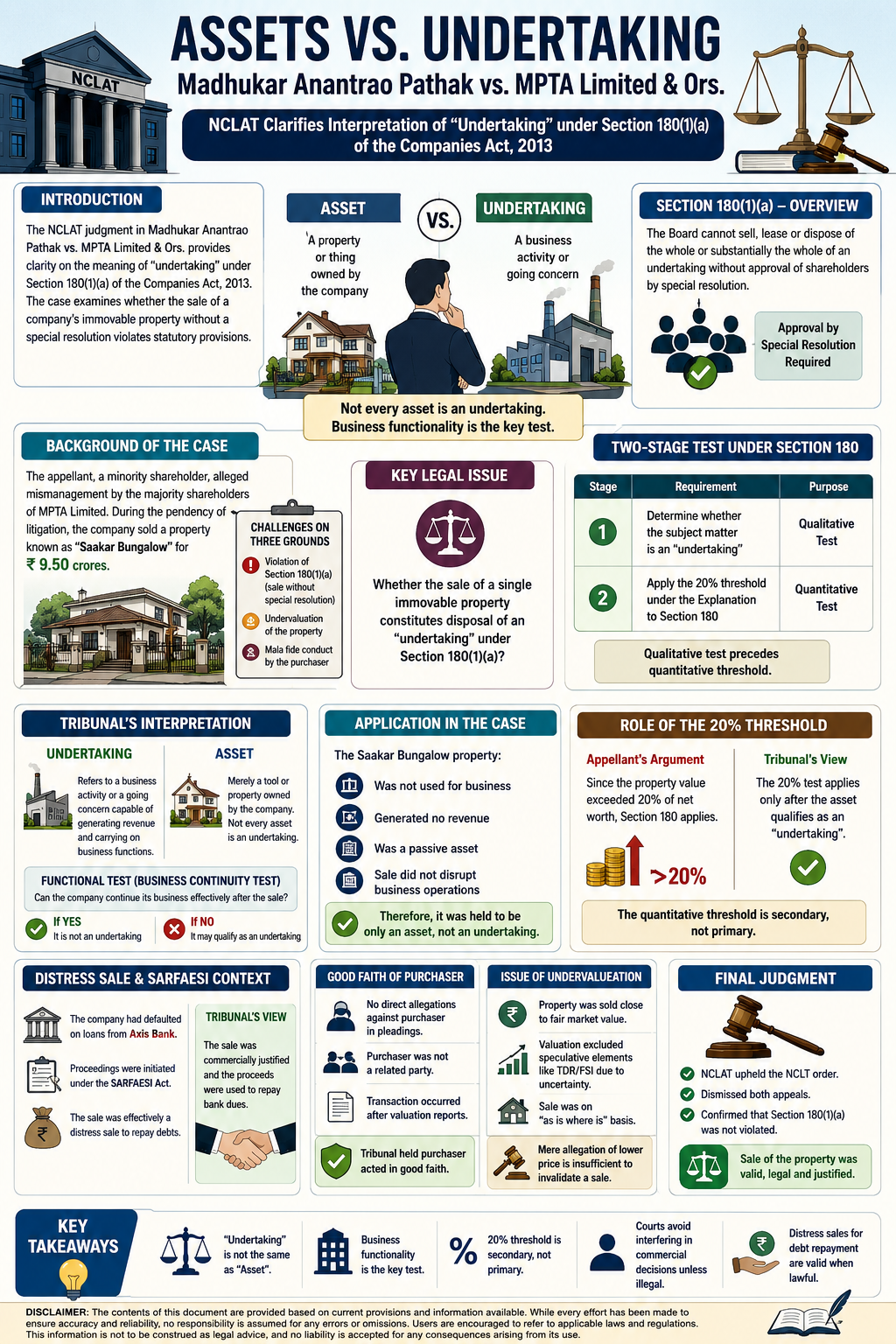
ASSETS VS. UNDERTAKING: AN ANALYSIS OF MADHUKAR ANANTRAO PATHAK VS. MPTA LIMITED & ORS.
Introduction
The distinction between an “asset” and an “undertaking” under the Companies Act, 2013 has long remained a subject of judicial interpretation and corporate debate. The decision of the National Company Law Appellate Tribunal (NCLAT) in Madhukar Anantrao Pathak vs. MPTA Limited & Ors. provides significant judicial clarity on this issue, particularly in the context of Section 180(1)(a) of the Companies Act, 2013.
The Tribunal examined whether the sale of a company’s immovable property amounts to the transfer of an “undertaking” requiring prior approval of shareholders through a special resolution. The ruling is important because it draws a clear legal distinction between a mere asset owned by a company and a business undertaking constituting the operational core of the enterprise.
The judgment also reinforces judicial reluctance to interfere in commercial decisions of management unless the transaction is tainted by illegality, fraud, mala fide conduct, or oppression.
Statutory Framework: Section 180(1)(a) of the Companies Act, 2013
Section 180(1)(a) of the Companies Act, 2013 restricts the powers of the Board of Directors in relation to disposal of substantial business assets. The provision mandates that the Board cannot sell, lease, or otherwise dispose of the whole or substantially the whole of an undertaking without obtaining approval of shareholders through a special resolution.
The legislative intent behind this provision is to ensure that shareholders retain control over decisions that may fundamentally affect the existence, structure, or operational continuity of the company.
The relevant statutory interpretation becomes crucial because the section applies only where the subject matter being transferred qualifies as an “undertaking.”
Meaning of “Undertaking” Under Section 180
The explanation appended to Section 180 defines “undertaking” in financial terms by prescribing a threshold linked to the company’s net worth and income contribution. However, the Tribunal clarified that the numerical threshold alone is not determinative.
Before applying the quantitative test, it must first be established that the property or business being transferred actually constitutes an “undertaking.”
This judgment therefore establishes a two-step interpretative approach:
| Stage | Requirement | Purpose |
|---|---|---|
| Stage 1 | Determine whether the subject matter is an “undertaking” | Qualitative test |
| Stage 2 | Apply the 20% threshold under the Explanation to Section 180 | Quantitative test |
The Tribunal categorically held that the quantitative threshold becomes relevant only after the qualitative requirement is satisfied.
Background of the Case
The dispute arose within MPTA Limited where allegations of oppression and mismanagement had already been raised by a minority shareholder.
During the pendency of litigation, the company sold an immovable property known as “Saakar Bungalow” for approximately ?9.50 crores. The appellant challenged the transaction before the Tribunal and alleged that the sale violated statutory safeguards and was prejudicial to shareholder interests.
The challenge primarily rested on three grounds, which may be summarized as follows:
| Issue Raised by Appellant | Allegation |
|---|---|
| Violation of Section 180(1)(a) | Sale occurred without special resolution |
| Undervaluation | Property allegedly sold below market value |
| Mala fide conduct | Purchaser allegedly acted in collusion with management |
The core legal controversy therefore revolved around whether the sale of the property amounted to disposal of an “undertaking.”
Core Legal Issue Before the Tribunal
The principal question before the NCLAT was:
Whether the sale of a single immovable property by a company constitutes disposal of an “undertaking” under Section 180(1)(a) of the Companies Act, 2013?
The answer to this issue had substantial implications because if the property constituted an undertaking, shareholder approval by special resolution would have been mandatory.
Tribunal’s Interpretation: “Undertaking” vs. “Asset”
The Tribunal upheld the findings of the National Company Law Tribunal (NCLT) and clarified that there is a fundamental legal distinction between an “undertaking” and an “asset.”
According to the Tribunal, an undertaking refers to a business activity, operational unit, or going concern capable of generating revenue and carrying on business functions. An asset, on the other hand, merely represents property or infrastructure owned by the company.
The judgment emphasized that every asset owned by a company cannot automatically be elevated to the status of an undertaking.
This interpretation is significant because companies often possess valuable immovable properties which may not form part of their core business operations. Merely because an asset has substantial monetary value does not mean that its sale triggers Section 180.
Functional Test Applied by the Tribunal
The NCLAT adopted a practical and functional approach while interpreting the term “undertaking.” The Tribunal relied upon earlier judicial precedents and evolved what may be termed as the “business continuity test.”
The essence of the test may be summarized in the following manner:
| Functional Test | Result |
|---|---|
| If the company can continue business effectively after sale | Property is not an undertaking |
| If business operations become impossible after sale | Property may qualify as an undertaking |
Thus, the determining factor is not merely ownership or value of the asset, but its functional importance to the company’s business operations.
The Tribunal therefore shifted the analysis from a purely financial assessment to a commercial and operational evaluation.
Application of the Functional Test in the Present Case
While applying the above principles to the facts, the Tribunal observed that the Saakar Bungalow property did not constitute a business undertaking.
The property was found to possess the following characteristics:
| Observation by Tribunal | Finding |
|---|---|
| Use in business operations | Not used for business |
| Revenue generation | Generated no operational income |
| Nature of asset | Passive immovable property |
| Impact of sale on business continuity | No substantial disruption |
The Tribunal therefore concluded that the property was merely an asset held by the company and not an undertaking within the meaning of Section 180(1)(a).
Consequently, shareholder approval through a special resolution was not legally required.
Interpretation of the 20% Threshold
One of the most important aspects of the judgment concerns the interpretation of the 20% threshold mentioned in the Explanation to Section 180.
The appellant argued that because the value of the property exceeded 20% of the company’s net worth, the transaction automatically attracted Section 180.
The Tribunal rejected this interpretation and clarified that the financial threshold cannot independently determine applicability of the provision.
The ruling establishes the following legal principle:
| Incorrect Interpretation | Correct Interpretation |
|---|---|
| Any asset exceeding 20% automatically becomes an undertaking | Asset must first qualify as an undertaking before 20% test applies |
This clarification has considerable practical significance for corporate transactions involving high-value immovable properties.
Distress Sale and SARFAESI Proceedings
The Tribunal also considered the commercial background in which the transaction occurred.
It was noted that the company had defaulted on loans obtained from Axis Bank and proceedings had been initiated under the SARFAESI Proceedings Against MPTA Limited.
The sale of the property was therefore undertaken in order to discharge outstanding liabilities and prevent further coercive recovery action.
The Tribunal treated the transaction as a commercially justified distress sale undertaken for legitimate financial purposes.
The following factors weighed with the Tribunal:
| Commercial Circumstance | Tribunal’s View |
|---|---|
| Loan default | Established financial stress |
| SARFAESI action initiated | Immediate repayment pressure |
| Sale proceeds used for debt repayment | Bona fide commercial purpose |
| Transaction necessity | Commercially justified |
The judgment reiterates the principle that courts should not substitute their commercial wisdom for that of management unless the transaction is unlawful or fraudulent.
Allegations Against the Purchaser
The appellant further alleged mala fide conduct and collusion between the purchaser and company management.
However, the Tribunal found no evidence supporting such allegations.
The Tribunal specifically observed that:
| Factor Considered | Finding |
|---|---|
| Pleadings against purchaser | No direct allegations |
| Relationship with company | Not a related party |
| Basis of transaction | Supported by valuation reports |
| Evidence of collusion | Not established |
Accordingly, the purchaser was held to have acted in good faith.
This aspect of the ruling demonstrates that mere suspicion or speculative allegations cannot invalidate a corporate transaction in the absence of substantive evidence.
Issue of Undervaluation
The appellant also contended that the property had been sold below market value.
The Tribunal, however, rejected the allegation after examining the valuation reports and surrounding circumstances.
It was observed that the valuation methodology consciously excluded speculative future elements such as Transferable Development Rights (TDR) and Floor Space Index (FSI) benefits because such benefits were uncertain and contingent.
Additionally, the property was sold on an “as is where is” basis, which naturally affects valuation considerations.
The Tribunal held that mere disagreement with valuation cannot invalidate a transaction unless fraud, manipulation, or gross arbitrariness is demonstrated.
The observations of the Tribunal may be summarized as follows:
| Valuation Aspect | Tribunal’s Observation |
|---|---|
| Sale consideration | Near fair market value |
| Exclusion of speculative factors | Justified |
| Nature of sale | “As is where is” basis |
| Proof of deliberate undervaluation | Not established |
Final Decision of the NCLAT
After considering all submissions, the NCLAT upheld the order passed by the NCLT and dismissed the appeals.
The Tribunal concluded that:
| Issue | Decision |
|---|---|
| Whether property constituted undertaking | No |
| Whether Section 180(1)(a) violated | No |
| Whether sale was mala fide | No |
| Whether undervaluation proved | No |
| Whether purchaser acted in bad faith | No |
The judgment therefore validated the sale transaction.
Legal Significance of the Judgment
The ruling has substantial implications for corporate governance and interpretation of Section 180.
First, it establishes that the concept of an undertaking is linked to business functionality rather than mere asset ownership.
Second, it clarifies that the statutory threshold under Section 180 is not independently determinative.
Third, it strengthens the principle of judicial deference toward commercial business decisions, particularly where management acts for debt repayment and business survival.
Fourth, it prevents unnecessary shareholder intervention in ordinary asset sales that do not affect the operational identity of the company.
Conclusion
The judgment in Madhukar Anantrao Pathak vs. MPTA Limited & Ors. marks an important development in Indian corporate jurisprudence by clearly distinguishing between an “asset” and an “undertaking” under Section 180(1)(a) of the Companies Act, 2013.
The Tribunal adopted a practical, business-oriented, and functional interpretation rather than a rigid mathematical approach. The ruling confirms that not every high-value asset sale requires shareholder approval. What is decisive is whether the asset constitutes the operational backbone of the company’s business activities.
The judgment also reinforces that courts will ordinarily respect commercial decisions of management, especially in situations involving financial distress and debt repayment, unless illegality, fraud, or mala fide conduct is clearly established.
From a corporate governance perspective, the ruling provides much-needed certainty regarding the scope and applicability of Section 180 and will likely serve as an important precedent in future disputes involving sale of corporate assets.
DISCLAIMER
The contents of this document are based on statutory provisions, judicial interpretations, and information available as on the date of writing. While every effort has been made to ensure accuracy, completeness, and reliability, no responsibility is assumed for any inadvertent errors or omissions. Readers are advised to independently verify applicable legal provisions, judicial precedents, notifications, and regulatory requirements before acting upon the information provided herein. The contents of this article are intended solely for educational and informational purposes and should not be construed as legal advice or professional opinion. No liability is accepted for any consequences arising from reliance placed on this material.
From the desk of CS Sharath