
Forget Password

View News
Can a Cousin Be Your “Independent” Director
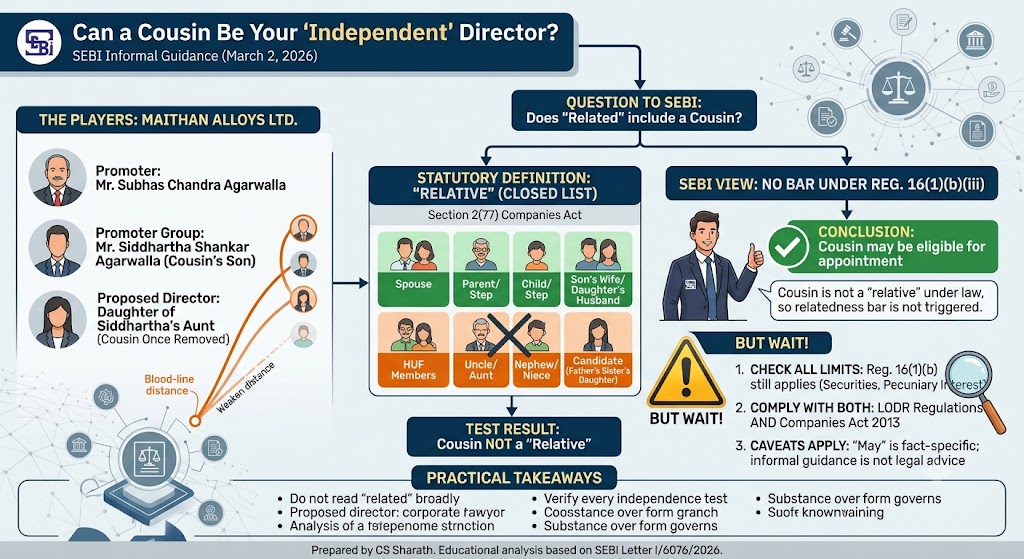
Can a Cousin Be Your “Independent” Director?
A Company Secretary’s breakdown of SEBI’s letter to Maithan Alloys Ltd. on Regulation 16(1)(b)(iii) of the LODR Regulations — what “related to promoters or directors” really means.
|
ISSUE NO. I/6076/2026 |
DATED March 2, 2026 |
REGULATION 16(1)(b)(iii) LODR |
1. The Players Involved
Maithan Alloys Ltd. is engaged in ferro-alloys and real estate. Its shares are listed on the Calcutta and National Stock Exchanges and are permitted to trade on the BSE. The query concerns the proposed appointment of an Independent Director and her relationship to the company’s promoter.
|
Person |
Role |
Relevance |
|
Mr. Subhas Chandra Agarwalla |
Promoter; Chairman & Managing Director |
The promoter against whom “relatedness” is to be tested. |
|
Mr. Siddhartha Shankar Agarwalla |
Promoter group; not on the Board |
Son of a cousin of the promoter. Holds 18.07% jointly with his wife; director in two subsidiaries. |
|
The Proposed Director |
Candidate for Independent Director |
Daughter of the sister of Siddhartha’s father — i.e. a cousin once removed from the promoter’s line. Assistant Professor, Praxis Business School. |
2. How Far Is the Cousin From the Promoter?
Tracing the bloodline shows how many steps separate the candidate from the promoter — each hop weakening any claim of a legal “relative” link:
Promoter (Subhas Chandra Agarwalla) → Cousin of the promoter → Cousin’s son (Siddhartha Shankar Agarwalla) → His aunt (father’s sister) → Her daughter = the proposed Independent Director
|
CS Note “Cousin” is several steps removed from the promoter, and the real question is whether the law even counts that connection as a “relative” at all. As the analysis below shows, it does not. |
3. The Question Put to SEBI
|
“Does the cousin of a Director / Promoter qualify as a person related to such Director / Promoter in terms of Regulation 16(1)(b)(iii) of the LODR Regulations?” |
The applicant’s argument
- “Related” means “relative.” The word “related” in Reg. 16(1)(b)(iii) should be read as limited to “relatives” as defined in Reg. 2(1)(zd) of the LODR Regulations.
- Reg. 17 stays in its lane. The wider Explanation under Reg. 17(1)(b) applies only to that regulation and cannot be imported into Reg. 16.
4. The Legal Test Applied
Regulation 16(1)(b)(iii) requires that an Independent Director not be related to the promoters or directors of the listed entity, its holding, subsidiary or associate company. The analysis runs in three steps:
- Step 1 — Is the candidate a “relative”? Test the relationship against Section 2(77) of the Companies Act, 2013 read with Rule 4 of the Companies (Specification of Definitions Details) Rules, 2014, and Reg. 2(1)(zd) of the LODR.
- Step 2 — A cousin is not on the list. The statutory definition of “relative” is a closed list, and it does not include a cousin (here, the daughter of the father’s sister).
- Step 3 — Therefore, not “related.” With no “relative” link, the relatedness bar in Reg. 16(1)(b)(iii) is not triggered.
5. Who Is a “Relative” in Law?
Under Section 2(77) of the Companies Act, 2013 and Rule 4 of the 2014 Rules, the list of “relatives” is exhaustive — if a relationship is not named, it simply does not count.
|
Counts as a relative |
Falls outside the definition |
|
|
6. SEBI’s View
“Without necessarily agreeing with your analysis…” SEBI arrived at the same destination as the applicant:
|
Conclusion The cousin may be eligible to be appointed as an Independent Director. A cousin is not a “relative” under the Companies Act / LODR framework, so the relatedness bar in Reg. 16(1)(b)(iii) is not attracted. |
…but SEBI flags three caveats
- “May,” not “must.” Eligibility is fact-specific; a different set of facts could produce a different result.
- Clear all of Reg. 16(1)(b). The other limbs still apply — for example sub-clause (iv) on holdings of securities and pecuniary interest in the listed entity.
- Read with the Companies Act. Compliance must satisfy both the LODR Regulations and the Companies Act, 2013 and its rules together.
7. Practical Takeaways for the Boardroom
- Statutory lists are exhaustive. Do not read “related” broadly. If a relationship is not in Section 2(77) / Rule 4, it is not a “relative.”
- Mind the boundaries between regulations. The wide Explanation in Reg. 17(1)(b) does not travel into Reg. 16; each provision is read on its own terms.
- Independence is not a single test. Even where a candidate is “not related,” verify every limb of Reg. 16(1)(b) — securities, pecuniary relationship, KMP history and so on.
- Informal guidance is not a shield. It binds no one, decides nothing for the Board, and proceeds entirely on the facts as stated by the applicant. Substance over form still governs.
|
Bottom line A cousin isn’t a “relative” in law — so relatedness alone won’t block the appointment. But “may be eligible” is not “is appointed.” Clear every other independence test before the Board passes its resolution. |
Prepared by CS Sharath. Educational analysis only — not legal advice. Based on SEBI Informal Guidance Issue No. I/6076/2026 dated March 2, 2026.