
Forget Password

View News
Can the Board of a Listed Company Function Without Any Executive Directors?
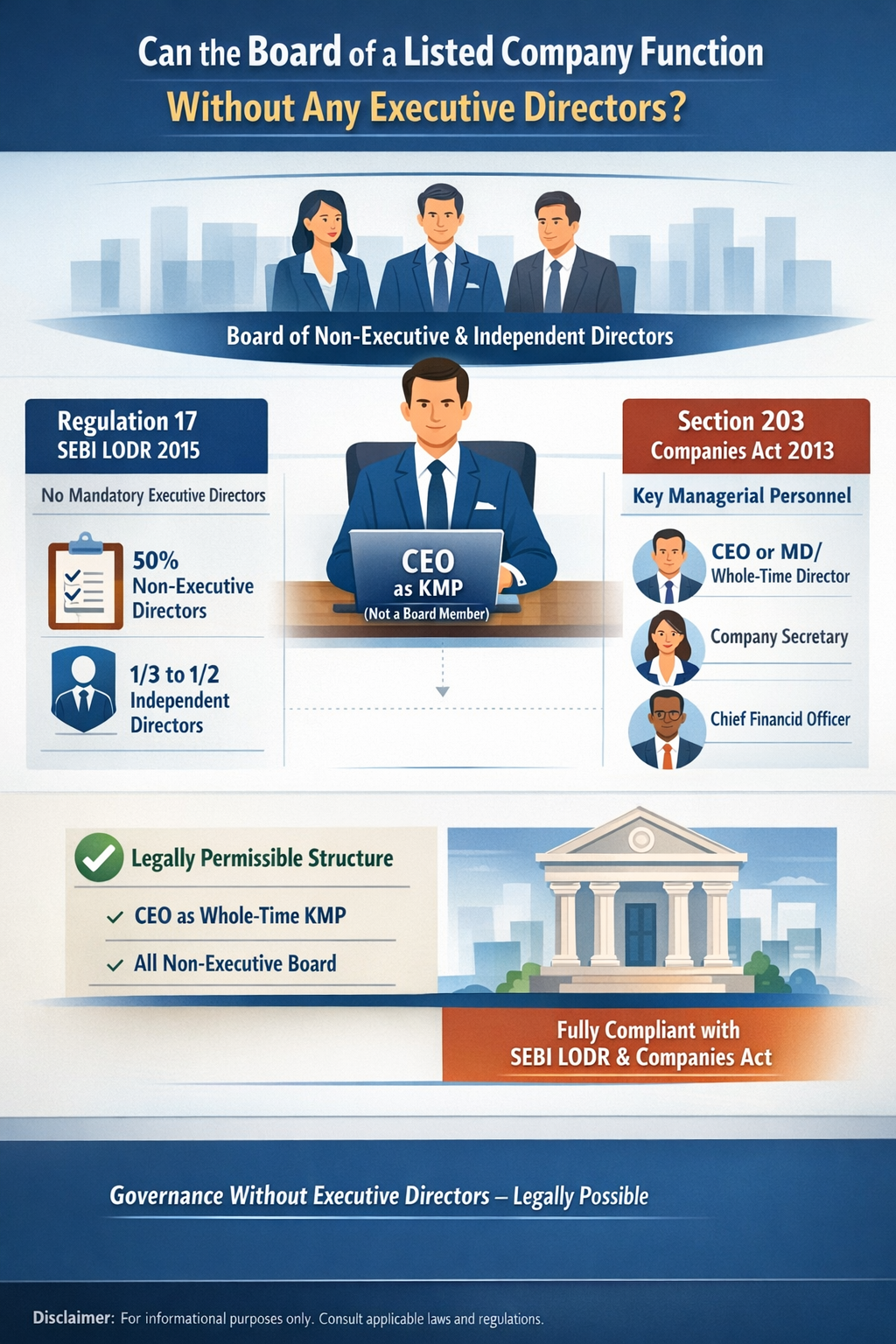
Can the Board of a Listed Company Function Without Any Executive Directors?
A frequent issue in corporate governance relates to whether the board of directors of a listed company can be constituted without the presence of any executive directors. This question assumes significance because of the interplay between the board composition requirements prescribed under the SEBI (Listing Obligations and Disclosure Requirements) Regulations, 2015 and the mandatory appointment of Key Managerial Personnel under the Companies Act, 2013. A harmonious reading of both frameworks, however, demonstrates that such a structure is legally permissible.
Regulation 17 of SEBI (LODR) Regulations, 2015 – Board Composition
Regulation 17 of the SEBI LODR Regulations lays down the fundamental principles governing the composition of the board of directors of a listed entity. The regulation emphasizes the need for an optimum balance between executive and non-executive directors, with a clear intent to strengthen independent oversight and governance standards.
The regulation requires that the board must include at least one woman director and that not less than fifty percent of the board should consist of non-executive directors. In addition, the proportion of independent directors varies depending upon the nature of the chairperson. Where the chairperson of the board is a non-executive director, at least one-third of the board must comprise independent directors. In cases where the listed entity does not have a regular non-executive chairperson, or where the non-executive chairperson is a promoter or is related to a promoter or to a person occupying a management position at the board level or one level below, at least fifty percent of the board must consist of independent directors.
A careful analysis of Regulation 17 indicates that while it prescribes minimum thresholds for non-executive and independent directors, it does not mandate the compulsory appointment of an executive director. The regulation is silent on the minimum number of executive directors, thereby allowing flexibility in board structuring.
Practical Concern Regarding Section 203 of the Companies Act, 2013
Despite the regulatory flexibility under SEBI LODR, a practical concern often arises as to whether a board without executive directors would violate Section 203 of the Companies Act, 2013, which governs the appointment of Key Managerial Personnel. This concern stems from the assumption that operational leadership must necessarily be represented on the board through an executive or whole-time director.
Section 203 of the Companies Act, 2013 – Key Managerial Personnel
Section 203 mandates that every listed company shall appoint certain whole-time Key Managerial Personnel, namely a Managing Director, or a Chief Executive Officer, or a Manager, and in their absence, a Whole-time Director, along with a Company Secretary and a Chief Financial Officer. Importantly, the provision explicitly recognizes the role of a Chief Executive Officer as an alternative to a Managing Director or Whole-time Director.
The statute does not require the Chief Executive Officer to be a director on the board. Consequently, the appointment of a CEO as a whole-time KMP, without designating such person as an executive director, satisfies the statutory requirement under Section 203.
Reconciling Regulation 17 and Section 203
The flexibility built into Section 203 effectively resolves the perceived conflict between board composition requirements under SEBI LODR and KMP obligations under the Companies Act. A listed company can remain fully compliant with both regulatory frameworks even in the absence of executive directors on its board, provided that a Chief Executive Officer is appointed as a whole-time KMP who is not a board member.
This approach is also consistent with contemporary corporate governance principles, which encourage a clear separation between management and board oversight, thereby enhancing independence and accountability.
Illustrative Compliant Governance Structure
In practice, a listed company may therefore adopt a governance structure where day-to-day management is vested in a Chief Executive Officer appointed as a Key Managerial Personnel, while the board comprises entirely of non-executive and independent directors. Such a structure continues to meet the requirements relating to independent directors, non-executive directors, and woman director under Regulation 17 of SEBI LODR, while simultaneously ensuring compliance with Section 203 of the Companies Act, 2013.
Conclusion
In conclusion, a listed company can legally function with a board composed exclusively of non-executive and independent directors, without appointing any executive directors, provided that a Chief Executive Officer is appointed as a whole-time Key Managerial Personnel and all other statutory and regulatory requirements are duly complied with. The absence of executive directors on the board does not, by itself, result in non-compliance under either SEBI LODR or the Companies Act, 2013. Such a governance model is not only legally permissible but also aligns with robust corporate governance practices.
Disclaimer
The contents of this article are based on the legal provisions and regulatory framework in force as on the date of writing. While every effort has been made to ensure accuracy, no responsibility is assumed for any errors or omissions. Readers are advised to refer to the relevant statutes, rules, and regulations before acting upon the information contained herein. This article is intended for informational purposes only and does not constitute legal advice.
From the desk of CS Sharath