
Forget Password

View News
27 Apr 2026
Case Analysis: Bail Jurisprudence, Criminal Liability & Procedural Fairness under Criminal Law
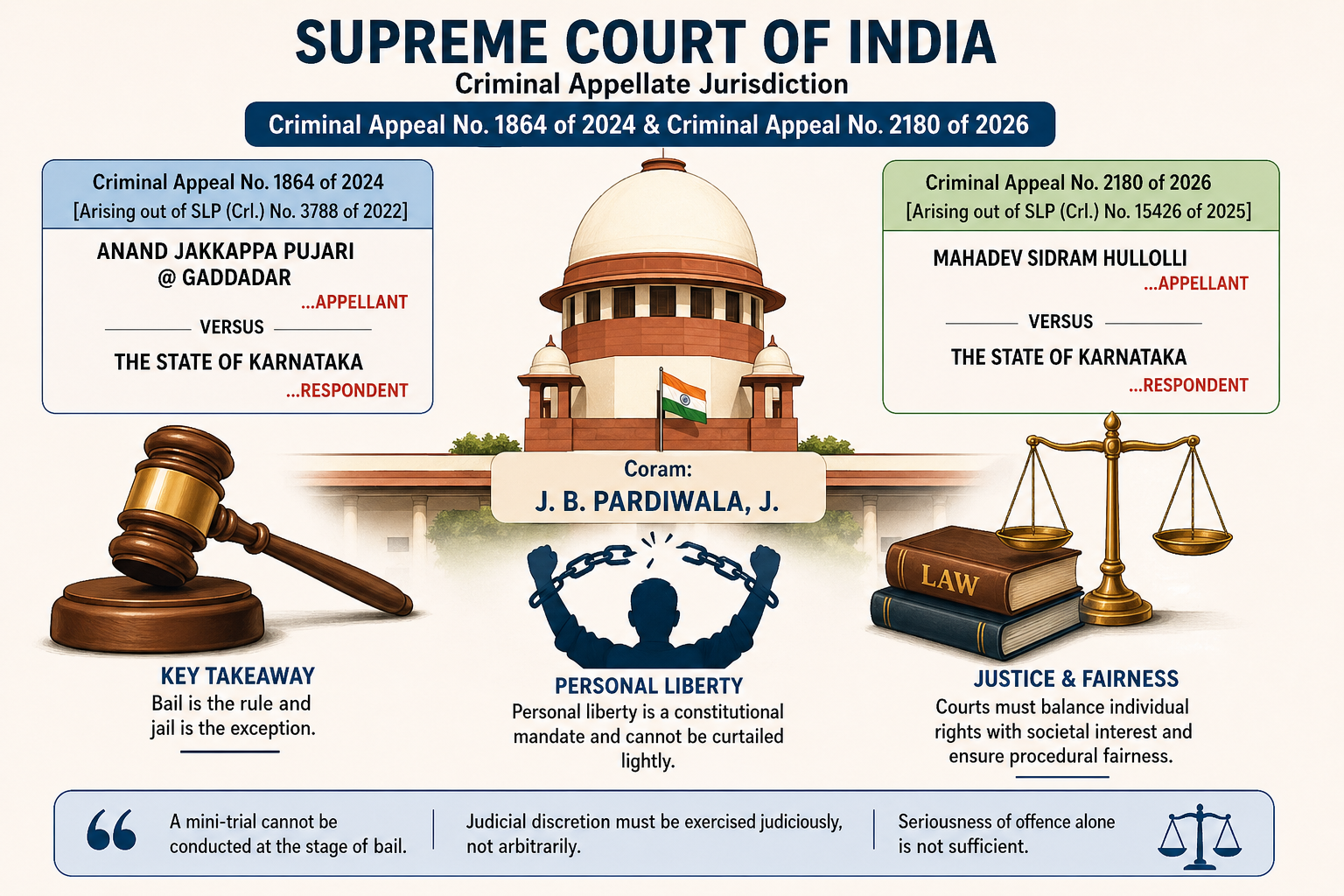
Case Analysis: Bail Jurisprudence, Criminal Liability & Procedural Fairness under Criminal Law
Case Details
| Particulars | Details |
|---|---|
| Case Title | Anand Jakkappa Pujari @ Gaddadar v. State of Karnataka |
| Connected Matter | Mahadev Sidram Hullolli v. State of Karnataka |
| Court | Supreme Court of India |
| Jurisdiction | Criminal Appellate Jurisdiction |
| Coram (Bench) | Justice J. B. Pardiwala |
| Case Numbers | Criminal Appeal No. 1864 of 2024 & Criminal Appeal No. 2180 of 2026 |
| Arising From | SLP (Crl.) No. 3788 of 2022 & SLP (Crl.) No. 15426 of 2025 |
| Parties Involved | Appellants vs State of Karnataka |
| Subject Matter | Criminal Liability, Bail Principles & Procedural Fairness |
Detailed Case Analysis
| Heading | Detailed Analysis |
|---|---|
| Introduction | The present judgment delivered by the Supreme Court of India is a significant pronouncement dealing with criminal jurisprudence, particularly focusing on the principles governing bail, procedural fairness, and evaluation of evidence at the pre-trial stage. The Court reiterated that criminal law must balance individual liberty with societal interest and emphasized that “deprivation of liberty must be justified on cogent grounds”. |
| Background and Facts of the Case | The appeals arose from criminal proceedings initiated against the appellants in connection with serious offences under penal law. The appellants were accused of involvement in criminal activities and were either denied bail or subjected to adverse judicial findings by lower courts. The prosecution alleged active participation, whereas the appellants contended false implication and lack of credible evidence. The factual matrix indicated that the courts below may have relied heavily on allegations without sufficiently scrutinizing the evidentiary material. |
| Core Legal Issues | The Supreme Court examined whether denial of bail was justified in the absence of strong prima facie evidence, whether courts can conduct a detailed appreciation of evidence at the bail stage, and whether continued incarceration violated the fundamental rights of the accused. Another key issue was whether the approach of lower courts was excessively rigid and inconsistent with settled bail jurisprudence. |
| Relevant Legal Framework | The case involved interpretation of provisions under the Code of Criminal Procedure, 1973 relating to bail, arrest, and investigation. The Court also relied upon constitutional principles under Article 21 of the Constitution of India, which guarantees protection of life and personal liberty. The judgment emphasized that “personal liberty is a constitutional mandate and cannot be curtailed lightly”. |
| Arguments by Appellants | The appellants argued that the allegations were vague and unsupported by reliable evidence. It was contended that the courts below failed to appreciate that at the stage of bail, only a prima facie view is required and not a detailed examination of evidence. The appellants emphasized that “bail is the rule and jail is the exception”, and prolonged incarceration without trial amounts to violation of fundamental rights. |
| Arguments by the State | The State opposed the grant of bail by arguing that the offences were serious in nature and had wider societal implications. It contended that the involvement of the accused was evident from the material on record and that granting bail could hamper investigation or trial. The prosecution emphasized the need to maintain public order and prevent misuse of liberty. |
| Court’s Observations – On Bail Jurisprudence | The Court reiterated the settled principle that “bail is the rule and jail is the exception”. It observed that denial of bail should not be used as a punitive measure and must be based on clear and compelling reasons. The Court clarified that seriousness of offence alone cannot justify denial of bail unless supported by credible material. |
| Court’s Observations – On Appreciation of Evidence | The Court held that at the stage of bail, detailed evaluation of evidence is impermissible. It stated that “a mini-trial cannot be conducted at the stage of bail” and that courts must restrict themselves to a prima facie assessment. Over-analysis of evidence at this stage may prejudice the trial. |
| Court’s Observations – On Personal Liberty | Emphasizing constitutional safeguards, the Court held that “personal liberty cannot be curtailed except in accordance with procedure established by law”. It further observed that prolonged incarceration without trial amounts to injustice and undermines the rights guaranteed under Article 21. |
| Court’s Observations – On Role of Lower Courts | The Court critically examined the approach adopted by the lower courts and found that they had failed to apply settled principles of law. It observed that “judicial discretion must be exercised judiciously and not arbitrarily”, and that courts must strike a balance between individual rights and societal interest. |
| Final Decision of the Court | The Supreme Court allowed the appeals and granted appropriate relief to the appellants (including bail, as applicable). The impugned orders of the lower courts were set aside. The Court held that the material on record did not justify continued incarceration and that the appellants were entitled to relief in light of established legal principles. |
| Ratio Decidendi | The core ratio of the judgment is that bail decisions must be guided by principles of fairness, reasonableness, and proportionality. The Court reaffirmed that “liberty is the norm and detention an exception” and that denial of bail must be supported by substantial grounds. |
| Key Legal Principles Emerging | The judgment reinforces several important principles including “bail is the rule”, “no mini-trial at bail stage”, and “personal liberty is paramount”. It also emphasizes that judicial discretion must be exercised carefully and in accordance with established precedents. |
| Practical Implications | This judgment serves as an important precedent for criminal practitioners. It provides clarity on the scope of judicial scrutiny at the bail stage and limits excessive intervention in evidentiary matters. It also strengthens the rights of accused persons against arbitrary detention and ensures a balanced approach in criminal proceedings. |
| Conclusion | The judgment is a significant reaffirmation of constitutional values and criminal law principles. It underscores that “justice must not only be done but must also be seen to be done”, and that courts must safeguard individual liberty while ensuring the proper administration of justice. The ruling contributes to the evolving jurisprudence on bail and procedural fairness in India. |
Unlock the Potential of Legal Expertise with LegalMantra.net – Your Trusted Legal Consultancy Partner
Disclaimer
Every effort has been made to ensure accuracy in this material. However, inadvertent errors or omissions may occur. Any discrepancies brought to the author’s notice will be rectified in subsequent editions. The author shall not be liable for any direct, indirect, incidental, or consequential damages arising from the use of this material. This article is based on various sources including statutory enactments, judicial decisions, academic research papers, professional journals, and publicly available legal materials.
CS Anshul Goel
LegalMantra.net Team