
Forget Password

View News
CHECKLIST FOR OBTAINING TRADING APPROVAL FOR RIGHTS ISSUE
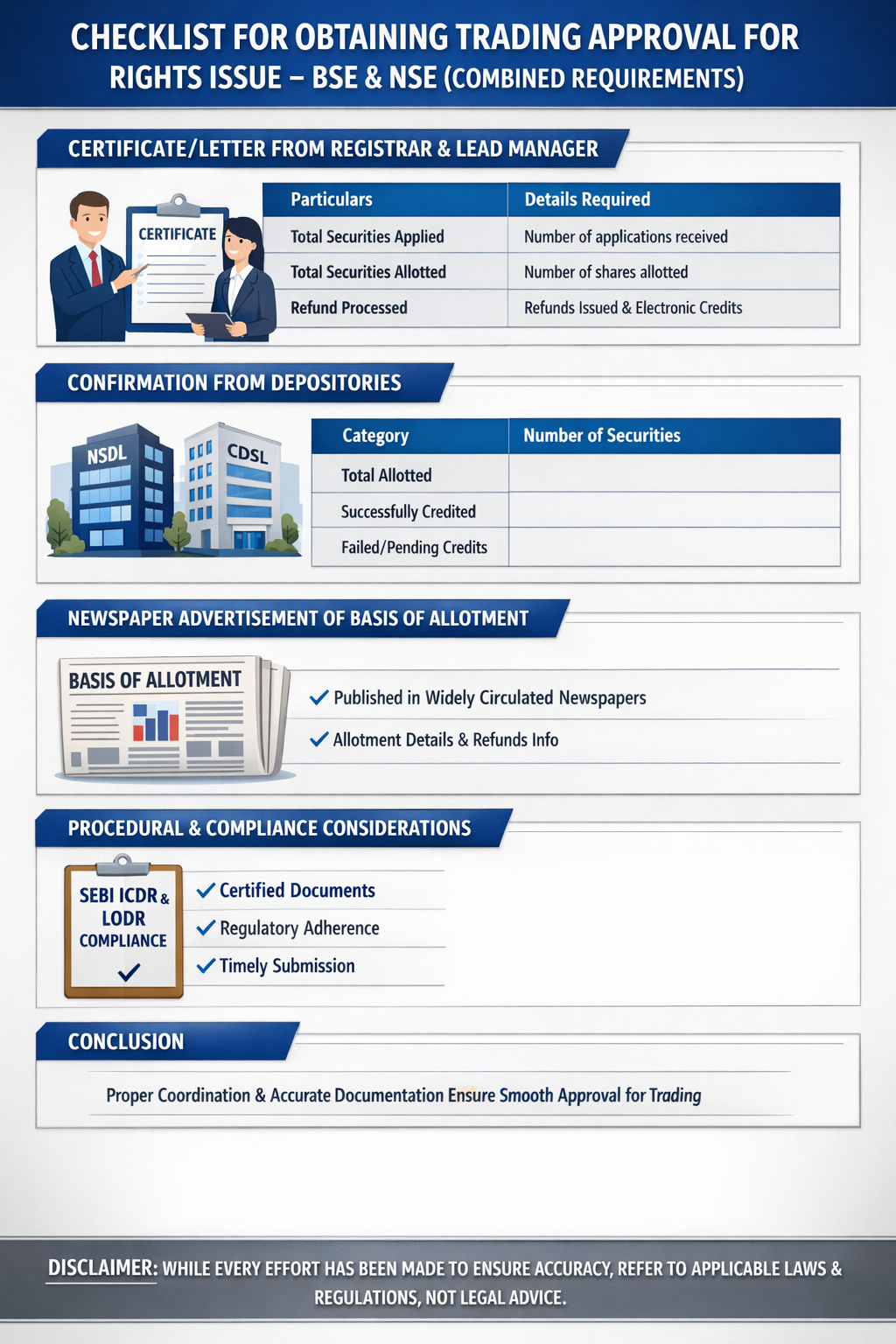
CHECKLIST FOR OBTAINING TRADING APPROVAL FOR RIGHTS ISSUE – BSE & NSE COMBINED
When a listed company undertakes a rights issue, it is required to obtain trading approval from both BSE Limited and National Stock Exchange of India Limited before the newly issued equity shares are permitted to trade on the respective stock exchanges. Trading approval is sought after the completion of allotment and credit of securities to eligible shareholders. The stock exchanges examine whether the issue has been completed in compliance with the Securities and Exchange Board of India (SEBI) regulations, including the SEBI (Issue of Capital and Disclosure Requirements) Regulations, 2018 (ICDR Regulations), the SEBI (Listing Obligations and Disclosure Requirements) Regulations, 2015 (LODR Regulations), and the applicable exchange circulars.
The following discussion sets out the principal documentation requirements, presented in a structured paragraph and sub-paragraph format, consolidating the requirements of both exchanges.
1. Certificate or Letter from the Registrar to the Issue and Lead Manager
The primary document required for trading approval is the certificate or confirmation letter issued by the Registrar to the Issue, and in certain cases jointly with the Lead Manager. This document evidences that the rights issue process has been duly completed in accordance with applicable regulatory requirements.
In the case of BSE, a certified true copy of the certificate from the Registrar is required confirming the completion of the rights issue process. The certificate must specify the date of completion of dispatch of share certificates (where physical allotment is applicable), the date of completion of refund orders, and confirmation that all allotment formalities have been duly completed. It should also confirm that refunds, wherever applicable, have been processed.
In the case of NSE, a certified true copy of the letter from the Registrar and Lead Manager is required confirming dispatch of share, debenture, or warrant certificates (as applicable), issuance of allotment advice, dispatch of refund orders, payment of underwriting commission (if any), uploading of electronic credits of securities to demat accounts, processing of ECS/NEFT/RTGS credits for refunds, and issuance of brokerage warrants, where applicable.
For clarity and uniformity, the confirmation letter should contain the following details:
| Particulars | Details Required in Certificate |
|---|---|
| Total securities applied for | Number of valid applications received |
| Total securities allotted | Number of shares/debentures allotted |
| Total securities refunded | Number of shares for which refund issued |
| Electronic credits | Confirmation of demat credit completion |
| Physical dispatch (if any) | Date of dispatch of certificates |
| Refund processing | Mode and date of refund completion |
The certificate must be dated, signed, and stamped by the Registrar (and Lead Manager where applicable) and must reconcile all numerical data accurately.
2. Confirmation from Depositories
Trading approval is also contingent upon confirmation that the securities have been credited to the demat accounts of the respective allottees. Accordingly, confirmation from the depositories is mandatory.
Both BSE and NSE require confirmation from National Securities Depository Limited and Central Depository Services Limited regarding the credit of securities to beneficiary owners’ accounts. This confirmation must specify the total number of securities credited, the number of pending or failed credits, and the reasons for any such discrepancies.
The confirmation should ideally be supported by a reconciliation statement from the Registrar demonstrating that:
| Category | Number of Securities |
|---|---|
| Total allotted | As per basis of allotment |
| Successfully credited | Credited to demat accounts |
| Failed credits | With reasons explained |
| Pending credits (if any) | Expected date of resolution |
It is advisable to coordinate closely with the Registrar and the depositories to ensure that all credits are completed prior to submission of the trading approval application. Any failed credits must either be resolved or appropriately disclosed with reasons.
3. Newspaper Advertisement of the Basis of Allotment
The stock exchanges also require evidence that the basis of allotment has been publicly disclosed in accordance with Regulation 92 of the ICDR Regulations.
BSE requires submission of copies of the newspaper advertisement containing the basis of allotment. The advertisement must include details such as the total number of shares applied for, total number of shares allotted, the ratio of allotment (if applicable), details of refunds processed, and other prescribed disclosures under SEBI regulations.
NSE additionally requires a certificate from the Registrar reconciling the total securities allotted with the total securities credited and the securities that have failed to be credited. This certificate must be supported by the published newspaper advertisement.
The advertisement must be published in widely circulated newspapers as prescribed under the ICDR Regulations, and the figures disclosed therein must match the allotment and depository confirmations without discrepancy.
4. Procedural and Compliance Considerations
Trading approval is typically sought after completion of the allotment process and successful credit of securities to demat accounts. Premature filing of the application may result in queries or delays from the exchanges.
All documents submitted to BSE and NSE must be certified true copies and duly signed by authorized signatories of the company, Registrar, and Lead Manager, as applicable.
The company must ensure full compliance with the ICDR Regulations, LODR Regulations, relevant SEBI circulars, and the stock exchange standard operating procedures. Any deviation, delay, or discrepancy in reconciliation of securities may result in additional clarification being sought by the exchanges.
5. Conclusion
Obtaining trading approval for a rights issue requires systematic coordination among the company, Registrar to the Issue, Lead Manager, and the depositories. Proper reconciliation of allotment data, confirmation of electronic credits, publication of the basis of allotment, and submission of certified documentation to BSE and NSE are critical to ensuring timely approval.
A well-documented and reconciled submission facilitates smooth processing by the exchanges and enables shareholders to commence trading of the newly allotted shares without unnecessary delay.
DISCLAIMER: The contents of this document are prepared based on currently available regulatory provisions and exchange practices. While due care has been taken to ensure accuracy, readers are advised to refer to the applicable statutes, SEBI regulations, and stock exchange circulars. This document is intended for informational purposes only and does not constitute legal advice. No liability is accepted for any consequences arising from its use.
From the desk of CS Sharath