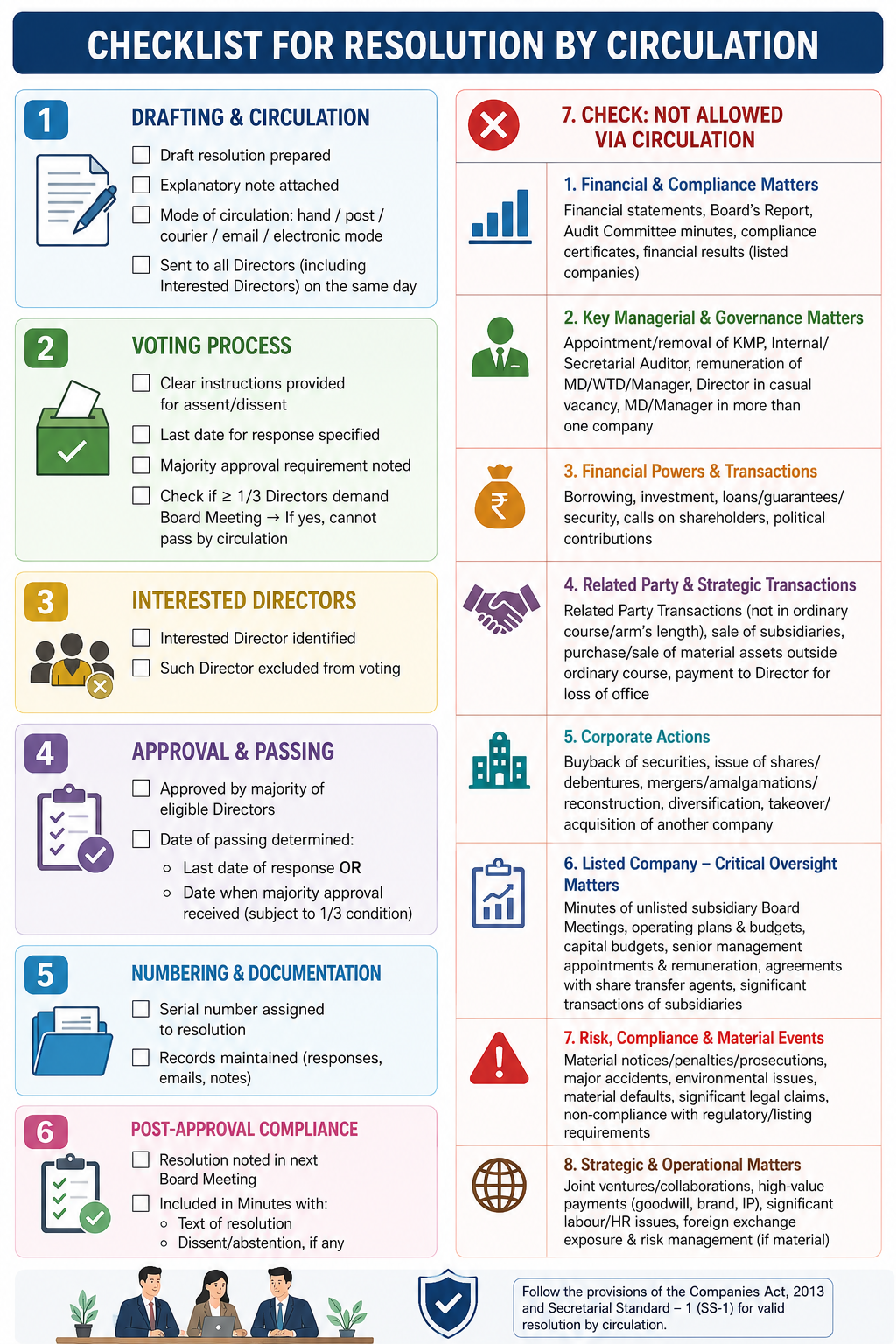
Checklist for Passing Resolution by Circulation under the Companies Act, 2013
Checklist for Passing Resolution by Circulation under the Companies Act, 2013
Under Section 175 of the Companies Act, 2013 read with Secretarial Standard - 1 (SS-1), a resolution by circulation may be passed by the Board of Directors in cases where obtaining approval at a duly convened Board Meeting is not practical or where urgent business requires immediate consideration. However, strict procedural compliance is necessary to ensure the validity of such resolutions.
The following checklist provides a practical compliance framework for companies while passing resolutions by circulation.
1. Drafting and Circulation of Resolution
Particulars
Compliance Check
Draft resolution is properly prepared
Explanatory note is attached with the resolution
Full details and background of the proposal are mentioned
Material facts relevant to decision-making are disclosed
Financial, legal, and operational implications are explained
Scope and purpose of the proposal are clearly specified
Disclosure of interest of Directors, if any, is included
Resolution circulated through permitted mode (hand delivery, post, courier, e-mail, or electronic mode)
Resolution sent to all Directors simultaneously on the same date
Interested Directors are also provided a copy for disclosure purposes
2. Voting and Approval Process
Particulars
Compliance Check
Clear instructions for assent or dissent are provided
Last date for sending response is specified
Majority approval requirement is mentioned
Responses received from Directors are properly recorded
Verification conducted whether one-third of Directors require the matter to be decided at a Board Meeting
Matter not proceeded through circulation if one-third Directors demanded Board Meeting
3. Treatment of Interested Directors
Particulars
Compliance Check
Interested Director identified
Nature of interest recorded
Interested Director excluded from voting wherever required
Voting counted only for eligible Directors
4. Approval and Determination of Date of Passing
Particulars
Compliance Check
Resolution approved by majority of eligible Directors
Date of passing correctly determined
Date considered as either the last date specified for response or the date on which majority approval is received, subject to compliance with SS-1
5. Numbering, Record Keeping and Documentation
Particulars
Compliance Check
Serial number assigned to the circular resolution
Copies of resolution preserved in records
E-mails, consent records, and responses maintained properly
Supporting notes and annexures retained for future reference
6. Post-Approval Compliances
Particulars
Compliance Check
Circular Resolution placed before the next Board Meeting for noting
Resolution recorded in the Minutes of subsequent Board Meeting
Text of resolution incorporated in Minutes
Dissent, abstention, or non-response of Directors recorded
Matters Generally Not Permitted Through Resolution by Circulation
Although the Companies Act, 2013 permits passing of resolutions by circulation, certain important matters are generally required to be approved only at a duly convened Board Meeting considering their strategic, financial, governance, or regulatory significance.
1. Financial Statements and Compliance Matters
Restricted Matters
Approval of annual financial statements
Approval of Board’s Report
Approval of quarterly, half-yearly, or annual financial results of listed companies
Noting minutes of Audit Committee or other Committees
Compliance certificates and identification of applicable laws
2. Key Managerial and Governance Matters
Restricted Matters
Appointment or removal of Key Managerial Personnel (KMP)
Appointment of Internal Auditor
Appointment of Secretarial Auditor
Fixation of remuneration of Managing Director, Whole-time Director, or Manager
Appointment of Director in casual vacancy
Appointment of Managing Director or Manager in more than one company
3. Borrowings, Investments and Financial Powers
Restricted Matters
Borrowing of money
Investment of company funds
Granting loans, guarantees, or securities
Making calls on shareholders
Approval of political contributions
4. Related Party and Strategic Transactions
Restricted Matters
Related Party Transactions not in ordinary course of business or not at arm’s length
Sale of subsidiaries
Purchase or sale of material assets outside ordinary course of business
Compensation or payment to Directors for loss of office
5. Corporate Restructuring and Capital Matters
Restricted Matters
Buyback of securities
Issue of shares or debentures in India or abroad
Mergers, amalgamations, or reconstruction
Diversification of business
Acquisition or takeover of another company
6. Critical Oversight Matters for Listed Companies
Restricted Matters
Noting minutes of Board Meetings of unlisted subsidiaries
Approval of annual operating plans and budgets
Approval of capital budgets and major amendments
Senior management appointments and remuneration
Agreements with share transfer agents
Review of significant transactions of subsidiaries
7. Material Risk, Litigation and Regulatory Matters
Restricted Matters
Material show cause notices, demand notices, prosecutions, or penalties
Major accidents, environmental or pollution-related incidents
Material defaults in financial obligations
Significant legal claims or adverse judgments
Serious non-compliance with regulatory or listing requirements
8. Strategic and Operational Matters
Restricted Matters
Joint ventures and collaboration agreements
High-value payments relating to goodwill, brands, or intellectual property
Significant labour settlements, wage agreements, or voluntary retirement schemes
Material foreign exchange exposure and risk management decisions
Conclusion
A Resolution by Circulation is an efficient mechanism for obtaining urgent Board approvals without convening a physical Board Meeting. However, companies must ensure strict adherence to the provisions of the Companies Act, 2013 and Secretarial Standard – 1 to maintain procedural validity and corporate governance standards. Matters involving significant financial, strategic, governance, or regulatory implications should ordinarily be placed before the Board at a properly convened meeting instead of being approved through circulation.
Disclaimer
The contents of this document are based on the provisions of the Companies Act, 2013, Secretarial Standard - 1, and other applicable laws as available on the date of preparation. While every effort has been made to ensure accuracy and reliability, no responsibility is assumed for any inadvertent errors or omissions. Readers are advised to independently verify the applicable legal provisions, rules, regulations, and amendments before acting upon the information provided herein. The contents of this document are intended solely for informational and educational purposes and should not be construed as legal or professional advice.
From the desk of CS Sharath
Welcome to Legal Mantra AI
You: Hello!
Bot: Hi there! How can help you today?
For detailed information contact our expert. mayank@legalmantra.net
Disclaimer.
The information provided by this AI-powered chatbox is for general informational purposes only and does not constitute legal advice. It is not the substitute for personalized legal counsel, guidance, or representation. For specific legal concerns, please consult a qualified expert.