
Forget Password

View News
Companies Compliance Facilitation Scheme 2026 A One-Time Relief for Defaulting Companies
Companies Compliance Facilitation Scheme, 2026 (CCFS-2026): A One-Time Relief for Defaulting Companies
1. Background: Annual Filing Requirements and Escalating Delay Penalties
1.1 Statutory Annual Filing Obligations
Under the provisions of the Companies Act, 2013, every company incorporated in India is required to comply with annual filing requirements with the Ministry of Corporate Affairs through the Registrar of Companies (RoC). These filings ensure transparency, regulatory oversight, and the maintenance of an accurate corporate registry.
Two core statutory filings are mandatory for all companies:
| Statutory Requirement | Relevant Section | Description |
|---|---|---|
| Annual Return | Section 92 | Contains details of the company’s shareholding pattern, directors, promoters, and other corporate information. |
| Financial Statements | Section 137 | Submission of audited financial statements including balance sheet, profit and loss account, and auditor’s report. |
The fee framework for such filings is governed by Section 403 of the Companies Act, 2013 read with the Companies (Registration Offices and Fees) Rules, 2014.
1.2 Delay Penalty Regime Introduced in 2018
From 1 July 2018, a strict additional fee structure was implemented for delayed filings. The structure is summarized below:
| Parameter | Provision |
|---|---|
| Additional Fee | Rs 100 per day |
| Maximum Cap | No upper limit |
While the objective was to improve filing discipline and ensure timely disclosures, the absence of an upper cap resulted in substantial financial burdens for companies that had accumulated multiple years of non-compliance.
2. Need for Regulatory Relief
2.1 Growing Corporate Base in India
India currently hosts more than 20 lakh active companies, including:
-
Micro, Small and Medium Enterprises (MSMEs)
-
Producer Companies
-
One Person Companies (OPCs)
-
Start-ups and emerging ventures
Many of these entities operate with limited compliance infrastructure and financial resources.
2.2 Challenges Faced by Defaulting Companies
Stakeholders across the corporate ecosystem highlighted several difficulties arising from the strict penalty framework:
-
Excessively high additional fees discouraged companies from regularizing their filings.
-
Many small companies became financially trapped due to accumulated penalties over several years.
-
Companies wishing to close or exit operations faced obstacles because pending filings and associated penalties had to be cleared before initiating strike-off procedures.
Recognizing these concerns and aligning with the Government’s Ease of Doing Business initiative, a corrective compliance window was introduced.
3. Introduction of the Companies Compliance Facilitation Scheme, 2026
3.1 Statutory Basis of the Scheme
The Central Government introduced the Companies Compliance Facilitation Scheme, 2026 (CCFS-2026) under the enabling powers contained in:
-
Section 460 – Power of the Central Government to condone delay in filings.
-
Section 403 – Filing of documents with payment of additional fees.
3.2 Key Objectives of the Scheme
The scheme aims to achieve multiple regulatory and compliance goals:
-
Encourage companies to file long-pending annual documents.
-
Provide relief from excessive additional fee burdens.
-
Update and cleanse the corporate registry maintained by the Registrar of Companies.
-
Allow inactive companies to either obtain dormant status or exit through strike-off mechanisms.
4. Timeline of the Scheme
The CCFS-2026 has been introduced as a limited-period compliance window.
| Event | Date |
|---|---|
| Scheme Commencement | 15 April 2026 |
| Scheme Closure | 15 July 2026 |
After the closure of the scheme, the Registrar of Companies may initiate enforcement actions against companies that continue to remain non-compliant.
5. Filing Requirements Covered Under the Scheme
The scheme primarily focuses on pending annual filings.
5.1 Annual Return Forms
The following forms are eligible for filing under the scheme:
| Form | Applicability |
|---|---|
| MGT-7 | Annual Return for companies other than OPCs and small companies |
| MGT-7A | Annual Return for OPCs and Small Companies |
These forms capture information regarding the company’s capital structure, shareholding, directors, key managerial personnel, and other corporate details.
5.2 Financial Statement Forms
| Form | Applicability |
|---|---|
| AOC-4 | Filing of financial statements |
| AOC-4 (XBRL) | For companies required to file in XBRL format |
| AOC-4 CFS | Consolidated financial statements |
| AOC-4 NBFC (Ind AS) | Applicable to NBFCs following Ind AS |
These filings provide the audited financial position and performance of the company.
Additionally, the scheme also covers legacy forms filed under the Companies Act, 1956, enabling companies to complete historical compliance where necessary.
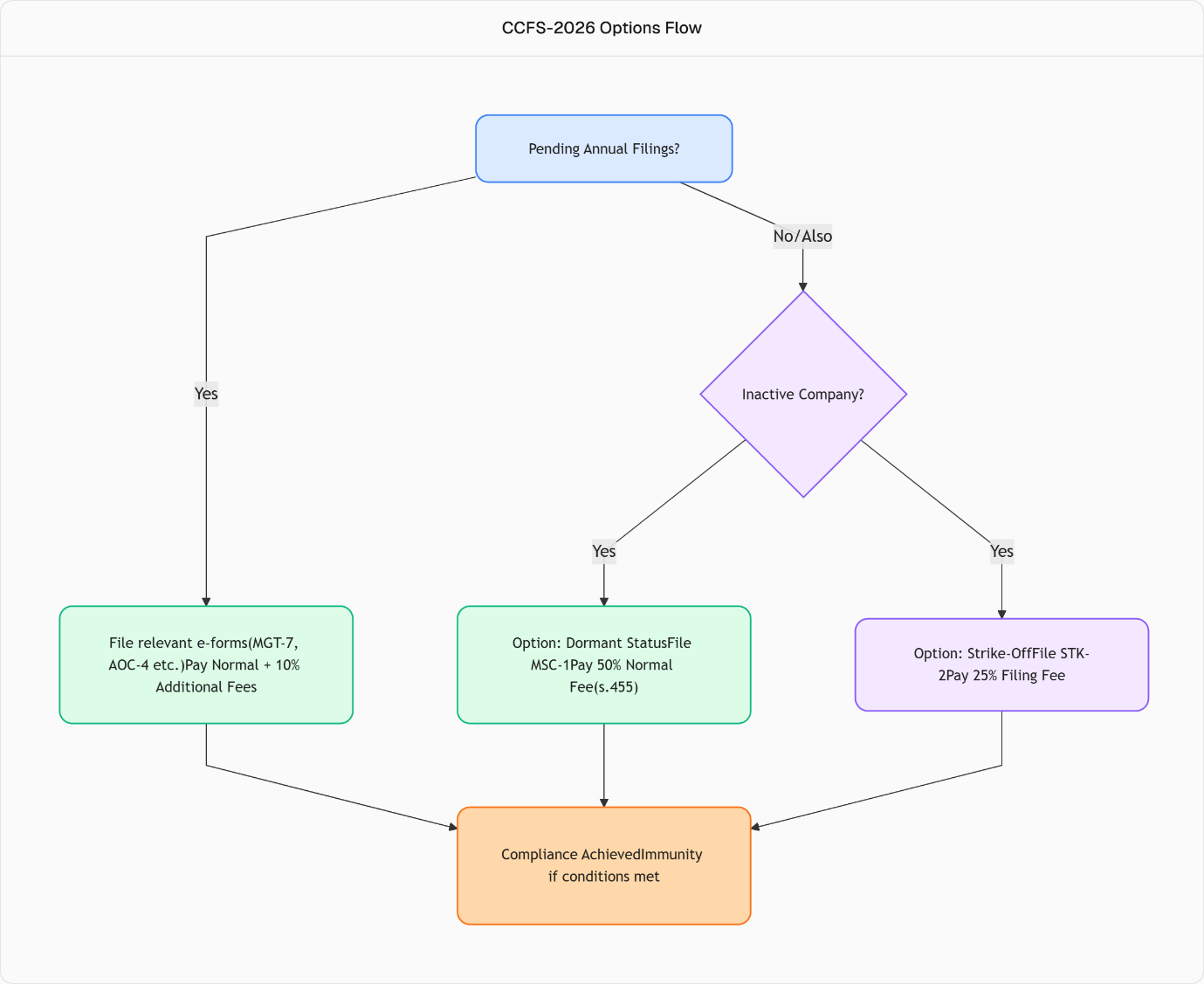
6. Compliance Options Available Under CCFS-2026
The scheme provides companies with three possible compliance pathways depending on their operational status.
6.1 Filing of Pending Documents
Companies may regularize their compliance by filing overdue Annual Returns and Financial Statements by paying the prescribed filing fees and reduced additional fees.
6.2 Application for Dormant Status
Companies that are currently inactive may apply for dormant status under Section 455 of the Companies Act, 2013.
| Requirement | Details |
|---|---|
| Form | MSC-1 |
| Benefit | Minimal compliance requirements |
| Status | Company remains registered but inactive |
This option allows companies to retain their corporate identity while significantly reducing ongoing compliance obligations.
6.3 Application for Strike-Off
Companies that no longer intend to operate may choose to exit the corporate registry.
| Requirement | Details |
|---|---|
| Form | STK-2 |
| Outcome | Permanent removal from the register of companies |
This structured approach enables companies either to revive compliance or to exit the system in an orderly manner.
7. Applicability and Exclusions
7.1 Eligible Entities
The scheme is broadly applicable to:
-
All companies with pending annual filings.
7.2 Entities Not Eligible for the Scheme
Certain categories of companies are excluded to prevent misuse of the scheme.
| Excluded Category | Reason |
|---|---|
| Companies that received final strike-off notice under Section 248 | Already under closure process |
| Companies that have already filed STK-2 | Strike-off process already initiated |
| Companies that applied for dormant status before the scheme | Dormancy already granted |
| Amalgamated or dissolved entities | No longer operational |
| Vanishing companies | Under regulatory investigation |
8. Revised Fee Structure Under CCFS-2026
A major relief under the scheme is the reduction in additional filing fees.
| Fee Component | Amount Payable |
|---|---|
| Normal filing fees | As prescribed under the rules |
| Additional fees | Only 10% of the applicable additional fees |
8.1 Special Concessions
| Filing Type | Fee Concession |
|---|---|
| Dormant Status Application (MSC-1) | 50% of normal filing fee |
| Strike-Off Application (STK-2) | 25% of applicable fee |
8.2 Illustrative Example
| Scenario | Amount |
|---|---|
| Accumulated additional fee | Rs. 1,00,000 |
| Payable under CCFS-2026 | Rs. 10,000 |
This reduction significantly lowers the financial barrier for companies seeking to regularize their filings.
9. Immunity from Penalties and Prosecution
The scheme also provides limited relief from penalties and prosecution.
9.1 Relief for Sections 92 and 137
No penalty shall apply where filings are made:
-
Before issuance of an adjudication notice, or
-
Within 30 days of receiving the adjudication notice.
9.2 Relief for Other Forms
For certain other forms such as:
-
ADT-1
-
FC-3 / FC-4
-
Forms under the Companies Act, 1956
Prospective immunity may be available if no prosecution or show-cause notice has been issued prior to filing.
Relief may also extend to officers in default, subject to the conditions prescribed under the scheme.
10. Consequences After the Scheme Period
Once the scheme ends on 15 July 2026, strict enforcement measures are expected to resume.
Possible consequences for continued non-compliance include:
-
Monetary penalties under the Companies Act
-
Initiation of prosecution proceedings
-
Disqualification of directors under applicable provisions
The scheme therefore represents a limited compliance window, and companies must act within the specified period.
11. Conclusion
The Companies Compliance Facilitation Scheme, 2026 (CCFS-2026) represents a significant regulatory initiative aimed at balancing compliance enforcement with business facilitation. By reducing additional fees and offering structured compliance options, the scheme encourages companies to regularize long-pending filings while enabling inactive entities to opt for dormancy or lawful exit.
For defaulting companies, the scheme offers a rare opportunity to:
-
Clear historical filing defaults at minimal cost
-
Regularize corporate compliance records
-
Obtain dormant status or pursue strike-off where appropriate
Companies should utilize this limited-period window to restore compliance and maintain their legal standing in the corporate registry.
Disclaimer:
The contents of this document are based on currently available provisions and information. While every effort has been made to ensure accuracy and reliability, no responsibility is assumed for any errors or omissions. Readers are advised to refer to the applicable laws, rules, and official notifications issued by the relevant authorities. The information provided herein should not be construed as legal advice, and no liability is accepted for any consequences arising from its use.
From the desk of CS Sharath