
Forget Password

View News
Copyright Singularity: Intellectual Property in Generative AI
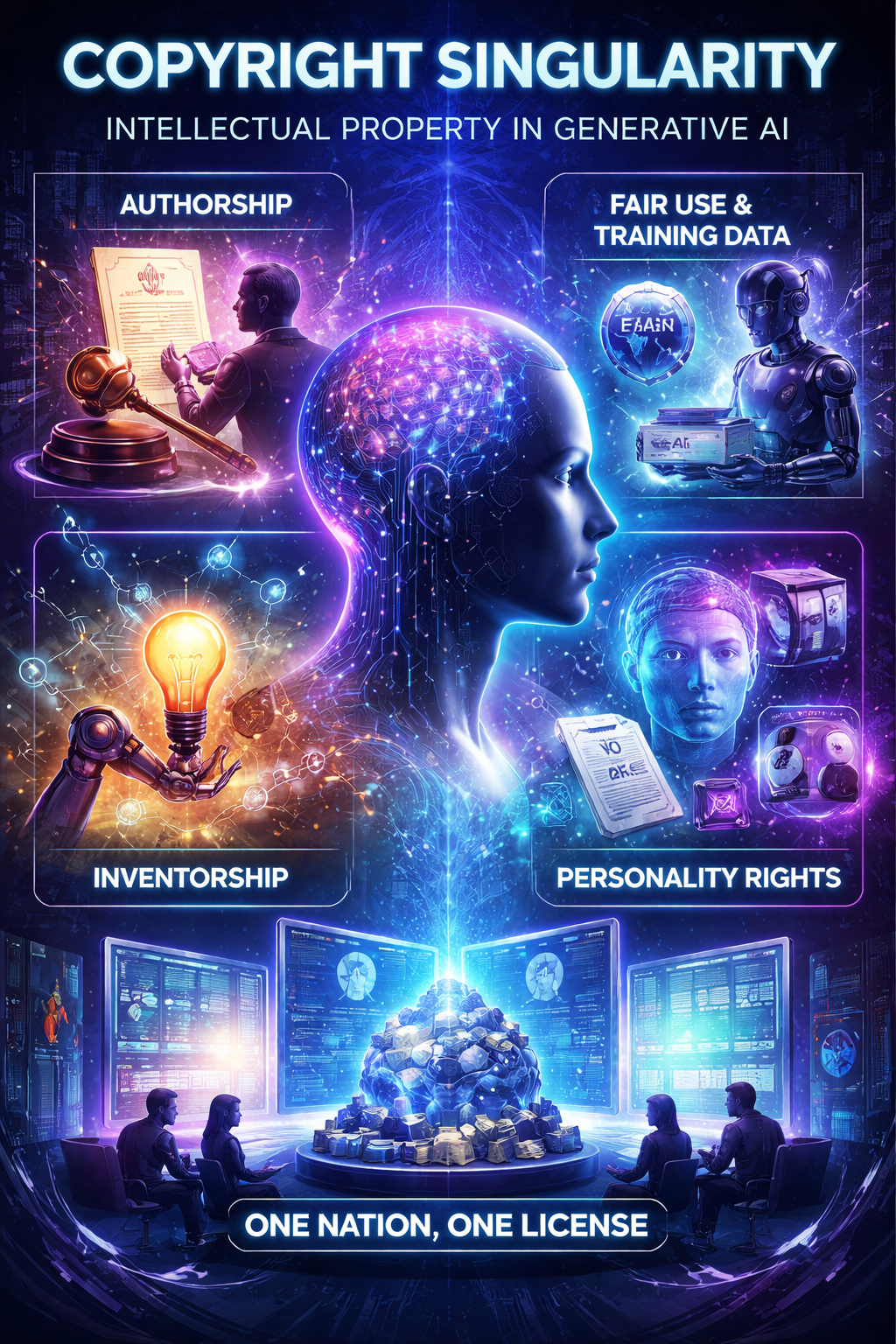
Copyright Singularity: Intellectual Property in Generative AI
~ Sura Anjana Srimayi
INTRODUCTION
The emergence of Generative Artificial Intelligence (GenAI) has triggered one of the most significant disruptions in the history of Intellectual Property (IP) law. What began around 2022 as experimental systems capable of generating images, music, and written content has, by 2026, evolved into a transformative technological force that challenges the foundational assumptions of copyright and patent law across the globe.
Historically, IP law has been constructed upon a central philosophical premise — the “Human Spark.” Copyright, patent, and related IP protections have traditionally been granted only where human creativity, intellect, and labour produced a novel expression or invention. From the invention of the steam engine to the creation of literary masterpieces, the law protected outputs that were undeniably products of human ingenuity.
However, the rapid evolution of Generative AI systems capable of autonomously producing complex artistic works, software code, research papers, cinematic content, and even technological solutions has begun to destabilize this foundational principle. Modern AI models can now generate hyper-realistic films, sophisticated software programs, music compositions, and visual artworks merely from textual prompts. As a result, legal systems worldwide are grappling with three fundamental and existential questions:
-
Who owns the output produced by AI systems?
-
Does training AI models on copyrighted data constitute infringement or lawful fair use?
-
Where should the law draw the boundary between human creativity and machine-generated output?
These questions are not merely theoretical debates. They represent an emerging “Copyright Singularity” — a moment when technological capabilities exceed the regulatory framework designed to govern them. As the law attempts to catch up with technological advancements, courts, legislatures, and international institutions are redefining the concept of authorship, ownership, and creativity in the digital age.
1. AUTHORSHIP CRISIS: THE HUMAN SPARK REQUIREMENT
1.1 Traditional Understanding of Authorship
Authorship lies at the core of copyright law. Under traditional legal frameworks such as the Copyright Act, 1976 (United States) and the Copyright Act, 1957 (India), copyright protection is granted only to works created by natural persons. The rationale behind this approach is rooted in the belief that copyright exists to reward human intellectual labour and encourage creativity.
For decades, the legal framework operated on the assumption that a work necessarily originated from a human author. Machines and tools were merely instruments through which human creativity was expressed. Whether it was a paintbrush, camera, or software program, the ultimate creative control remained with the individual.
However, Generative AI systems challenge this assumption by producing original works with minimal or sometimes no human intervention.
1.2 The Registration Deadlock
The most visible conflict has arisen in the context of copyright registration. The U.S. Copyright Office (USCO) has consistently rejected applications seeking protection for works entirely generated by AI systems. The Office has maintained that copyright law requires human authorship, and therefore purely machine-generated works cannot be registered.
Similarly, legal interpretation in India continues to emphasize human authorship under the Copyright Act, 1957, which defines an author in relation to literary, dramatic, musical, and artistic works in terms that implicitly assume human agency.
This has created what scholars now describe as the “Registration Deadlock.” AI-generated works are being created at an unprecedented scale, yet many of them exist in a legal vacuum where copyright protection is either uncertain or unavailable.
1.3 The Meaningful Human Input Standard
In response to these challenges, a new concept has begun to emerge in legal discourse — the “Meaningful Human Input” standard.
Under this evolving framework, courts and copyright offices are attempting to determine whether sufficient human creative contribution exists to justify copyright protection. The key issue is whether the human user exercised meaningful control over the expressive elements of the final work.
For instance, consider a situation where a user:
-
Writes a 500-word prompt,
-
Iteratively refines it dozens of times,
-
Selects from multiple outputs generated by the AI, and
-
Performs extensive manual editing of the generated content.
In such cases, the question arises whether the human user should be recognized as the author of the final work. Some legal scholars argue that this form of creative direction resembles traditional artistic processes, where tools assist but do not replace the human creator.
1.4 The Emerging “De Minimis” Judicial Approach
Courts have increasingly begun to apply what may be called a De Minimis Human Contribution Test. According to this approach:
-
If the AI merely functions as a tool similar to a camera, editing software, or paintbrush, the resulting work belongs to the human creator.
-
However, if the expressive decisions are primarily made by the AI system, the output may be considered public domain material.
This evolving jurisprudence attempts to preserve the principle of human authorship while acknowledging the growing role of AI-assisted creativity.
2. THE FAIR USE FRONTIER AND TRAINING DATA
2.1 The Controversy of AI Training
Perhaps the most expensive and complex litigation currently unfolding concerns the training data used to develop AI systems. Generative AI models are trained on vast datasets consisting of billions of text documents, images, videos, and other copyrighted materials scraped from the internet.
The central legal question is whether such large-scale data scraping constitutes copyright infringement or falls within permissible exceptions such as fair use.
2.2 The Transformative Use Argument
AI developers argue that training AI models is fundamentally transformative. According to this argument, the AI system does not store or reproduce the original works in a recognizable form. Instead, it analyzes patterns and statistical relationships within the data.
From this perspective, the training process involves mathematical learning rather than copying creative expression. Developers emphasize that models learn probabilistic relationships between words, pixels, or sounds, rather than memorizing specific works.
This argument has been advanced in several high-profile legal disputes involving major AI companies.
2.3 The Creator’s Counterargument: Data Laundering
Content creators, however, strongly challenge the transformative use argument. Many artists, writers, photographers, and media organizations argue that AI training constitutes a form of “data laundering.”
According to this perspective, AI models ingest enormous quantities of copyrighted works, absorb stylistic patterns, and then produce outputs that replicate those styles. The result is a system capable of generating content that directly competes with the original creators.
This creates a significant economic concern: AI-generated works may replace human creators in commercial markets, thereby eroding the financial incentives that copyright law was designed to protect.
2.4 Regulatory Response: The EU AI Act
The European Union has taken a more proactive regulatory approach. Under the EU Artificial Intelligence Act, which enters implementation phases in 2026, providers of General-Purpose AI (GPAI) systems must comply with several transparency obligations.
These include:
-
Publication of Training Data Summaries
AI developers must disclose summaries of copyrighted materials used in training datasets. -
Creator Opt-Out Mechanisms
Creators must be given machine-readable tools enabling them to prevent their works from being included in AI training datasets.
These measures aim to balance innovation with creator rights while introducing accountability in the development of AI technologies.
3. THE INVENTORSHIP DEBATE IN PATENT LAW
3.1 The DABUS Controversy
While copyright law addresses creative expression, patent law governs technological inventions. The rise of AI-generated inventions has sparked an equally intense debate within the patent system.
One of the most influential legal disputes involved DABUS (Device for the Autonomous Bootstrapping of Unified Sentience), an AI system developed by researcher Stephen Thaler. Thaler attempted to list DABUS as the sole inventor on several patent applications.
Patent offices in multiple jurisdictions rejected these applications, arguing that patent law requires a human inventor.
3.2 Global Consensus on Human Inventorship
Patent authorities worldwide — including the United States Patent and Trademark Office (USPTO), the European Patent Office (EPO), and the Indian Patent Office (IPO) — have largely reached a common conclusion: only humans can be inventors.
This position is based on statutory language and long-standing legal interpretations emphasizing human intellectual contribution.
3.3 The Human Traceable Test
By 2026, patent regulators have increasingly adopted what is informally known as the “Human Traceable Test.”
Under this framework, a patentable invention must be traceable to a significant human inventive contribution. AI systems may assist in research, simulation, and optimization, but they cannot independently qualify as inventors.
For example:
-
If a researcher uses AI to optimize a chemical compound, the invention may still be patentable because the human researcher directed the research process.
-
However, if a user simply asks an AI system to generate a completely new battery design, and the AI autonomously produces the concept without meaningful human input, patent protection may be denied.
4. PERSONALITY RIGHTS AND THE WAR ON DEEPFAKES
4.1 The Rise of Synthetic Identities
Another area of IP law increasingly affected by AI technologies is the protection of personality rights, including the right to one’s voice, likeness, and identity.
Advances in voice cloning, facial synthesis, and deepfake technology have made it possible to generate realistic digital replicas of individuals. Celebrities, politicians, and ordinary citizens alike now face the risk of unauthorized digital impersonation.
4.2 The Legal Recognition of Digital Persona
Governments and courts have begun to recognize that a person’s digital likeness constitutes a form of intellectual property deserving legal protection.
In the United States, proposed legislation such as the No FAKES Act seeks to establish explicit rights over voice and likeness in the context of AI-generated content.
Similarly, Indian courts have increasingly recognized the Right of Publicity, protecting individuals against unauthorized commercial exploitation of their identity.
4.3 Enforcement Mechanisms
Legal frameworks are gradually imposing new responsibilities on digital platforms. Online platforms are expected to implement notice-and-takedown systems allowing individuals to report and remove AI-generated content that misuses their likeness or voice.
This evolving legal landscape reflects the recognition that AI-generated impersonation can cause reputational, economic, and psychological harm.
5. TOWARDS A “ONE NATION, ONE LICENSE” MODEL
5.1 The Limits of Litigation
As lawsuits against AI companies multiply, policymakers increasingly recognize that litigation alone may not provide a sustainable solution. The scale of AI training datasets — often involving billions of works — makes individual copyright enforcement impractical.
Consequently, policymakers are exploring alternative regulatory mechanisms.
5.2 Compulsory Licensing for AI Training
One emerging proposal involves compulsory licensing systems similar to those used in the music industry.
Under this model, AI developers would pay standardized licensing fees for access to copyrighted materials used in training datasets. These fees would be distributed to creators through collective rights organizations.
5.3 The Indian Proposal: One Nation, One License
India has begun exploring a concept informally referred to as “One Nation, One License.”
Under this framework:
-
AI developers would pay a flat royalty fee to a national licensing authority.
-
The collected funds would be distributed to creators based on metrics indicating the usage of their works in training datasets.
This approach represents a shift in legal thinking — moving the debate away from the binary question of “Is it legal?”toward a more pragmatic question: “How should creators be compensated?”
The transformation mirrors the shift experienced in the music industry, where digital piracy gave way to licensed streaming platforms such as Spotify.
CONCLUSION
The rise of Generative AI has forced legal systems to confront one of the most profound philosophical questions in the history of intellectual property: What does it mean to be an author or inventor?
Existing legal frameworks were designed for a world in which creativity and innovation were exclusively human activities. In that world, machines served only as tools. Today, however, machines increasingly function as creative collaborators — and sometimes as autonomous creators.
As a result, traditional legal doctrines appear increasingly inadequate. Scholars and policymakers now widely acknowledge that AI may require a sui generis legal regime — a specialized body of law tailored specifically to machine-generated outputs.
The challenge for lawmakers lies in balancing two critical objectives:
-
Encouraging Technological Innovation
If AI-generated works remain entirely unprotected, businesses may hesitate to invest in the development of advanced creative technologies. -
Preserving Human Creativity
If human creators are replaced by AI systems trained on their own works without compensation, the cultural and creative ecosystem may suffer long-term damage.
Ultimately, the resolution of this conflict will shape the future of global creativity. The legal decisions made today will determine whether AI becomes a tool that amplifies human imagination or a system that undermines it.
In the era of the Copyright Singularity, the law is no longer merely protecting ideas and inventions. It is redefining the very meaning of authorship, creativity, and human identity in the age of intelligent machines.
Unlock the Potential of Legal Expertise with LegalMantra.net – Your Trusted Legal Consultancy Partner
Disclaimer
Every effort has been made to ensure accuracy in this material. However, inadvertent errors or omissions may occur. Any discrepancies brought to the author’s notice will be rectified in subsequent editions. The author shall not be liable for any direct, indirect, incidental, or consequential damages arising from the use of this material. This article is based on various sources including statutory enactments, judicial decisions, academic research papers, professional journals, and publicly available legal materials.