
Forget Password

View News
Copyrightability of AI-Generated Works: A Legal Analysis
Copyrightability of AI-Generated Works: A Legal Analysis
Introduction
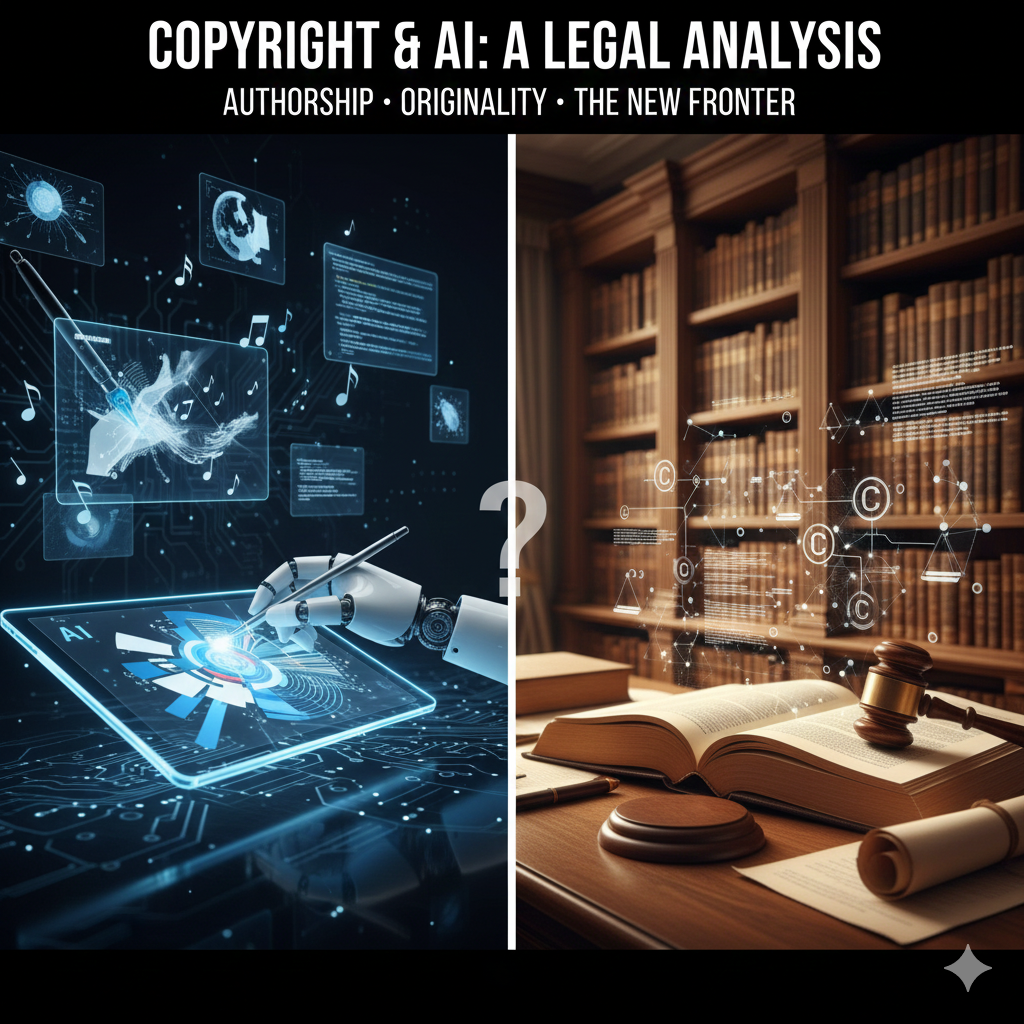
Artificial Intelligence (AI) has profoundly transformed creative processes, enabling machines to produce works ranging from visual art and poetry to music and software code. Platforms such as ChatGPT, DALL·E, and Midjourney generate outputs that increasingly mimic human creativity. This technological leap raises a critical legal question: Can AI-generated works be protected under copyright law, and if so, who holds the rights? Across jurisdictions, this debate revolves around the fundamental principles of copyright — authorship and originality — which traditionally presume human creativity.
Authorship and Originality in Copyright Law
Copyright law safeguards works stemming from human intellect. Under Section 13 of the Indian Copyright Act, 1957, protection extends to “original literary, dramatic, musical, and artistic works,” with originality being the cornerstone. Historically, originality has required human skill, judgment, and labor.
Similarly, the Berne Convention for the Protection of Literary and Artistic Works, to which India, the U.S., and the U.K. are signatories, emphasizes the protection of works by “authors,” implicitly excluding non-human entities.
Two primary legal tests for originality have emerged:
-
Sweat of the brow doctrine — focuses on human effort and diligence, exemplified in University of London Press Ltd. v. University Tutorial Press Ltd. ([1916] 2 Ch 601).
-
Creativity test — emphasizes minimal creative input, as articulated by the U.S. Supreme Court in Feist Publications v. Rural Telephone Service Co. (499 U.S. 340, 1991).
Both doctrines underscore the necessity of human involvement. AI-generated works, created without human intellect, challenge this foundational premise.
International Perspectives on AI Authorship
United States
The U.S. Copyright Office (USCO) has consistently held that works generated solely by AI are not eligible for copyright protection. In Re: Zarya of the Dawn (2023), protection was revoked for AI-generated images created with Midjourney, with the USCO emphasizing that “human authorship is a bedrock requirement.” Similarly, in Thaler v. Perlmutter (2023), the D.C. District Court reaffirmed that non-human entities cannot hold copyright. Consequently, fully autonomous AI works in the U.S. are considered part of the public domain.
United Kingdom
The UK’s Copyright, Designs and Patents Act, 1988 adopts a more flexible stance. Section 9(3) provides that for “computer-generated works” with no human author, “the author shall be taken to be the person by whom the arrangements necessary for the creation of the work are undertaken.” While this allows recognition of the human orchestrator, the provision predates contemporary generative AI and leaves interpretational ambiguities in self-learning systems.
European Union
The Court of Justice of the European Union (CJEU) in Infopaq International A/S v. Danske Dagblades Forening (C-5/08) held that originality requires the author’s “own intellectual creation,” presupposing human creativity. Though the European Parliament has discussed AI-generated works, no distinct legal regime for ownership has been established.
India
Indian law has not yet addressed AI authorship directly. Section 2(d) of the Copyright Act, 1957 defines “author” in human terms. The Delhi High Court in Tech Plus Media Pvt. Ltd. v. Jyoti Janda (2014) reinforced that copyright protection applies only to works produced through human skill and judgment. By analogy, works created entirely by AI are unlikely to qualify for copyright unless a human demonstrates meaningful creative input.
Human–AI Collaboration: The Grey Area
While fully autonomous AI outputs may lack copyright protection, human–AI collaboration presents a nuanced scenario. Courts may recognize copyright where human input contributes substantially to the work — for instance, through prompt selection, editing, or curating AI outputs.
-
In the U.S., the Copyright Office permits registration for works where AI assistance is paired with “substantial creative modifications.”
-
In India, if the human contribution exceeds mechanical tasks and demonstrates creative choice — such as determining style, structure, or thematic direction — the resulting work may qualify as a derivative of human authorship.
Thus, the distinction between mechanical and creative input becomes pivotal: the greater the human influence, the higher the likelihood of copyright eligibility.
Policy Considerations and the Need for Reform
Legal ambiguity around AI-generated works generates practical and ethical challenges:
-
Ownership disputes: Uncertainty persists over whether the developer, user, or no one holds rights.
-
Economic incentives: Lack of protection may deter investment in AI-driven creativity.
-
Moral rights: Attribution and integrity, central to copyright, are difficult to apply to machine-made works.
-
Liability concerns: Determining responsibility for AI-generated infringement or defamatory content remains unresolved.
Scholars propose potential reforms:
-
Sui generis rights for AI-generated works, akin to database rights in the EU.
-
Proxy authorship recognizing the developer or user as the author.
-
Mandatory disclosure requiring AI-generated content to be labeled, ensuring transparency.
These approaches aim to balance innovation, accountability, and legal clarity.
The Road Ahead
As AI technology evolves, lawmakers face a choice: uphold human authorship as an immutable principle or adapt copyright law to accommodate non-human creativity. Countries such as Japan and China are exploring limited rights frameworks for AI-assisted works, hinting at a gradual global shift.
For India and other common law jurisdictions, incremental reform may be prudent: acknowledging human–AI collaboration within existing doctrines of joint authorship and derivative works, while treating fully autonomous AI outputs as public domain until a comprehensive legal framework emerges.
Conclusion
The copyrightability of AI-generated works represents a defining challenge of the digital era. Current legal frameworks, rooted in human creativity, generally exclude machine authorship. However, the growing role of AI in the creative economy underscores the need for nuanced reform. Central to this debate is a fundamental question: can creativity exist without consciousness? Until legislatures provide clarity, the safest approach is to anchor copyright in human oversight, preserving the essence of originality at the heart of intellectual property law.
Unlock the Potential of Legal Expertise with LegalMantra.net - Your Trusted Legal Consultancy Partner”
Disclaimer: Every effort has been made to avoid errors or omissions in this material in spite of this, errors may creep in. Any mistake, error or discrepancy noted may be brought to our notice which shall be taken care of in the next edition In no event the author shall be liable for any direct indirect, special or incidental damage resulting from or arising out of or in connection with the use of this information Many sources have been considered including Newspapers, Journals, Bare Acts, Case Materials , Charted Secretary, Research Papers etc
LegalMantra.net Team
Prerna Yadav