
Forget Password

View News
Corporate Greenwashing: Legal Implications of Misleading Environmental Claims
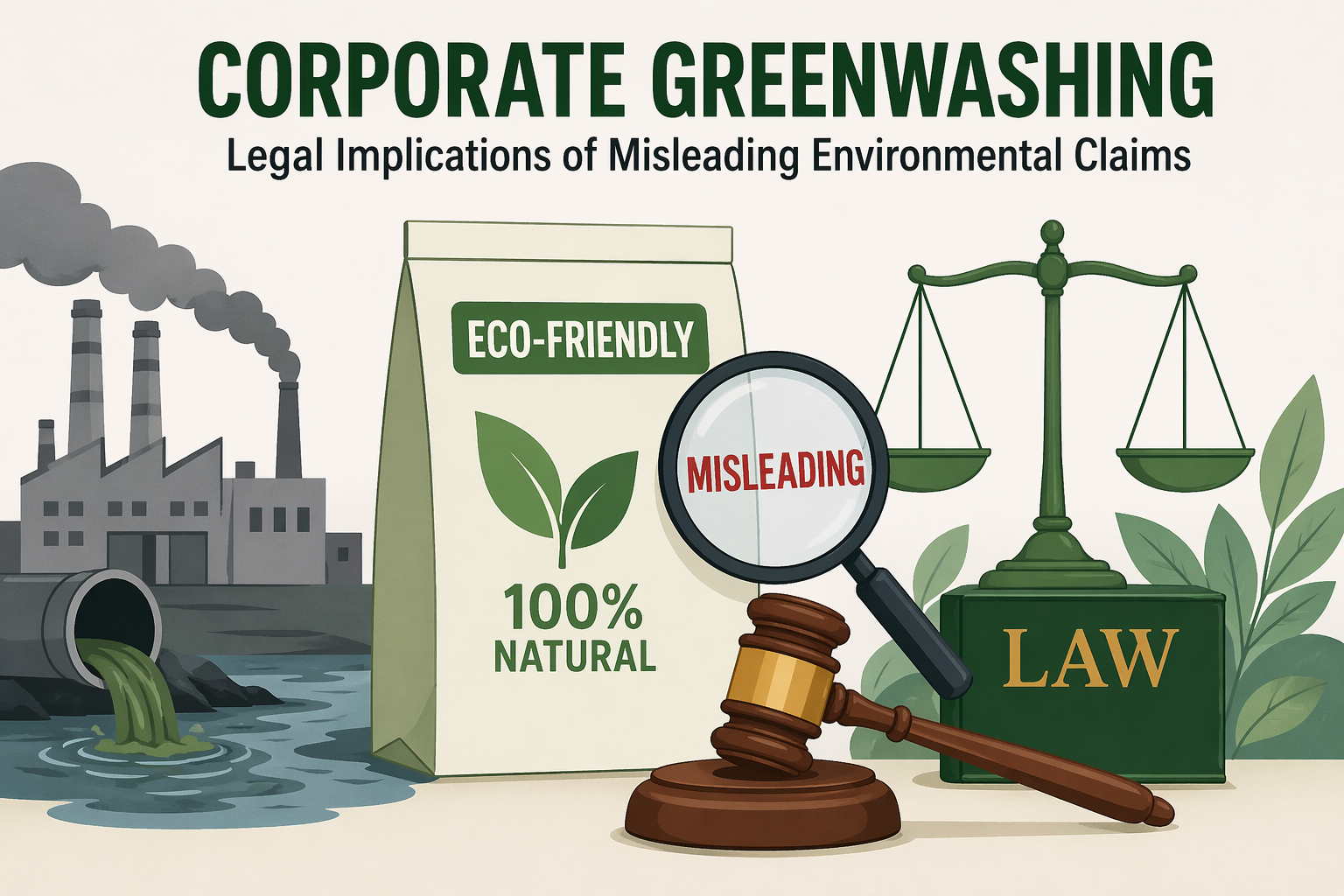
Corporate Greenwashing: Legal Implications of Misleading Environmental Claims
Introduction
In the contemporary global economy, environmental consciousness has evolved from a peripheral concern into a central determinant of consumer choice and corporate strategy. Businesses across industries increasingly position themselves as environmentally responsible by promoting products and operations as “sustainable,” “eco-friendly,” or “carbon-neutral.” While such claims may reflect genuine efforts toward sustainability, a growing number of corporations engage in misleading practices that exaggerate or fabricate environmental benefits. This phenomenon, commonly referred to as greenwashing, raises serious legal, ethical, and governance concerns. It not only deceives consumers but also distorts fair competition and undermines authentic environmental initiatives.
Understanding the Concept of Greenwashing
Greenwashing refers to the practice of conveying a false or misleading impression about the environmental soundness of a company’s products, policies, or overall operations. This may occur through ambiguous labeling, omission of material information, unverified claims, or the use of misleading symbols that resemble legitimate environmental certifications. For instance, a company may label its product as “100% natural” without disclosing environmentally harmful production processes, or use imagery and language suggesting sustainability without any substantive backing.
Such practices exploit the increasing consumer preference for environmentally responsible goods, enabling companies to gain a competitive advantage without undertaking meaningful environmental improvements. Consequently, greenwashing is not merely an ethical lapse but also a form of deception that attracts legal scrutiny under multiple regulatory frameworks.
Legal Framework Governing Greenwashing in India
In India, the regulation of greenwashing is primarily rooted in consumer protection, advertising standards, and environmental laws. The legal system does not yet have a standalone statute exclusively addressing greenwashing; however, several existing laws collectively address its various dimensions.
The Consumer Protection Act, 2019 plays a pivotal role in addressing misleading environmental claims. The statute prohibits unfair trade practices and deceptive advertisements that misrepresent the quality, characteristics, or benefits of goods and services. Environmental claims that are false, exaggerated, or incapable of substantiation fall squarely within the ambit of misleading advertisements. The Central Consumer Protection Authority (CCPA), established under the Act, is empowered to initiate investigations, impose monetary penalties, order the discontinuation of misleading advertisements, and even direct corrective advertising to rectify consumer misinformation.
In addition, the Advertising Standards Council of India (ASCI), a self-regulatory body, has issued guidelines governing environmental claims in advertisements. These guidelines require that all environmental assertions be truthful, specific, and supported by credible evidence. Broad or vague terms such as “green” or “eco-friendly” must be substantiated with verifiable data. Although ASCI’s framework is not statutory, its decisions carry persuasive value and often influence regulatory enforcement and judicial reasoning.
Environmental legislation, particularly the Environment (Protection) Act, 1986, may also become relevant in cases where companies falsely claim compliance with environmental standards or misrepresent their environmental performance. Misleading assertions regarding adherence to statutory environmental norms may expose companies to liability under this Act.
Global Legal Developments on Greenwashing
The challenge of greenwashing is not confined to India; it has become a global regulatory concern. Jurisdictions worldwide are strengthening legal frameworks to curb deceptive environmental practices.
In the European Union, the Unfair Commercial Practices Directive prohibits misleading environmental claims, and the European Commission has proposed stricter measures requiring companies to substantiate sustainability claims with scientific evidence. Similarly, in the United States, the Federal Trade Commission enforces the “Green Guides,” which provide detailed standards for environmental marketing claims, ensuring that they are clear, substantiated, and not deceptive.
Courts and regulatory bodies across jurisdictions are increasingly scrutinizing corporate sustainability representations. Litigation has emerged against companies for falsely claiming products to be biodegradable, carbon-neutral, or ethically sourced. These developments reflect a growing consensus that greenwashing not only harms consumers but also obstructs genuine environmental progress.
Legal Consequences of Greenwashing
The legal ramifications of greenwashing are significant and multifaceted. Companies engaging in deceptive environmental practices may face substantial monetary penalties imposed by regulatory authorities. Under Indian law, fines may vary depending on the severity and scale of the violation, but they can be considerable enough to deter non-compliance.
Regulatory bodies and courts may also issue injunctions restraining companies from continuing misleading advertisements. In many cases, businesses may be directed to undertake corrective advertising to inform consumers of the true nature of their claims, thereby restoring transparency in the marketplace.
Civil liability constitutes another major consequence. Consumers and competitors adversely affected by deceptive practices may initiate legal proceedings seeking damages. Class action suits are particularly relevant where a large group of consumers has been misled.
Beyond formal legal sanctions, reputational damage often proves to be the most enduring consequence. Loss of consumer trust can significantly impact brand value, market share, and long-term profitability. In extreme cases involving deliberate fraud or intentional misrepresentation, criminal liability may also arise against responsible individuals within the organization.
Challenges in Regulating Greenwashing
Despite the existence of legal mechanisms, regulating greenwashing presents several practical challenges. One of the primary issues is the inherent vagueness of environmental terminology. Terms such as “sustainable,” “natural,” and “eco-friendly” lack universally accepted definitions, making it easier for companies to exploit interpretational ambiguities.
Another significant challenge is the absence of standardized metrics for assessing environmental impact. Without clear benchmarks, determining whether a claim is misleading becomes complex. Regulatory authorities often face resource constraints and technical limitations in evaluating scientific and environmental data underlying such claims.
The global nature of commerce further complicates enforcement. Companies operating across jurisdictions may be subject to varying regulatory standards, creating inconsistencies and enforcement gaps that can be exploited. Cross-border advertising and digital marketing exacerbate these challenges, making it difficult to hold entities accountable under a single legal framework.
The Role of Corporate Governance in Preventing Greenwashing
Effective corporate governance is crucial in mitigating the risks associated with greenwashing. Companies must ensure that all environmental claims are grounded in verifiable data and supported by transparent reporting mechanisms. The adoption of internal compliance systems, third-party audits, and adherence to recognized sustainability frameworks such as Environmental, Social, and Governance (ESG) standards can significantly reduce the likelihood of misleading representations.
Board oversight plays a vital role in this context. Directors have a fiduciary duty to act in the best interests of the company, which includes ensuring compliance with legal and ethical standards. Failure to address risks associated with misleading environmental claims may expose directors to liability for breach of duty. Integrating sustainability considerations into corporate decision-making processes can enhance accountability and align business practices with long-term environmental goals.
The Way Forward
Addressing greenwashing requires a comprehensive and coordinated approach involving regulators, corporations, and consumers. Legislators must work toward establishing clearer definitions and standardized guidelines for environmental claims. Mandatory disclosure requirements and independent verification mechanisms can enhance transparency and credibility.
Consumer awareness is equally critical. Educated consumers are better equipped to identify misleading claims and demand accountability. Media organizations and civil society groups also play a significant role in exposing deceptive practices and promoting responsible corporate behavior.
Technological innovations offer promising solutions. Tools such as blockchain and digital tracking systems can improve traceability in supply chains and enable verification of environmental claims. By providing reliable and tamper-proof data, these technologies can significantly reduce the scope for misrepresentation.
Conclusion
Corporate greenwashing represents a serious challenge at the intersection of law, business ethics, and environmental sustainability. By misleading consumers and distorting market dynamics, it undermines genuine efforts to address pressing environmental concerns. Legal frameworks in India and across the world are increasingly recognizing the gravity of this issue and imposing stricter consequences for non-compliance.
However, effective regulation cannot rely solely on statutory provisions. It requires a collective commitment to transparency, accountability, and ethical conduct from corporations, supported by vigilant regulators and informed consumers. As sustainability continues to shape the global economic landscape, preserving the integrity of environmental claims will be essential to building trust and achieving meaningful environmental progress.
Unlock the Potential of Legal Expertise with LegalMantra.net – Your Trusted Legal Consultancy Partner
Disclaimer
Every effort has been made to ensure accuracy in this material. However, inadvertent errors or omissions may occur. Any discrepancies brought to the author’s notice will be rectified in subsequent editions. The author shall not be liable for any direct, indirect, incidental, or consequential damages arising from the use of this material. This article is based on various sources including statutory enactments, judicial decisions, academic research papers, professional journals, and publicly available legal materials.
Prerna Yadav
LegalMantra.net Team