
Forget Password

View News
Disclosure framework for acquisitions under SEBI LODR
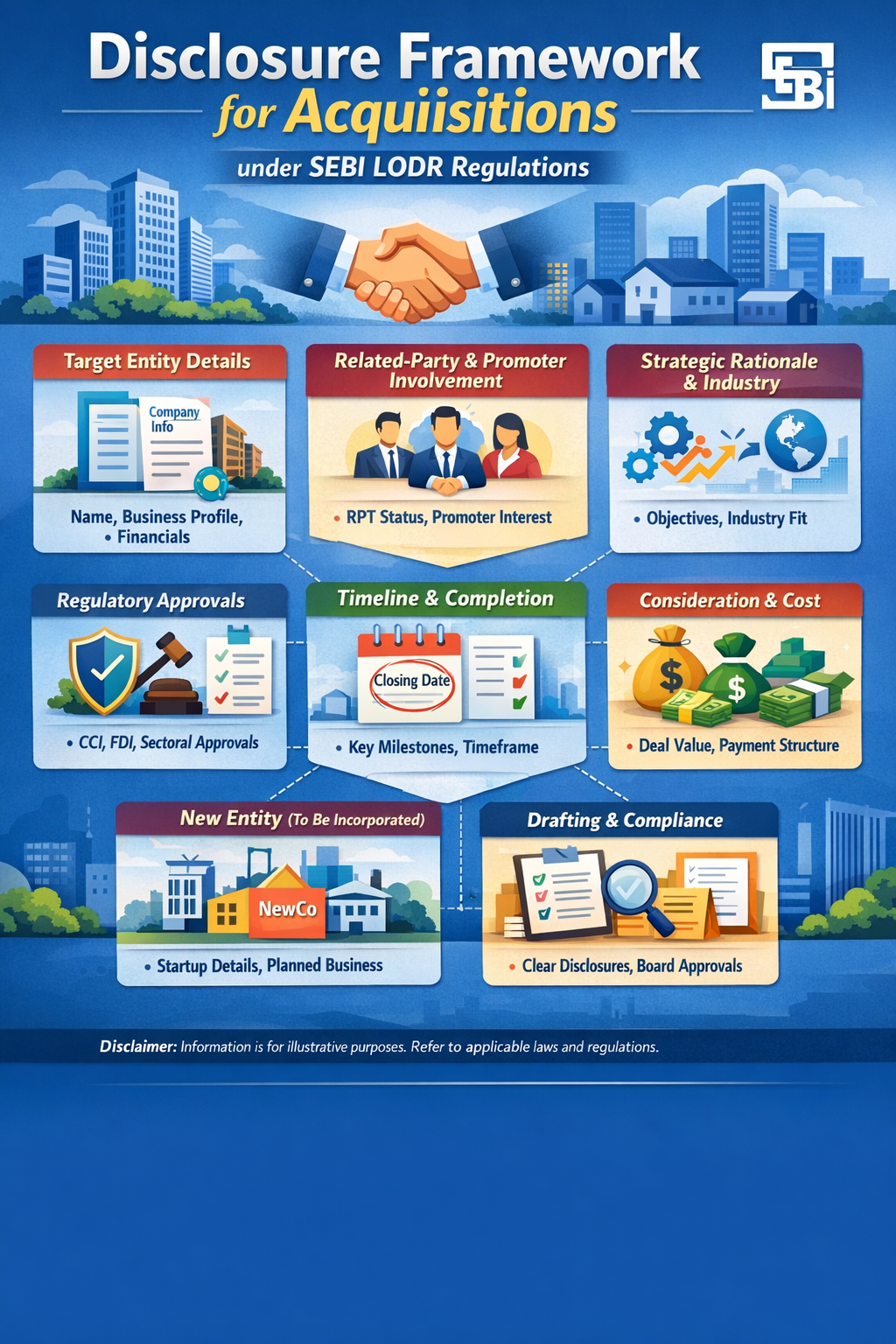
Disclosure Framework for Acquisitions under the SEBI LODR Regulations
The disclosure requirements relating to acquisitions by listed entities are governed by the SEBI (Listing Obligations and Disclosure Requirements) Regulations, 2015, issued by the Securities and Exchange Board of India. These regulations mandate that any acquisition, or agreement to acquire, crossing the prescribed materiality threshold must be disclosed to the stock exchanges in a detailed and structured manner.
The purpose of such disclosure is to ensure that investors receive adequate, accurate, and timely information regarding transactions that may materially affect the financial position, risk profile, or strategic direction of the listed entity. The regulatory intent is to promote transparency and protect investor interests by requiring disclosures that explain not only what is being acquired, but also why, how, and with what financial and regulatory implications.
I. Target Entity Details
I.1 Corporate Identity and Legal Status
The listed entity is required to disclose the name of the target entity, its registered office address, and its legal form, such as whether it is a private limited company, public company, limited liability partnership, or any other form of legal entity. The date of incorporation and the jurisdiction in which the entity is incorporated must also be specified.
These disclosures establish the legal identity of the target and provide clarity on the regulatory framework applicable to it.
I.2 Financial and Size Indicators
In order to enable investors to assess the scale of the acquisition, the listed entity must disclose relevant financial indicators of the target. This includes turnover for the last three financial years, net worth as per the latest audited financial statements, and profit or loss performance. Where relevant, details regarding the approximate number of employees and key operational locations should also be provided.
Such information allows investors to evaluate whether the acquisition is incremental, strategic, or transformative relative to the size of the listed entity.
I.3 Business Profile and Operations
The principal line of business, key products or services, and industry classification of the target entity must be clearly described. The disclosure should also outline the geographic areas in which the target operates and highlight any material licenses, regulatory approvals, intellectual property rights, or long-term contracts held by the target.
This information enables investors to assess operational risks, regulatory exposure, and the strategic compatibility of the target with the acquiring entity.
II. Related Party and Promoter Group Involvement
II.1 Determination of Related Party Status
The listed entity must expressly state whether the proposed acquisition qualifies as a related party transaction under the LODR Regulations. This involves examining whether promoters, members of the promoter group, directors, key managerial personnel, or group companies have any direct or indirect involvement in the transaction.
II.2 Nature and Extent of Interest
If the transaction involves related parties, the nature of their interest must be clearly disclosed. This may include shareholding, voting rights, board representation, management control, or financial arrangements. The extent of such interest, expressed in percentage terms or monetary exposure, must also be specified.
These disclosures are essential to ensure that minority shareholders are aware of potential conflicts of interest.
II.3 Arm’s Length Considerations
The listed entity must clarify whether the transaction is being conducted at arm’s length. Where applicable, reference should be made to independent valuation reports, fairness opinions, audit committee approvals, and shareholder approvals. In cases where pricing is not at arm’s length, adequate justification must be provided along with disclosure of the basis for valuation.
III. Industry Classification and Strategic Rationale
III.1 Industry Identification
The disclosure must identify the industry or sector to which the target entity belongs, such as manufacturing, information technology, healthcare, infrastructure, financial services, or other sectors. This classification provides context for assessing sector-specific regulatory and market risks.
III.2 Objects and Strategic Impact
The listed entity must clearly articulate the purpose of the acquisition. This includes explaining whether the acquisition is intended for vertical integration, horizontal expansion, diversification into new business segments, entry into new geographical markets, acquisition of technology, or enhancement of operational capacity.
The disclosure should describe how the acquisition aligns with the long-term business strategy of the listed entity.
III.3 Alignment with Core Business
Where the acquisition is outside the main line of business of the listed entity, the reasons for diversification must be explained. The associated risks, management capability, and integration challenges should also be addressed to enable investors to evaluate whether the diversification strategy is prudent.
III.4 Financial Impact
To the extent feasible, the listed entity should describe the expected financial impact of the acquisition. This may include anticipated revenue growth, cost efficiencies, capital expenditure requirements, impact on earnings per share, and changes in leverage levels. Such disclosure assists investors in assessing the potential return on investment and risk exposure.
IV. Regulatory and Governmental Approvals
IV.1 Competition Law Approvals
If the acquisition triggers thresholds under competition law, the requirement for approval from the Competition Commission of India must be disclosed. The status of such approval, whether applied for, granted, or pending, should also be specified.
IV.2 Sector-Specific Regulatory Approvals
Depending on the industry, approvals from sectoral regulators may be required. These may include approvals from financial, insurance, telecommunications, or other regulatory authorities. The disclosure must outline the nature of such approvals and their current status.
IV.3 Foreign Investment Considerations
In cases involving foreign shareholding or cross-border acquisitions, compliance with foreign direct investment regulations and sectoral caps must be disclosed. Any conditions attached to such approvals should also be clearly explained.
IV.4 Consequences of Non-Receipt
If any approval is pending or uncertain, the listed entity must disclose the expected timeline for receipt and the potential consequences in the event the approval is not obtained.
V. Timeline and Completion
The disclosure should provide an indicative timeline for completion of the acquisition. This includes the expected closing date or time frame, the execution of definitive agreements, receipt of regulatory approvals, and satisfaction of conditions precedent.
Providing such information enables investors to evaluate execution risk and the likelihood of successful completion.
VI. Consideration Structure and Cost of Acquisition
VI.1 Nature of Consideration
The listed entity must specify whether the acquisition consideration is to be paid in cash, through issuance of shares (share swap), deferred payment arrangements, earn-out mechanisms, or a combination thereof.
VI.2 Valuation Basis
The basis of valuation must be disclosed, including whether the valuation was determined using methods such as discounted cash flow analysis, earnings multiples, book value, or independent third-party valuation. This ensures transparency regarding pricing methodology.
VI.3 Total Cost and Shareholding
The total acquisition cost must be clearly stated, along with the price per share where applicable. In case of share swap arrangements, the exchange ratio must be disclosed. The percentage of shareholding or control to be acquired, and the number of shares to be issued or acquired, must also be specified.
These details enable investors to assess dilution, valuation fairness, and financial commitment.
VII. Acquisitions in Entities Yet to Be Incorporated
Where the acquisition involves subscription to an entity that is yet to be incorporated, additional disclosures are required.
VII.1 Incorporation and Relationship
The listed entity must disclose the proposed name of the entity, the country of incorporation, and its intended relationship with the listed entity, such as whether it will become a subsidiary, joint venture, or associate.
VII.2 Business Model and Industry
The intended line of business, target market, and proposed operational structure must be described in sufficient detail to enable investors to understand the commercial rationale.
VII.3 Regulatory and Subscription Details
The disclosure must specify regulatory formalities required for incorporation and the nature of consideration to be invested. The subscription amount, price per share, and percentage shareholding to be acquired must be clearly stated.
VIII. Drafting and Compliance Considerations
In preparing acquisition disclosures, the listed entity should ensure that the narrative is transaction-specific and not generic. The disclosure should cross-reference relevant board approvals, valuation reports, and agreements where required. Material litigation, contingent liabilities, or ongoing regulatory investigations involving the target must also be disclosed if they may influence investor decision-making.
The overarching objective of the disclosure framework is to ensure that investors receive a complete, fair, and comprehensible picture of the transaction, thereby promoting market integrity and informed investment decisions.
Disclaimer
The contents of this document are based on the prevailing statutory provisions and information available at the time of writing. While every effort has been made to ensure accuracy and completeness, no responsibility is assumed for errors or omissions. Readers are advised to refer to applicable laws, rules, regulations, and circulars for authoritative guidance. This document is intended for informational purposes only and does not constitute legal advice. No liability is accepted for any consequences arising from reliance on this material.
From the desk of CS Sharath