
Forget Password

View News
Drug Abuse in Educational Institutions Supreme Court’s Concern in a Recent Narcotics Case
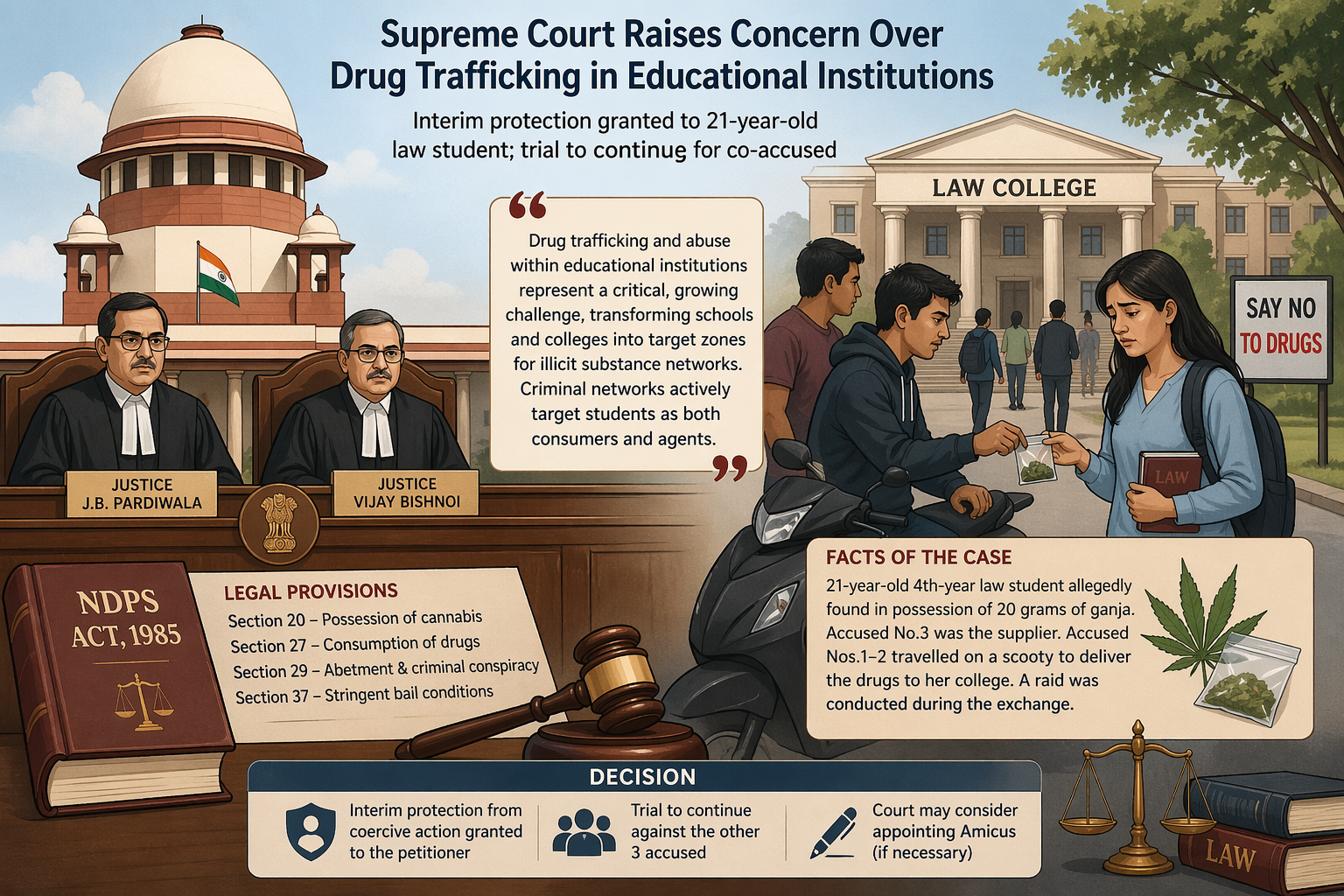
Drug Abuse in Educational Institutions: Supreme Court’s Concern in a Recent Narcotics Case
Introduction
The Supreme Court of India has recently drawn attention to a disturbing and rapidly growing issue—the increasing prevalence of drug trafficking and substance abuse within educational institutions across the country. While dealing with a narcotics-related case involving a young law student, the Court underscored how schools and colleges are no longer insulated spaces of learning but are gradually being exploited as active zones for illicit drug networks. The observations made by Justice J.B. Pardiwala and Justice Vijay Bishnoi reflect not only judicial concern in the specific case but also a broader societal alarm regarding the vulnerability of students to organized drug operations.
Factual Background
The case arose from allegations against a 21-year-old fourth-year law student who was found in possession of approximately 20 grams of ganja. The circumstances, as presented before the Court, indicated that the contraband substance was allegedly supplied to the petitioner through a coordinated effort involving three other accused persons. It appeared that Accused No. 3 functioned as the primary supplier, while Accused Nos. 1 and 2 transported the substance to the petitioner’s college premises using a scooty. The authorities conducted a raid at the time of the alleged exchange, leading to the recovery of the ganja from the petitioner.
Upon preliminary examination of the material on record, the Court observed that the three co-accused seemed to be acting in concert, thereby suggesting the existence of a supply chain rather than an isolated act. However, the petitioner’s position as a young student required the Court to adopt a cautious and balanced approach in assessing her role in the alleged offence.
Legal Framework
The matter falls within the ambit of the Narcotic Drugs and Psychotropic Substances Act, 1985, which provides a stringent statutory regime for dealing with offences related to narcotic drugs and psychotropic substances. Under this framework, possession of cannabis is punishable under Section 20, while Section 27 deals with consumption-related offences. Further, Section 29 extends liability to cases involving abetment and criminal conspiracy, thereby capturing the role of individuals participating in organized drug distribution networks.
It is noteworthy that the quantity allegedly recovered from the petitioner—20 grams of ganja—falls within the category of “small quantity” as per the statutory thresholds prescribed under the Act. This classification assumes significance, as it allows courts to adopt a comparatively lenient and reform-oriented approach, particularly in cases involving young or first-time offenders. Nonetheless, the stringent bail conditions under Section 37 continue to guide judicial discretion in such matters.
Issues Before the Court
The central question before the Court was whether the petitioner should be granted protection from coercive action, including arrest, during the pendency of proceedings. In addressing this issue, the Court was also required to consider the broader question of how the law ought to respond when a young student is implicated in a narcotics case. The matter thus raised important concerns regarding the balance between strict statutory compliance under the NDPS Act and the need to safeguard the future and rehabilitation prospects of youth. Additionally, the case brought into focus the systemic issue of drug trafficking within educational institutions and the role of organized networks in exploiting such environments.
Observations of the Court
The Court made significant and far-reaching observations on the issue of drug abuse in educational institutions. It noted with concern that drug trafficking within campuses is emerging as a critical and growing challenge, with criminal networks actively targeting students not only as consumers but also as agents of distribution. The Court remarked that such practices effectively transform educational institutions into fertile grounds for illicit activities, thereby undermining their fundamental purpose.
Expressing particular concern for the petitioner, the bench observed that it was deeply troubling to witness a “bright young girl pursuing law” being entangled in such circumstances. The Court acknowledged that similar patterns are being observed across the country, indicating that the issue is not confined to isolated incidents but represents a larger societal problem.
At the same time, the Court emphasized the need for a delicate and balanced approach in handling such cases. It recognized that excessive or premature coercive action could have long-term adverse consequences on the academic and professional future of young individuals. Thus, while maintaining the seriousness of the offence, the Court underscored the importance of adopting a reformative perspective, particularly in cases involving students.
Decision of the Court
In light of the facts and circumstances, the Court granted interim protection from coercive action to the petitioner, thereby shielding her from immediate arrest or similar measures. This relief was granted with due consideration to her age, academic status, and the need to prevent irreversible harm to her career at a formative stage.
Simultaneously, the Court permitted the trial court to continue proceedings against the remaining accused persons, who were allegedly involved in the supply and distribution of the narcotic substance. This distinction reflects the Court’s attempt to differentiate between individuals who are part of organized drug networks and those who may be relatively less culpable or susceptible to reform.
The bench also indicated that it may consider appointing an amicus curiae in subsequent hearings, if necessary, to assist the Court in addressing the broader legal and policy implications arising from such cases.
Analysis and Implications
The present case highlights an important shift in judicial thinking, where courts are increasingly attempting to strike a balance between strict enforcement of narcotics laws and the principles of reformative justice. While the NDPS Act is designed to combat drug trafficking through stringent provisions, its application in cases involving young students necessitates a more nuanced approach.
The Court’s observations reinforce the principle that punishment must be proportionate not only to the offence but also to the role and circumstances of the accused. In doing so, the judiciary acknowledges that young individuals, particularly students, may be more vulnerable to external influences and therefore deserving of an opportunity for correction and rehabilitation.
At a broader level, the case serves as a wake-up call for educational institutions, policymakers, and law enforcement agencies. It underscores the urgent need for preventive measures, including awareness campaigns, counselling mechanisms, and stricter campus monitoring, to curb the spread of drug-related activities within academic environments.
Conclusion
The decision of the Supreme Court of India in this case reflects a careful and considered approach to a complex social and legal issue. By granting interim protection to the student while allowing proceedings against the alleged suppliers to continue, the Court has demonstrated a commitment to both upholding the rule of law and protecting the future of young individuals.
The case ultimately underscores the need for a collective response to the growing menace of drug abuse in educational institutions, combining strict legal enforcement with compassionate and reform-oriented strategies.
Unlock the Potential of Legal Expertise with LegalMantra.net – Your Trusted Legal Consultancy Partner
Disclaimer
Every effort has been made to ensure accuracy in this material. However, inadvertent errors or omissions may occur. Any discrepancies brought to the author’s notice will be rectified in subsequent editions. The author shall not be liable for any direct, indirect, incidental, or consequential damages arising from the use of this material. This article is based on various sources including statutory enactments, judicial decisions, academic research papers, professional journals, and publicly available legal materials.
Anshul Goel
LegalMantra.net Team