
Forget Password

View News
E Commerce Consumer Protection Legal Perspective in the Digital Age
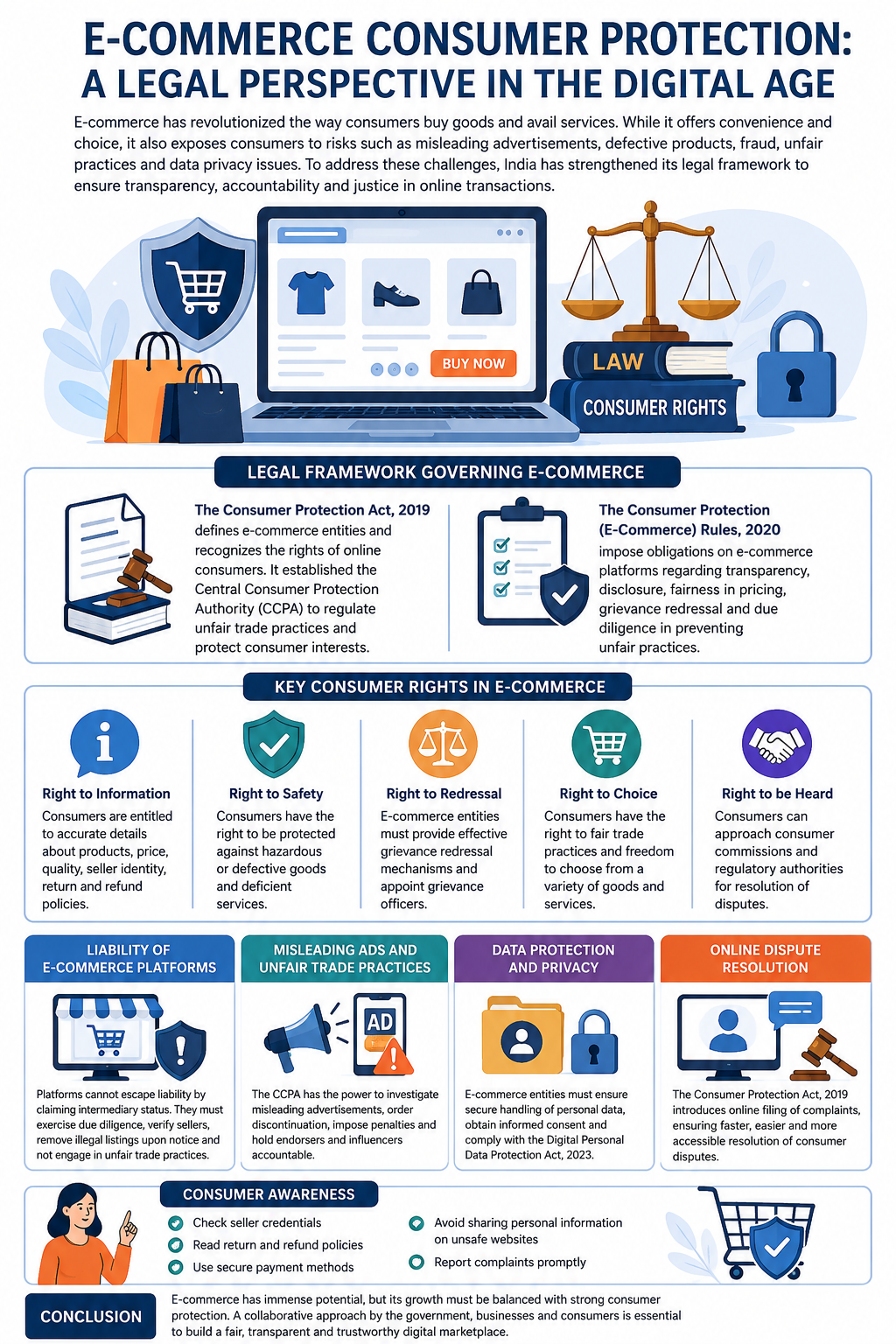
E-Commerce Consumer Protection: A Legal Perspective in the Digital Age
Introduction
The rapid development of e-commerce has fundamentally transformed the commercial environment across the globe. In India, the rise of digital marketplaces, online payment systems, and app-based delivery services has significantly altered consumer purchasing behaviour. Consumers today are able to purchase goods and avail services with unprecedented convenience, accessibility, and efficiency. From household essentials and electronics to healthcare and financial services, e-commerce platforms have become an integral part of daily life.
The expansion of digital commerce has also contributed substantially to economic growth by encouraging entrepreneurship, increasing market competition, and connecting businesses with consumers across geographical boundaries. However, alongside these benefits, e-commerce has created several new legal and consumer protection concerns. Consumers frequently encounter issues such as misleading advertisements, counterfeit products, defective goods, delayed deliveries, data privacy violations, fraudulent sellers, hidden charges, and unfair trade practices. Unlike traditional transactions, online commerce often involves anonymous sellers, cross-border dealings, and complex technological systems, making consumer protection more challenging.
The traditional legal framework governing consumer rights was not adequately designed to address these modern digital concerns. Recognizing the need for stronger regulation, the Indian legislature enacted the Consumer Protection Act, 2019along with the Consumer Protection (E-Commerce) Rules, 2020 to establish transparency, accountability, and fairness in online transactions. These laws seek to strengthen consumer rights while ensuring responsible growth of the digital economy.
This article examines the legal framework governing e-commerce consumer protection in India, the rights available to online consumers, the obligations and liabilities of e-commerce platforms, the role of regulatory authorities, and the emerging challenges associated with digital commerce.
Evolution of Consumer Protection in the Digital Economy
Consumer protection law in India initially focused on conventional commercial transactions taking place through physical markets. Earlier legal frameworks primarily dealt with defective goods, deficiency in services, and unfair trade practices within traditional business models. However, technological advancements and increasing internet penetration gradually shifted commerce into the digital sphere.
The emergence of online marketplaces introduced entirely new dimensions to consumer transactions. Consumers began interacting with sellers whom they had never physically met, relying solely on digital product descriptions, reviews, and advertisements. This increased the possibility of deception and fraud. Furthermore, the rapid growth of algorithm-based advertising, influencer marketing, and digital payment systems created complexities that existing consumer laws could not adequately address.
The need for specialized e-commerce regulation became more apparent with the increasing number of complaints relating to fake products, manipulative pricing practices, delayed refunds, and misuse of consumer data. In response, the Indian legislature modernized the consumer protection regime through the enactment of the Consumer Protection Act, 2019, which specifically recognized e-commerce as a regulated commercial activity.
The legislation marked a significant shift toward digital consumer governance by introducing concepts such as product liability, e-commerce regulation, online dispute resolution, and platform accountability. The subsequent introduction of the Consumer Protection (E-Commerce) Rules, 2020 further clarified the duties and responsibilities of online marketplaces and digital sellers.
Legal Framework Governing E-Commerce in India
The principal legislation governing e-commerce consumer protection in India is the Consumer Protection Act, 2019. The Act replaced the earlier Consumer Protection Act, 1986 and expanded the scope of consumer rights to address modern digital transactions. It introduced definitions for e-commerce entities, electronic service providers, marketplace models, and inventory-based models, thereby bringing online commercial activities directly within the ambit of consumer law.
The Act also established the Central Consumer Protection Authority (CCPA), which functions as a regulatory authority empowered to investigate unfair trade practices, misleading advertisements, and violations of consumer rights. The authority possesses powers to order product recalls, impose penalties, and issue directions against entities engaging in deceptive practices.
To strengthen the implementation of the Act in the digital environment, the government introduced the Consumer Protection (E-Commerce) Rules, 2020. These rules apply to both domestic and foreign e-commerce entities operating in India. The rules impose obligations relating to transparency, grievance redressal, seller verification, pricing practices, and consumer information disclosure.
Together, these legal instruments seek to ensure that digital marketplaces function in a fair, transparent, and consumer-friendly manner.
Nature and Classification of E-Commerce Entities
The legal framework distinguishes between different categories of e-commerce entities based on their operational structure. This classification is important because the nature of obligations and liabilities differs according to the business model adopted.
Marketplace e-commerce entities primarily act as intermediaries that connect buyers and sellers through digital platforms. These entities facilitate transactions without directly owning the products being sold. They provide technological infrastructure, payment gateways, and logistical support while independent sellers supply the goods or services.
Inventory-based e-commerce entities, on the other hand, directly own the inventory and sell products or services to consumers. Since such entities exercise greater control over the transaction process, they bear direct responsibility for product quality, delivery, warranties, and customer grievances.
The distinction between marketplace and inventory-based models becomes particularly significant when determining liability for defective products, misleading advertisements, or unfair trade practices.
Consumer Rights in E-Commerce Transactions
The legal framework governing e-commerce seeks to preserve and strengthen the fundamental rights of consumers in digital transactions.
Consumers possess the right to receive complete and accurate information regarding products and services offered online. E-commerce entities are required to disclose essential details such as price, quality, specifications, seller identity, warranty conditions, delivery timelines, and refund policies. Misrepresentation or concealment of material information may amount to an unfair trade practice under the law.
The right to safety is another crucial consumer protection principle. Consumers must be protected against hazardous, defective, or counterfeit products that may endanger health, life, or property. Online platforms are expected to exercise reasonable diligence to prevent the sale of unsafe products and to remove illegal or dangerous listings upon receiving notice.
Consumers also possess the right to seek redressal against unfair practices and service deficiencies. The law mandates that e-commerce entities establish effective grievance redressal mechanisms and appoint grievance officers whose contact details are publicly accessible. Complaints are required to be acknowledged and resolved within prescribed timelines.
The legal framework further protects the consumer’s right to fair treatment and informed choice. Practices such as manipulative flash sales, artificial price inflation, fake discounts, and discriminatory pricing are discouraged to ensure transparency and fairness within digital marketplaces.
Obligations and Responsibilities of E-Commerce Platforms
The Consumer Protection (E-Commerce) Rules, 2020 impose several obligations upon e-commerce entities to enhance consumer protection and accountability.
E-commerce platforms are required to provide clear and accessible information regarding their legal identity, business address, customer care details, terms of service, payment methods, return policies, and delivery arrangements. This transparency enables consumers to make informed decisions before entering into online transactions.
The Rules prohibit e-commerce entities from adopting unfair trade practices that manipulate consumer behaviour or distort market competition. Platforms are expected to maintain neutrality and avoid influencing product prices in a manner that harms consumer interests.
Additionally, marketplace platforms are required to ensure that sellers provide accurate product descriptions and lawful information regarding the goods or services being offered. They are also expected to remove unlawful or misleading listings upon receiving appropriate notice.
Failure to comply with these obligations may result in legal liability and regulatory action.
Liability of E-Commerce Platforms
One of the most complex issues in e-commerce law concerns the extent to which online platforms may be held liable for the actions of third-party sellers.
Marketplace entities often argue that they merely function as intermediaries and therefore should not be held directly responsible for defective products or fraudulent conduct by sellers. However, Indian law imposes certain due diligence obligations upon such platforms.
An e-commerce platform may incur liability where it fails to take reasonable steps to prevent unlawful activities, permits misleading advertisements, conceals seller information, or neglects consumer grievances. Liability may also arise where the platform exercises substantial control over pricing, product presentation, or transaction terms.
The law seeks to strike a balance between encouraging digital innovation and ensuring accountability. While intermediary protection remains important for the growth of digital commerce, consumer welfare considerations require platforms to exercise reasonable oversight over transactions conducted through their systems.
Misleading Advertisements and Influencer Marketing
The growth of social media and digital advertising has significantly increased the use of influencer marketing and personalized promotional strategies. Consumers are frequently influenced by celebrity endorsements, sponsored content, and targeted advertisements while making purchasing decisions.
This environment creates a substantial risk of deceptive or misleading promotional practices. False claims regarding product quality, exaggerated benefits, manipulated reviews, and undisclosed sponsorships may mislead consumers and distort market fairness.
The Central Consumer Protection Authority possesses broad powers to regulate misleading advertisements and unfair commercial practices. It may initiate investigations, impose penalties, direct discontinuation of deceptive advertisements, and prohibit endorsers from participating in promotional activities in serious cases.
The legal framework increasingly recognizes that influencers and endorsers must exercise due diligence before making commercial representations to consumers.
Product Liability in E-Commerce
The introduction of product liability provisions under the Consumer Protection Act, 2019 represents a major advancement in consumer protection law.
Consumers may seek compensation against manufacturers, sellers, service providers, and, in certain circumstances, e-commerce entities for harm caused by defective products or deficient services. Liability may arise due to manufacturing defects, design defects, inadequate instructions, failure to warn consumers, or breach of warranties.
These provisions strengthen consumer confidence by ensuring that businesses remain accountable for the safety and quality of products sold through digital platforms.
Data Protection and Privacy Concerns
E-commerce transactions involve extensive collection, storage, and processing of consumer data. Online platforms frequently gather information relating to consumer preferences, financial details, browsing behaviour, and purchasing history.
This has raised significant concerns regarding privacy violations, identity theft, cyber fraud, unauthorized data sharing, and excessive consumer profiling. Data breaches involving e-commerce companies may expose consumers to serious financial and reputational harm.
While the consumer protection framework addresses certain aspects of unfair digital practices, data privacy regulation is now increasingly governed by the Digital Personal Data Protection Act, 2023. E-commerce entities are expected to obtain informed consent from consumers, ensure secure handling of personal data, and maintain transparency regarding data usage practices.
The protection of consumer data has become an essential component of digital consumer rights in the modern economy.
Cross-Border E-Commerce and Jurisdictional Challenges
The globalization of e-commerce allows consumers to purchase goods and services from international sellers operating across multiple jurisdictions. While this enhances consumer choice and market access, it also creates complex legal and enforcement challenges.
Consumers may encounter difficulties in pursuing remedies against foreign sellers due to differences in legal systems, jurisdictional limitations, and enforcement barriers. Questions frequently arise regarding applicable law, dispute resolution forums, taxation, and enforcement of judgments.
Indian law attempts to address these issues by requiring foreign e-commerce entities operating in India to comply with domestic consumer protection regulations. However, practical enforcement remains difficult because of the inherently borderless nature of digital commerce.
International cooperation and harmonization of digital trade regulations may become increasingly necessary to ensure effective cross-border consumer protection.
Consumer Awareness and Digital Literacy
Legal protections alone are insufficient unless consumers are adequately informed about their rights and remedies. A significant number of online consumers remain unaware of the legal safeguards available to them in cases of fraud, defective products, or unfair trade practices.
Digital literacy plays a crucial role in strengthening consumer protection. Consumers must exercise caution while engaging in online transactions by verifying seller credentials, reviewing refund policies, using secure payment systems, and avoiding suspicious websites or links.
Public awareness initiatives, educational campaigns, and digital literacy programs are essential to empower consumers and encourage responsible participation in the digital marketplace.
Online Dispute Resolution Mechanisms
The Consumer Protection Act, 2019 introduced significant procedural reforms to improve access to consumer justice in the digital age. Consumers may now file complaints electronically before consumer commissions depending upon the value and nature of the claim.
The online dispute resolution framework reduces procedural complexity and enhances accessibility, particularly for consumers located in remote areas. Digital complaint mechanisms align effectively with the nature of e-commerce transactions and promote efficient resolution of disputes.
The transition toward technology-enabled dispute resolution reflects the broader objective of modernizing consumer justice administration in India.
Emerging Challenges in the Regulation of E-Commerce
Despite the existence of comprehensive legal frameworks, the rapidly evolving digital environment continues to create new regulatory challenges.
Artificial intelligence and algorithm-driven pricing systems may lead to discriminatory pricing practices and reduced market transparency. Fake reviews and manipulated ratings continue to influence consumer decisions unfairly. Certain digital platforms employ deceptive user interface designs, commonly referred to as “dark patterns,” to manipulate consumer behaviour and obtain unintended consent.
The increasing use of automated decision-making systems and personalized advertising also raises concerns regarding fairness, accountability, and ethical digital governance.
As technology evolves, legal systems must continuously adapt to address these emerging risks while maintaining a balance between innovation and consumer welfare.
Conclusion
E-commerce has revolutionized modern trade by creating unprecedented convenience, accessibility, and economic opportunities for businesses and consumers alike. However, the digital marketplace also presents unique legal and regulatory challenges that necessitate robust consumer protection mechanisms.
The Consumer Protection Act, 2019 and the Consumer Protection (E-Commerce) Rules, 2020 represent important legislative measures aimed at ensuring transparency, fairness, accountability, and consumer confidence within online marketplaces. These laws seek to protect consumers against unfair trade practices while promoting responsible growth of the digital economy.
At the same time, technological advancements continue to generate new concerns relating to artificial intelligence, data privacy, cross-border commerce, digital fraud, and platform governance. The legal framework must therefore remain dynamic and responsive to emerging developments in digital commerce.
Ultimately, effective e-commerce consumer protection depends upon coordinated efforts by legislators, regulatory authorities, businesses, technology platforms, and informed consumers. A secure and transparent digital marketplace is essential for ensuring sustainable growth of e-commerce and preserving public trust in the digital economy.
Unlock the Potential of Legal Expertise with LegalMantra.net – Your Trusted Legal Consultancy Partner
Disclaimer
Every effort has been made to ensure accuracy in this material. However, inadvertent errors or omissions may occur. Any discrepancies brought to the author’s notice will be rectified in subsequent editions. The author shall not be liable for any direct, indirect, incidental, or consequential damages arising from the use of this material. This article is based on various sources including statutory enactments, judicial decisions, academic research papers, professional journals, and publicly available legal materials.
Prerna Yadav
LegalMantra.net Team