
Forget Password

View News
ENVIRONMENT AND URBAN LAW ENFORCEMENT
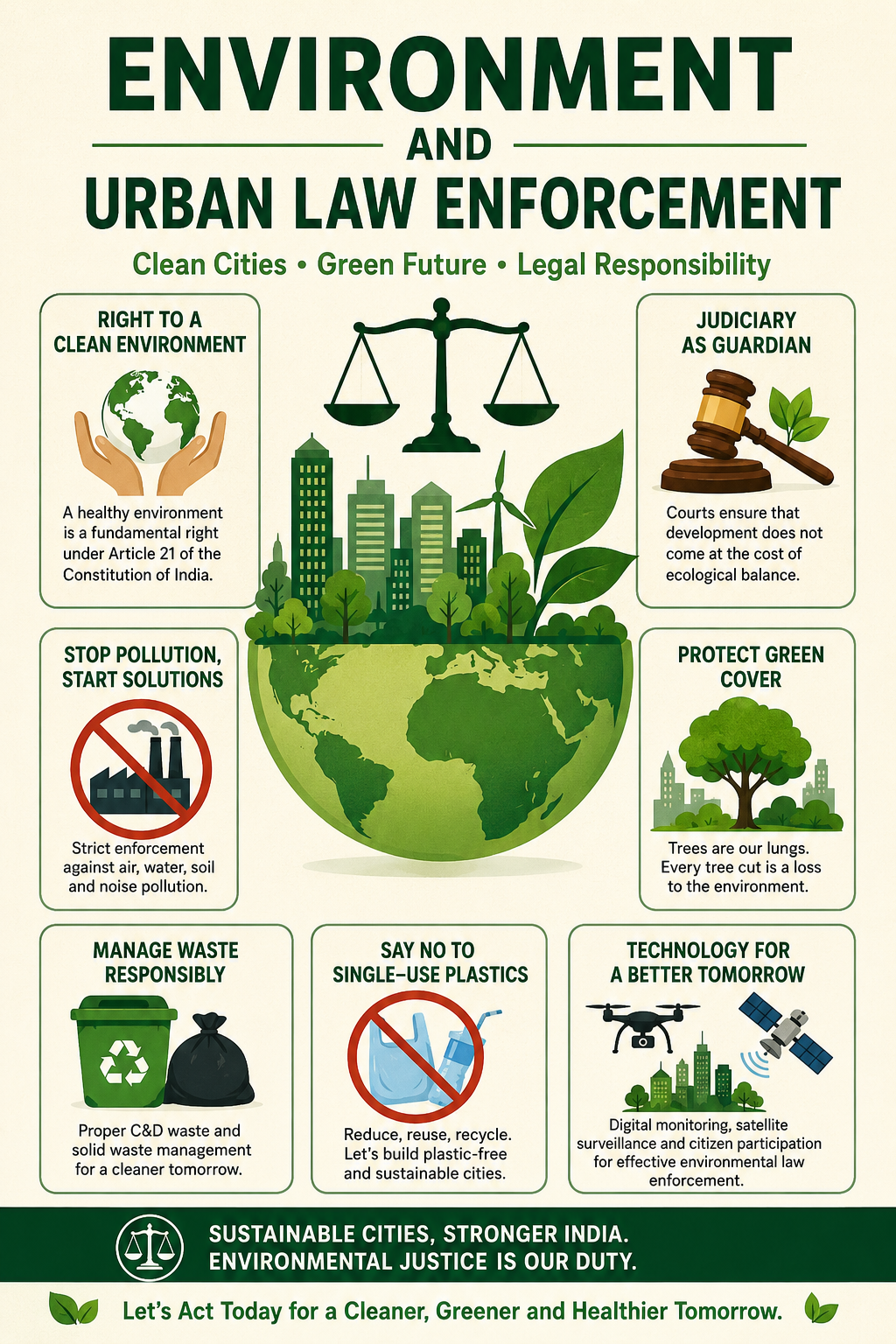
ENVIRONMENT AND URBAN LAW ENFORCEMENT
Judicial Activism, Sustainable Development, and the Future of Indian Cities
By Sura Anjana Srimayi
INTRODUCTION
Urban India in 2026 stands at a decisive crossroads. On one side lies the ambitious vision of Smart Cities, Digital India, and Viksit Bharat; on the other lies the grim reality of collapsing infrastructure, unbreathable air, shrinking green spaces, overflowing landfills, disappearing water bodies, and unsustainable urbanization. Cities that once symbolized economic growth are now becoming centres of ecological stress. The modern urban crisis is not merely administrative or developmental—it is constitutional, environmental, and humanitarian. Pollution, unauthorized construction, waste mismanagement, destruction of forests, depletion of groundwater, and climate-induced urban disasters have transformed environmental governance into one of the most litigated areas of public law in India.
Historically, municipal corporations, development authorities, pollution control boards, and state governments were expected to safeguard urban ecology. However, persistent governance failures, corruption, bureaucratic inaction, and poor implementation of environmental laws compelled the judiciary to intervene aggressively. Consequently, environmental and urban law enforcement in India has evolved from a regulatory framework into a constitutional battlefield where courts increasingly shape urban policy. Today, the Indian judiciary—particularly the Supreme Court of India and the National Green Tribunal—has emerged as the principal guardian of environmental rights. Through Public Interest Litigations (PILs), constitutional interpretation, and environmental jurisprudence, courts have transformed ecological protection from a moral obligation into an enforceable legal duty. Environmental degradation is no longer viewed merely as a policy failure; it is treated as a direct violation of the Right to Life guaranteed under Article 21 of the Constitution of India.
CONSTITUTIONAL FOUNDATION OF ENVIRONMENTAL LAW ENFORCEMENT
The constitutional framework of India provides a strong foundation for environmental protection and urban ecological governance. Article 21 of the Constitution, which guarantees the Right to Life and Personal Liberty, has been expansively interpreted by the judiciary to include the right to clean air, safe drinking water, pollution-free surroundings, and a healthy environment. The courts have repeatedly held that life cannot be reduced to mere physical survival; it also includes the right to live with dignity in an ecologically balanced environment. Landmark decisions such as M.C. Mehta v. Union of India and Vellore Citizens Welfare Forum v. Union of India laid the foundation for modern environmental jurisprudence in India.
Apart from fundamental rights, the Constitution also imposes obligations upon both the State and citizens. Article 48A directs the State to protect and improve the environment and safeguard forests and wildlife, while Article 51A(g) imposes a fundamental duty upon citizens to preserve and improve the natural environment. These constitutional provisions collectively establish environmental protection as a shared responsibility and reinforce the idea that ecological conservation is integral to governance and citizenship.
THE RISE OF JUDICIAL ACTIVISM IN URBAN ENVIRONMENTAL GOVERNANCE
The Indian judiciary has gradually transformed from a passive adjudicatory institution into an active environmental regulator. Courts are no longer limiting themselves to resolving disputes; instead, they are monitoring pollution control measures, supervising municipal waste management systems, regulating construction activities, restricting industrial emissions, and protecting wetlands and urban forests. This transition was largely driven by administrative failures and the inability of executive agencies to effectively implement environmental laws.
One of the most important doctrines applied by Indian courts is the Public Trust Doctrine, under which the State acts as a trustee of natural resources for present and future generations. This principle prevents governments from exploiting forests, rivers, lakes, and green spaces for short-term economic gain. The judiciary has therefore emphasized that natural resources are not assets for unrestricted commercial exploitation but public resources requiring long-term ecological protection.
CONSTRUCTION AND DEMOLITION (C&D) WASTE: THE INVISIBLE URBAN DISASTER
Rapid urbanization and infrastructure development have significantly increased construction and demolition activities across Indian cities. High-rise buildings, highways, flyovers, metro projects, and redevelopment initiatives generate enormous quantities of debris and dust. Improper disposal of construction waste contributes to severe air pollution, particulate matter emissions, blocked drainage systems, urban flooding, and soil contamination. In many metropolitan cities, construction dust has emerged as one of the leading causes of declining air quality.
To address this growing problem, the government introduced the Construction and Demolition Waste Management Rules, 2016 under the Environment (Protection) Act, 1986. These rules impose obligations upon developers to segregate waste, recycle debris, prevent dust pollution, and ensure scientific disposal. However, weak implementation initially reduced the effectiveness of these regulations.
By 2026, the judiciary and the National Green Tribunal adopted a stricter approach. Courts increasingly imposed environmental compensation on violators and empowered municipal authorities to issue stop-work notices against non-compliant projects. The doctrine of strict liability has become particularly significant in this context, as developers can now be held liable for environmental damage irrespective of intent or negligence. Large infrastructure projects are therefore subjected to rigorous environmental scrutiny and compliance monitoring.
TREE FELLING, URBAN GREEN COVER, AND ECOLOGICAL JUSTICE
Urban trees are no longer viewed merely as decorative elements within city landscapes. Courts increasingly recognize them as ecological assets essential for regulating temperature, improving air quality, reducing carbon emissions, and maintaining biodiversity. The destruction of urban green cover directly affects public health, increases heatwaves, and weakens the environmental resilience of cities.
The Taj Trapezium Zone surrounding the Taj Mahal remains one of the most prominent examples of judicial environmental intervention. To protect the Taj Mahal from pollution-related damage, courts imposed restrictions on industrial activities, vehicular emissions, and construction projects in the surrounding region. In recent years, judicial oversight within the zone has intensified further, particularly with respect to tree felling and ecological degradation.
A notable legal development has been the recognition of the Net Present Value (NPV) of trees. Courts now acknowledge that mature trees provide measurable ecosystem services such as oxygen production, carbon sequestration, temperature regulation, groundwater recharge, and pollution absorption. Consequently, the destruction of a mature tree may result in substantial financial liability for developers. This principle has compelled urban planners to redesign infrastructure projects around existing trees rather than removing them indiscriminately.
The judiciary has also become increasingly skeptical of compensatory afforestation schemes where trees cut in urban areas are replaced by saplings planted in distant locations. Courts have observed that a mature urban canopy cannot be effectively replaced by plantations elsewhere because ecological benefits are location-specific. This has led to greater judicial preference for tree transplantation and in-situ conservation over mere compensatory plantation measures.
THE WAR AGAINST SINGLE-USE PLASTICS
Plastic pollution has emerged as one of the most severe environmental challenges facing Indian cities. Single-use plastics clog drainage systems, contaminate rivers and lakes, contribute to urban flooding, and create long-term ecological hazards through microplastic pollution. Although India imposed nationwide restrictions on several categories of single-use plastics, enforcement remained weak for many years.
The Plastic Waste Management Rules, along with subsequent amendments introducing Extended Producer Responsibility (EPR), significantly transformed the legal framework governing plastic waste. Under EPR, manufacturers, importers, and brand owners are legally responsible for collecting and processing the plastic waste generated by their products. Environmental responsibility therefore extends beyond consumers and municipal authorities to corporate entities themselves.
The judiciary has strongly supported this framework by imposing accountability upon companies failing to meet collection and recycling targets. Courts increasingly treat plastic waste mismanagement as corporate environmental negligence. At the same time, municipal bodies are also being subjected to stricter judicial oversight. In several cases, courts have warned municipal commissioners of contempt proceedings for failing to implement waste segregation and anti-plastic regulations effectively. This trend reflects a broader judicial shift toward direct administrative accountability in urban environmental governance.
AIR POLLUTION AND THE URBAN HEALTH EMERGENCY
Air pollution continues to remain one of the gravest environmental crises in urban India. Several cities regularly record hazardous Air Quality Index (AQI) levels exceeding safe limits, especially during winter months. Pollution originates from multiple sources, including vehicular emissions, industrial discharge, construction dust, diesel generators, waste burning, and crop residue burning in neighboring regions.
The judiciary has repeatedly characterized air pollution as a public health emergency and has intervened through various directions aimed at reducing pollution levels. Courts have ordered the closure of highly polluting industries, imposed restrictions on diesel vehicles, promoted cleaner fuel standards, regulated construction activities, and monitored implementation of anti-pollution measures. Firecracker restrictions and odd-even traffic schemes have also been judicially supported in several instances. The courts increasingly view access to clean air as a non-negotiable constitutional entitlement under Article 21.
PROTECTION OF WATER BODIES, FLOODPLAINS, AND WETLANDS
Rapid urban expansion has resulted in the encroachment and destruction of lakes, wetlands, rivers, and floodplains. Illegal construction activities over natural drainage systems have intensified urban flooding and reduced groundwater recharge capacities. Environmental degradation of water bodies also contributes to severe water scarcity in rapidly growing cities.
Indian courts have consistently emphasized that wetlands and floodplains perform critical ecological functions and cannot be sacrificed for commercial development. Judicial interventions have therefore focused on preventing encroachments, demolishing illegal structures, and restoring degraded ecological zones. The protection of water bodies has become particularly important in the context of climate change, as urban floods and water shortages are increasingly linked to unsustainable urban planning.
DIGITAL ENFORCEMENT AND TECHNOLOGICAL SURVEILLANCE
One of the most significant developments in urban environmental law enforcement is the increasing use of technology in monitoring environmental compliance. Satellite imagery is now frequently utilized to detect illegal encroachments, unauthorized construction, and deforestation activities. Courts rely upon such technological evidence to reduce dependence on potentially manipulated inspection reports.
Drone surveillance has also become a major enforcement mechanism. Drones are used to monitor construction dust, illegal dumping, waste burning, and mining activities in real time. This allows authorities to identify violations more efficiently and collect stronger evidentiary material for legal proceedings.
Technology has also strengthened citizen participation in environmental governance. Mobile applications and digital complaint systems now enable citizens to upload geo-tagged photographs and report environmental violations directly to authorities and tribunals. This evolution of Public Interest Litigation into a digitally supported participatory mechanism has significantly expanded environmental accountability.
THE ROLE OF THE NATIONAL GREEN TRIBUNAL
The National Green Tribunal has emerged as one of the most influential institutions in environmental governance. Established under the National Green Tribunal Act, 2010, the tribunal specializes in environmental disputes involving pollution control, forest conservation, biodiversity protection, industrial regulation, and waste management.
Unlike ordinary courts, the NGT possesses technical expertise and follows relatively faster procedures. It has the authority to impose environmental compensation, order ecological restoration, suspend projects, and issue directions for compliance. Over time, the tribunal has become a powerful mechanism for ensuring environmental accountability and strengthening urban ecological governance.
CHALLENGES IN ENVIRONMENTAL LAW ENFORCEMENT
Despite increasing judicial intervention, environmental law enforcement in India continues to face significant challenges. Municipal bodies often lack adequate manpower, financial resources, and technological infrastructure to implement environmental regulations effectively. Corruption and political influence frequently shield illegal construction and environmentally harmful activities from enforcement actions. In many cases, compliance with judicial orders remains delayed or selective.
Rapid urban population growth further intensifies pressure on infrastructure and natural resources. Simultaneously, climate change is increasing the frequency of heatwaves, floods, and water shortages, thereby making urban ecological governance even more difficult. These challenges indicate that judicial activism alone cannot solve environmental problems unless supported by strong administrative and political commitment.
CONCLUSION
The environmental governance framework of India in 2026 reflects a profound legal transformation. Environmental protection is no longer treated as a secondary administrative concern; it has become a constitutional imperative backed by aggressive judicial enforcement. The judiciary has fundamentally altered the legal landscape by declaring that development cannot occur at the cost of ecological destruction.
Whether through regulation of construction waste, protection of urban forests, enforcement of plastic waste rules, or safeguarding of floodplains, courts have made environmental accountability unavoidable. Municipal authorities are increasingly being held personally accountable for administrative failures, corporations face direct environmental liability, developers operate under strict judicial scrutiny, and citizens actively participate in environmental monitoring and enforcement.
The future of Indian cities will therefore depend not merely upon economic growth or infrastructure expansion but upon sustainable and environmentally responsible development. A city that fails to provide clean air, safe water, ecological balance, and environmental dignity to its residents cannot truly be regarded as developed. The future of urban India ultimately lies in balancing growth with sustainability and ensuring that development occurs within the framework of constitutional environmental justice.
Unlock the Potential of Legal Expertise with LegalMantra.net – Your Trusted Legal Consultancy Partner
Disclaimer
Every effort has been made to ensure accuracy in this material. However, inadvertent errors or omissions may occur. Any discrepancies brought to the author’s notice will be rectified in subsequent editions. The author shall not be liable for any direct, indirect, incidental, or consequential damages arising from the use of this material. This article is based on various sources including statutory enactments, judicial decisions, academic research papers, professional journals, and publicly available legal materials.