
Forget Password

View News
FEMA Compliance Checklist for Companies Dealing with Foreign Investment
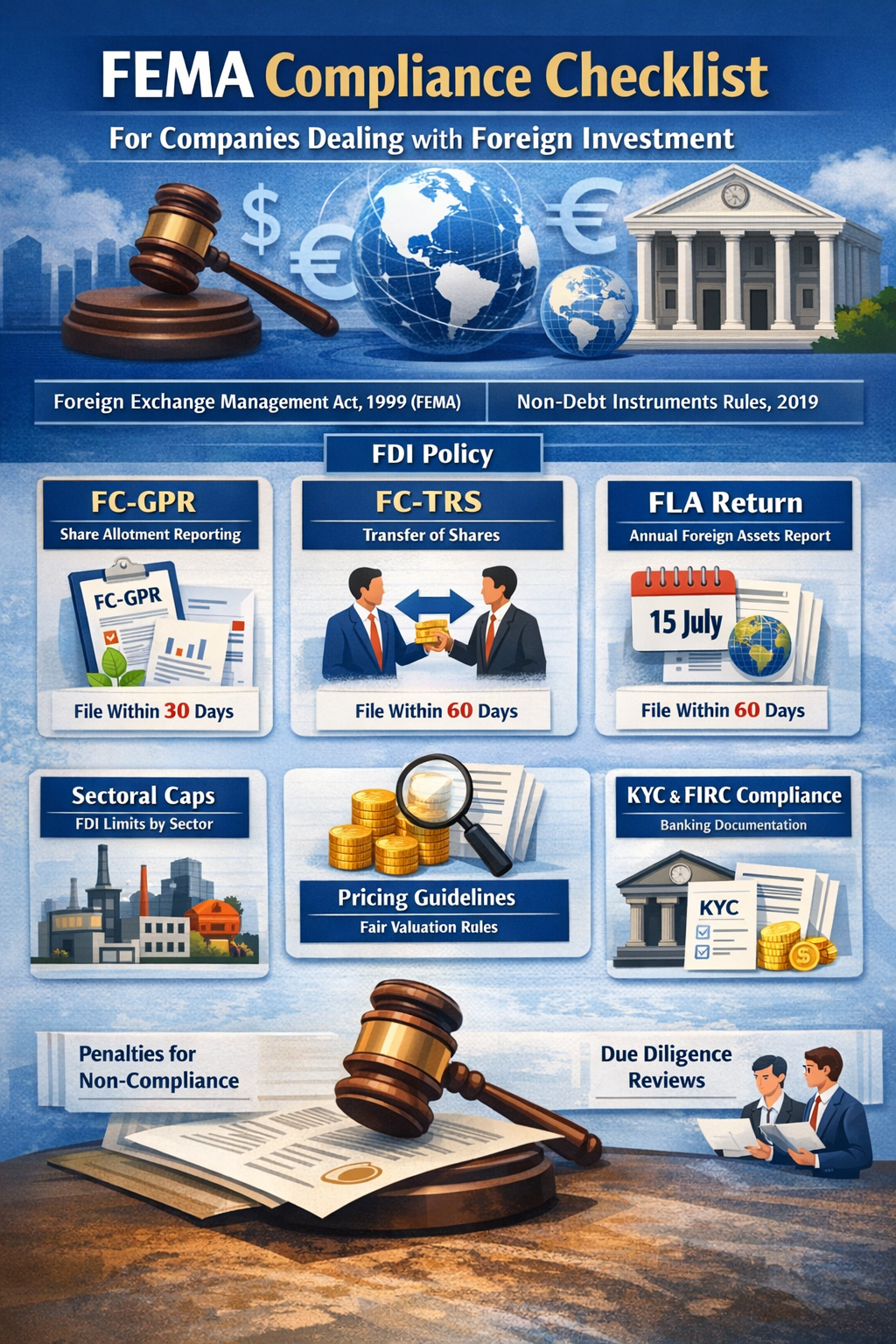
FEMA Compliance Checklist for Companies Dealing with Foreign Investment
A Legal and Regulatory Analysis
1. Introduction
Foreign investment plays a significant role in strengthening the capital base of Indian companies and facilitating technology transfer, market integration, and economic growth. To regulate cross-border capital flows and maintain stability in the foreign exchange market, India has established a comprehensive regulatory framework under the Foreign Exchange Management Act, 1999 (FEMA).
The legal regime governing foreign investment in equity instruments of Indian companies is primarily structured through the Foreign Exchange Management (Non-Debt Instruments) Rules, 2019, framed by the Central Government in exercise of powers conferred under Section 46 of FEMA. In addition, the Foreign Exchange Management (Mode of Payment and Reporting of Non-Debt Instruments) Regulations, 2019, issued by the Reserve Bank of India (RBI), prescribe the operational framework for reporting foreign investment transactions.
Further guidance on foreign investment limits and sectoral restrictions is provided in the Consolidated Foreign Direct Investment Policy, issued periodically by the Department for Promotion of Industry and Internal Trade (DPIIT).
Companies receiving foreign investment must therefore ensure compliance with multiple statutory obligations, including transaction-based reporting, annual disclosures, adherence to pricing guidelines, and compliance with sectoral caps. These obligations are closely scrutinized during regulatory inspections, investment due diligence, and corporate restructuring transactions.
2. Statutory Framework Governing Foreign Investment
The legal framework governing foreign investment in India may be broadly classified into the following components.
| Regulatory Instrument | Governing Authority | Key Purpose |
|---|---|---|
| Foreign Exchange Management Act, 1999 | Parliament of India | Parent legislation regulating foreign exchange |
| FEMA Non-Debt Instruments Rules, 2019 | Central Government | Governs foreign investment in equity instruments |
| FEMA Mode of Payment & Reporting Regulations, 2019 | Reserve Bank of India | Prescribes reporting mechanisms |
| Consolidated FDI Policy | DPIIT | Provides sectoral caps and investment routes |
Section 6(3)(b) of FEMA empowers the Central Government, in consultation with the RBI, to regulate transfer or issue of any security by a person resident outside India. Pursuant to this authority, the Non-Debt Instruments Rules, 2019 establish the framework for foreign investment in equity instruments of Indian companies.
3. Reporting Requirements for Foreign Investment Transactions
The FEMA regulatory framework mandates that foreign investment transactions be reported to the RBI through electronic filing systems. These reporting requirements ensure transparency in foreign capital flows and enable the RBI to maintain statistical records of foreign investment in India.
3.1 Reporting of Share Allotment to Non-Residents (Form FC-GPR)
Under Rule 9 of the Non-Debt Instruments Rules, 2019, an Indian company issuing equity instruments to a person resident outside India must report such issuance to the RBI.
The reporting is carried out through Form FC-GPR (Foreign Currency – Gross Provisional Return), which forms part of the Single Master Form (SMF) available on the RBI’s FIRMS portal.
The reporting timeline is prescribed under Regulation 4 of the Mode of Payment and Reporting Regulations, 2019, which requires the company to file the FC-GPR within thirty days from the date of allotment of equity instruments.
The filing typically includes the following documents:
| Supporting Document | Purpose |
|---|---|
| Board Resolution approving allotment | Evidence of corporate approval |
| Shareholders’ resolution (if applicable) | Compliance with Companies Act |
| Foreign Inward Remittance Certificate (FIRC) | Confirmation of foreign remittance |
| KYC report from Authorized Dealer Bank | Investor verification |
| Valuation certificate from CA or Merchant Banker | Compliance with pricing guidelines |
| Practicing professional certificate | Confirmation of FEMA compliance |
The failure to report the allotment within the prescribed timeline constitutes a contravention under FEMA and may require regularization through the compounding mechanism administered by the RBI.
3.2 Reporting of Transfer of Shares (Form FC-TRS)
While FC-GPR deals with fresh issuance of equity instruments, transfer of existing shares between residents and non-residents must be reported through Form FC-TRS (Foreign Currency – Transfer of Shares).
Regulation 5 of the Mode of Payment and Reporting Regulations, 2019 provides that transfers involving foreign investors must be reported within sixty days from the date of transfer or receipt of consideration.
FC-TRS reporting is applicable in the following circumstances.
| Nature of Transfer | Reporting Requirement |
|---|---|
| Resident to Non-Resident | FC-TRS mandatory |
| Non-Resident to Resident | FC-TRS mandatory |
| Certain Non-Resident to Non-Resident transfers | FC-TRS may apply |
The reporting responsibility typically lies with the resident party to the transaction.
Supporting documentation generally includes the share transfer agreement, consent letters, valuation certificate, KYC documentation, and proof of payment.
4. Annual Reporting of Foreign Liabilities and Assets (FLA Return)
In addition to transaction-specific filings, Indian companies with foreign investment are required to file an annual return known as the Foreign Liabilities and Assets (FLA) Return.
This requirement arises under the FEMA reporting regulations and is administered through the RBI’s FLAIR portal.
The return captures the company’s foreign investment position as of the end of the financial year and includes data relating to:
-
Foreign equity investments
-
Overseas direct investment made by the company
-
External commercial borrowings
-
Trade credits and financial liabilities
The FLA Return must be filed on or before 15 July each year. Importantly, companies that have received foreign investment in earlier years are required to file the return even if no fresh investment has been received during the reporting year.
5. Sectoral Cap Compliance under the FDI Policy
Foreign investment in Indian companies is subject to sectoral caps prescribed in the Consolidated FDI Policy issued by the DPIIT.
Sectoral caps determine the maximum percentage of foreign ownership permitted in specific industries and may vary depending on whether the investment is permitted under the automatic route or requires government approval.
Illustrative sectoral limits are presented below.
| Sector | Maximum Foreign Investment |
|---|---|
| Insurance | 74% |
| Private Sector Banking | 74% |
| Telecommunications | 100% |
| Defence Manufacturing | 74% under automatic route |
Companies must continuously monitor their shareholding structure to ensure compliance with these caps, particularly when undertaking secondary transfers of shares involving foreign investors.
6. Pricing Guidelines for Issue and Transfer of Equity Instruments
FEMA regulations prescribe pricing guidelines to ensure that cross-border share transactions occur at fair market value and do not facilitate capital manipulation.
Under Rule 21 of the Non-Debt Instruments Rules, 2019, the price of equity instruments issued to persons resident outside India must not be lower than the fair value determined by a SEBI-registered merchant banker or a Chartered Accountant using internationally accepted valuation methodologies.
Similarly, pricing guidelines for share transfers operate as follows.
| Transaction Type | Pricing Requirement |
|---|---|
| Resident to Non-Resident transfer | Price must not be lower than fair value |
| Non-Resident to Resident transfer | Price must not exceed fair value |
These valuation rules ensure that foreign investment transactions reflect genuine commercial value and prevent capital flight or round-tripping.
7. Banking Compliance and KYC Verification
Authorized Dealer (AD) Banks play a critical role in the FEMA compliance ecosystem. Before processing FEMA reporting forms, AD Banks verify the authenticity of foreign remittances and conduct KYC verification of foreign investors.
Companies must obtain the following documents from their AD Bank:
| Document | Purpose |
|---|---|
| Foreign Inward Remittance Certificate (FIRC) | Confirmation of foreign funds received |
| KYC Report of Investor | Verification of investor identity |
| Purpose Code for remittance | Classification of transaction |
Incomplete or inconsistent banking documentation frequently results in rejection of FEMA filings on the FIRMS portal.
8. Consequences of Non-Compliance under FEMA
Contraventions of FEMA provisions attract penalties under Section 13 of the Foreign Exchange Management Act, 1999.
The penalty may extend up to three times the amount involved in the contravention where such amount is quantifiable. Where the amount cannot be determined, the penalty may extend up to two lakh rupees.
In addition, if the contravention continues, a further penalty may be imposed for each day during which the violation persists.
In practice, many reporting delays are regularized through the compounding mechanism administered by the RBI, whereby the defaulting entity may apply for compounding of the contravention and pay the penalty determined by the RBI.
9. FEMA Compliance in Corporate Due Diligence
FEMA compliance forms an essential component of legal due diligence in corporate transactions such as mergers and acquisitions, private equity investments, and public offerings.
Investors typically examine historical FEMA filings to verify whether all foreign investment transactions have been properly reported and whether the company has complied with applicable sectoral caps and pricing guidelines.
Common irregularities identified during due diligence include delayed FC-GPR filings, absence of FC-TRS reporting for share transfers, incorrect valuation certificates, and non-filing of the FLA Return.
Such irregularities may delay transactions or require regulatory regularization before the investment can proceed.
10. Conclusion
Foreign investment significantly contributes to the development of Indian industry and integration with global capital markets. However, companies receiving foreign investment must comply with the detailed regulatory framework established under FEMA and the Non-Debt Instruments Rules, 2019.
Timely reporting of share allotments through FC-GPR, reporting of share transfers through FC-TRS, and annual disclosure through the FLA Return are essential elements of FEMA compliance. Additionally, companies must ensure adherence to sectoral caps, pricing guidelines, and banking documentation requirements.
From a governance perspective, maintaining a structured FEMA compliance framework not only reduces regulatory risk but also enhances investor confidence and facilitates smoother execution of future investment transactions.
Unlock the Potential of Legal Expertise with LegalMantra.net – Your Trusted Legal Consultancy Partner
Disclaimer
Every effort has been made to ensure accuracy in this material. However, inadvertent errors or omissions may occur. Any discrepancies brought to the author’s notice will be rectified in subsequent editions. The author shall not be liable for any direct, indirect, incidental, or consequential damages arising from the use of this material. This article is based on various sources including statutory enactments, judicial decisions, academic research papers, professional journals, and publicly available legal materials.
Mayank Garg