
Forget Password

View News
India–EU Free Trade Agreement: The ‘Mother of All Deals’ and a New Blueprint for Global Economic Cooperation
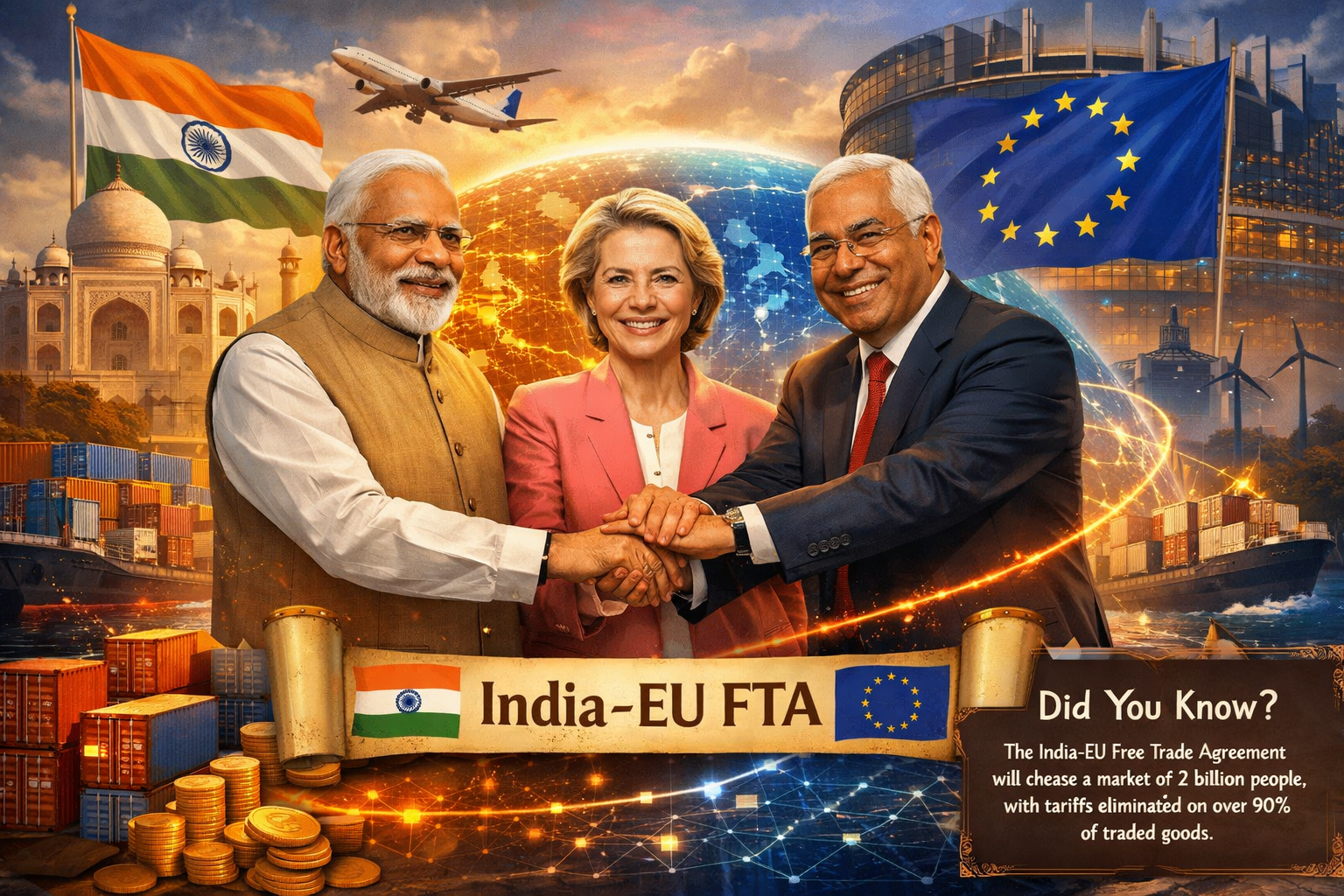
India–EU Free Trade Agreement: The ‘Mother of All Deals’ and a New Blueprint for Global Economic Cooperation
After nearly twenty years of intermittent, often stalled negotiations, India and the European Union have finally concluded what is already being described as the most ambitious trade agreement in India’s history. Announced at the 16th India–EU Summit held in New Delhi on 27 January 2026, the India–EU Free Trade Agreement (FTA) is not merely a commercial arrangement but a far-reaching economic, legal and strategic compact between two of the world’s largest democratic blocs.
At a time when global trade is marked by tariff wars, supply-chain disruptions and growing geopolitical uncertainty, the India–EU FTA stands out as a decisive statement in favour of open markets, rules-based commerce and long-term strategic trust.
Two Decades in the Making: From Deadlock to Delivery
The idea of a comprehensive trade agreement between India and the European Union was first formalised in 2007. What followed were years of negotiations punctuated by deadlocks over sensitive issues such as tariffs on automobiles and dairy products, market access for wines and spirits, intellectual property protection, labour standards and environmental commitments. For long periods, the talks remained frozen, reflecting the political and economic sensitivities on both sides.
The formal relaunch of negotiations in 2021 marked a turning point. The COVID-19 pandemic, disruptions in global supply chains and rising economic nationalism forced major economies to rethink their dependencies. Against this backdrop, India and the EU rediscovered strategic convergence, culminating in the announcement made jointly by Prime Minister Narendra Modi, European Commission President Ursula von der Leyen and European Council President António Costa.
Describing the agreement as a moment that would be “remembered forever in our shared history”, Prime Minister Modi emphasised that the deal would open new pathways for growth, investment and strategic cooperation. European Commission President von der Leyen captured the mood succinctly when she declared, “PM Modi, we did it. We delivered the mother of all deals.”
A Deal of Unprecedented Scale
What makes the India–EU FTA exceptional is its sheer economic and demographic scale. Together, India and the European Union represent nearly two billion people and a massive share of global economic activity. Trade between the two sides already stood at USD 136.5 billion in the financial year ending March 2025, and the agreement is expected to significantly accelerate this trajectory.
Under the FTA, tariffs will be gradually eliminated or substantially reduced on approximately ninety-six per cent of trade between the two partners. European officials have described this as the most ambitious market access India has ever granted to any trading partner. Projections suggest that EU exports to India could double by 2032, while Indian exporters gain preferential access to one of the world’s most lucrative consumer markets.
EU Trade Commissioner Maroš Šef?ovi? aptly described the agreement as the “biggest FTA ever delivered”, highlighting that high tariffs have been brought down and opportunities unlocked through a genuinely cooperative negotiation process.
India’s Opportunity: Exports, Employment and Industrial Growth
For India, the agreement arrives at a critical moment in its economic journey. As the country seeks to position itself as a global manufacturing and services hub, preferential access to the EU market offers a significant competitive advantage. Labour-intensive sectors such as textiles, garments, leather goods, footwear, gems and jewellery, toys, sports goods and marine products are expected to be among the primary beneficiaries.
Beyond goods, the agreement strengthens cooperation in services, including information technology and professional services, where India enjoys strong comparative advantages. Commerce and Industry Minister Piyush Goyal has emphasised that the FTA will provide a major boost to labour-intensive sectors, translating into employment generation and export-led growth.
Equally important is the signal the agreement sends to global investors. By locking in predictable and transparent trade rules with its largest trading partner, India reinforces its image as a stable and reliable destination for long-term investment. The FTA also complements India’s existing trade arrangements with the United Kingdom, the European Free Trade Association, New Zealand and Oman, creating a multi-layered trade architecture.
Europe’s Gains: Access with Balance and Safeguards
From the European Union’s perspective, the agreement opens the doors to the world’s most populous market on terms that were previously unattainable. Tariff reductions will significantly lower the cost of exporting European automobiles, wines, spirits, processed foods, olive oil and industrial goods to India. In some categories, duties that once reached as high as one hundred and fifty per cent will now be brought down in a phased and calibrated manner.
At the same time, the structure of the agreement reflects India’s insistence on safeguarding sensitive domestic sectors. Products such as dairy and certain agricultural commodities remain protected, while market opening for automobiles and alcoholic beverages is linked to price thresholds and quantitative limits. This calibrated approach ensures that liberalisation does not come at the cost of domestic economic stability.
European industry leaders have already welcomed the deal. Airbus, which has maintained a presence in India for over six decades, has reiterated that “Make in India” lies at the core of its global strategy, particularly in civil aviation, defence and space.
Beyond Trade: Security, Strategy and Trust
One of the most striking aspects of the India–EU FTA is that it is embedded within a much broader strategic framework. Alongside the trade agreement, India and the European Union have launched their first-ever Security and Defence Strategic Partnership. This framework covers cooperation in maritime security, cybersecurity, counter-terrorism and defence industrial collaboration.
European leaders have underlined that economic prosperity cannot exist without security. By integrating trade with defence and strategic cooperation, the India–EU partnership positions itself as a geopolitical stabiliser in an increasingly fragmented global order, particularly across the Indo-Pacific and European regions.
Technology, Sustainability and the Law of the Future
The agreement also reflects the changing nature of international trade law. Several parallel instruments were announced at the summit, including the constitution of a Green Hydrogen Task Force to align standards and certification, a memorandum of understanding between the Reserve Bank of India and the European Securities and Markets Authority to strengthen financial regulatory cooperation, and an administrative arrangement on electronic seals and digital signatures to facilitate secure digital trade.
In addition, the European Union has indicated financial support of approximately five hundred million euros over the next two years to assist India in its green transition and industrial decarbonisation. These commitments underline that the FTA is as much about the future of sustainable and digital trade as it is about conventional tariff reduction.
Do You Know?
Few trade negotiations in the modern era have lasted as long as the India–EU FTA talks, stretching across nearly two decades and multiple global economic cycles. The agreement also places India within overlapping European trade frameworks, alongside its arrangements with the United Kingdom and EFTA countries. Notably, the deal will undergo legal vetting for several months before formal signing, with implementation expected within a year, making it a carefully structured and legally intensive process rather than a symbolic announcement.
Legal and Compliance Implications
From a legal and regulatory standpoint, the India–EU FTA will have far-reaching consequences. Businesses will need to adapt to new rules of origin, revised customs procedures, enhanced ESG compliance expectations and evolving digital trade standards. Regulators on both sides will engage in deeper cooperation to ensure alignment with World Trade Organization norms, competition law principles and sustainable development commitments.
For legal professionals, compliance officers and policymakers, the agreement represents a new chapter in trade law, blending classical tariff liberalisation with modern concerns such as data governance, environmental responsibility and supply-chain resilience.
Conclusion: More Than a Trade Agreement
As Prime Minister Modi observed, this is not merely a trade agreement but a blueprint for shared prosperity. In an era defined by fractured alliances and economic uncertainty, the India–EU Free Trade Agreement demonstrates that large democracies can still choose cooperation over confrontation.
For India, it is a gateway to deeper integration with global value chains. For Europe, it is a strategic partnership with one of the fastest-growing major economies. For the world, it is a powerful reminder that multilateralism, when backed by political will and legal rigour, remains very much alive.
"Unlock the Potential of Legal Expertise with LegalMantra.net - Your Trusted Legal Consultancy Partner”
Disclaimer: Every effort has been made to avoid errors or omissions in this material in spite of this, errors may creep in. Any mistake, error or discrepancy noted may be brought to our notice which shall be taken care of in the next edition In no event the author shall be liable for any direct indirect, special or incidental damage resulting from or arising out of or in connection with the use of this information Many sources have been considered including Newspapers, Journals, Bare Acts, Case Materials , Charted Secretary, Research Papers etc
Mayank Garg
LegalMantra.net team