
Forget Password

View News
Managing the Digital Horizon The Modernization of Maritime Law and the Bills of Lading 2025
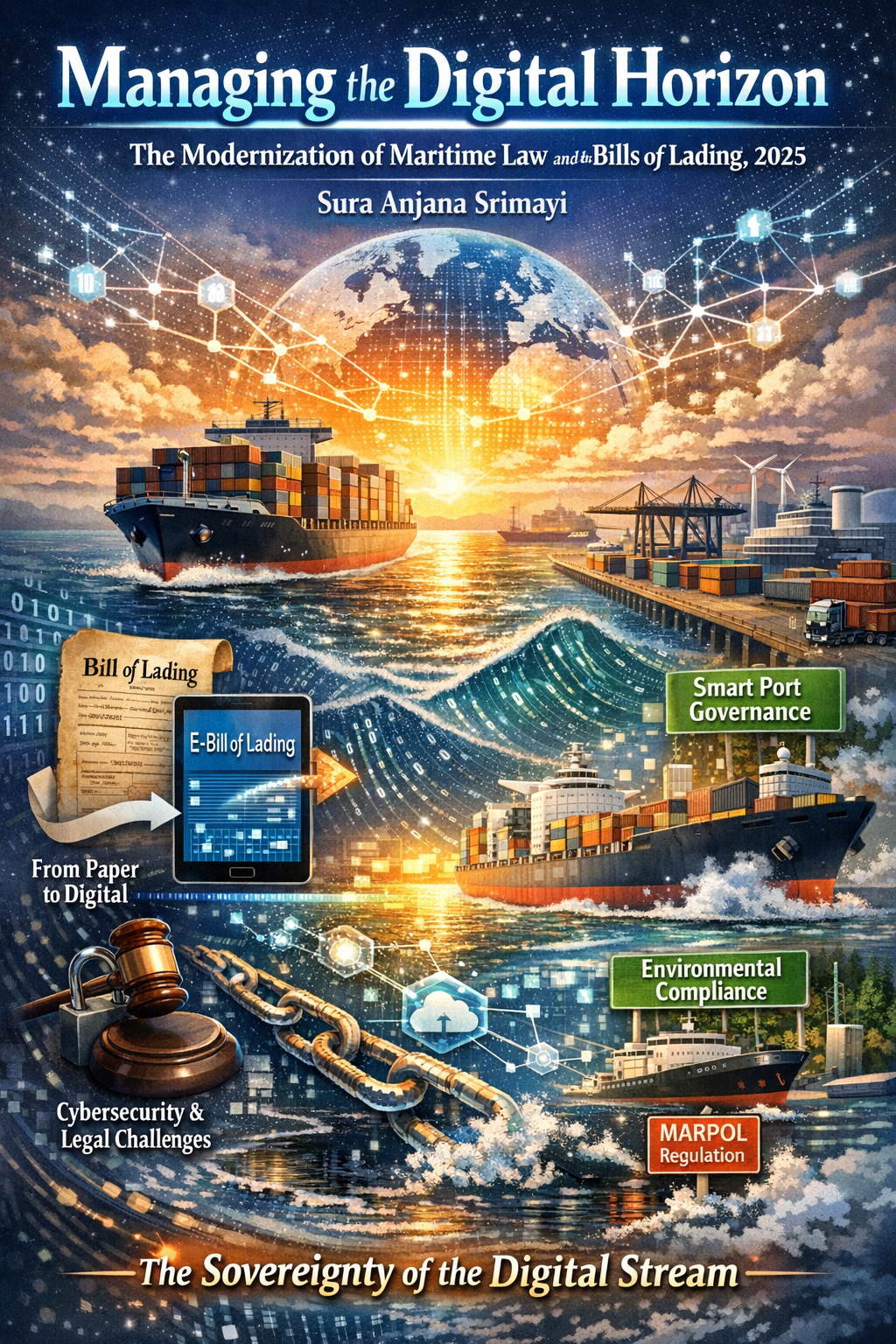
Managing the Digital Horizon: The Modernization of Maritime Law and the Bills of Lading, 2025.
~Sura Anjana Srimayi
INTRODUCTION
World shipping has been characterized by the paper chokehold almost over two centuries. Maritime trade that has contributed more than 90 percent of international trade has been using physical documents to transport billions of money in cargo since the 19th century. The Indian Bills of Lading Act of 1856 that was an old colonial law in India governed this and failed to consider the internet, not to mention blockchain and real-time data exchange.
But it was the year 2025 that was the watershed of legislation. The legal structure of the high seas has been restructured to keep up with the digital era with the enactment of the Bills of Lading Act, 2025 and the complementing Indian Ports Act, 2025. This is not simply a technological upgrade of the modernization, it is a paradigm shift in the lex maritima (maritime law). It transforms the industry on a physical possession system to a digital control system and introduces the principle of functional equivalence and redefines port governance to allow India and the trade routes through it to operate like light instead of operating like a courier.
1. Legal Evolution of the Bill of Lading
The most important international trade document is a Bill of Lading that fulfills three specific legal roles: it acts as a receipt of the goods, it serves as an evidence of the carriage contract, and it is a document of title (it can be transferred in ownership when goods are at sea).
The evolution of Paper to "Electronic Transferable Records.
The dilemma of the original document is solved by the Bills of Lading Act, 2025. Historically, title was transferred by means of a physical original. The new law is in accord with the UNCITRAL Model Law on Electronic Transferable Records (MLETR), that brings two critical concepts of law into the fore:
Functional Equivalence: A digital document is legally the same thing as a paper document, provided that it has the same information and that it is ensuring integrity reliably.
The Control Standard: You cannot have a physical sense of possession of a digital file, so the law is now trying to concentrate on Control. The holder of the document of title is legally regarded as the person who has the exclusive control over the electronic Bill of Lading (e-BL).
Fraud and Litigation Reduction.
Paper BoLs have a notorious tendency to be forged and subjected to scams in the form of letter of indemnity (LOI). The 2025 Act has minimized litigation risks by requiring the use of secure and encrypted digital signatures and audit trails. The legal rights and responsibilities of both the carriers and shippers during the transfer of these digital documents have now been made clear in the law and now, the chain of title is mathematically verifiable instead of being merely found by eye.
2. Port Governance Digitization
The goods are governed by the Bill of Lading, whereas the gateways are governed by the Indian Ports Act, 2025 (which replaces the 1908 Act). The current maritime law has begun to conceive a port not as a wharf on the ground, but as a digital environment.
MSDW and SMBs Statutory Framework.
The new law statutorily empowers the Maritime State Development Council (MSDC) and State Maritime Boards (SMBs). In law, this has the effect of providing a coherent national planning system but with states having more discretion to control the non-major ports.
Transparency in Tariffs: Tariff structures of ports are legally obligated to be initiated digitally. Otherwise, the mandated "Conservator" will be able to preside over penalties, so that the "hidden costs" do not impede trade.
The Maritime Single Window: In accordance with IMO, the act imposes a Single Window system. By law, an owner of a ship is obliged to provide data to a single digital portal, which will transfer it to the customs, health, and port authorities.
3. Environmental Jurisprudence and Compliance.
Environmental law now can no longer be separated or disconnected to the modern maritime law. The 2025 law incorporates the international standards such as the MARPOL (Pollution Prevention) and Ballast Water Management Convention into the domestic port regulation.
Mandatory Audits: Ports are now required to have plans of Pollution Control and Disaster Management. The Central Government has the power by the law to inspect these plans on a periodical basis.
The Mandatory of the "Green Port: A vessel is now required, legally, to declare its Advance Waste Declarations. When a ship contravenes the environmental regulations on the port limits, the "Conservator" can detain the vessel, which is a strong in rem legal measure that ensures the ship complies.
4. Challenges: The Legal "Patchwork" and Cybersecurity
Despite the progress, the modernization of maritime law faces a significant "Interoperability" challenge.
Jurisdictional Gaps: While India recognizes e-BLs under the 2025 Act, a trading partner in a country that has not adopted MLETR might still demand paper. This creates a "legal hybrid" where a digital document must be "converted" back to paper mid-voyage, raising complex questions about the continuity of title.
The "Ghost in the Machine": As documentation moves to the cloud, Cybersecurity becomes a core legal liability. If a Port Community System (PCS) is hacked and cargo is rerouted, who is liable? The 2025 Act begins to address this by requiring "Permissioned Access," but "Data Privacy" in maritime law remains a burgeoning field of litigation.
CONCLUSION
The Bills of Lading, 2025 and the Indian Ports Act, 2025 represent more than just a repeal of colonial statutes; they represent the "Sovereignty of the Digital Stream."
The legal aspects of this modernization—functional equivalence, statutory port governance, and mandatory environmental audits—ensure that the maritime sector is no longer an outlier in the digital economy. As the industry moves toward its goal of 100% e-BL adoption by 2030, the law will remain the anchor, providing the necessary stability, transparency, and justice required to navigate the complexities of global trade. The transition from "ink and parchment" to "code and cloud" is now a legal reality, ensuring that the ancient traditions of the sea can thrive in the silicon age.
Unlock the Potential of Legal Expertise with LegalMantra.net – Your Trusted Legal Consultancy Partner
Disclaimer
Every effort has been made to ensure accuracy in this material. However, inadvertent errors or omissions may occur. Any discrepancies brought to the author’s notice will be rectified in subsequent editions. The author shall not be liable for any direct, indirect, incidental, or consequential damages arising from the use of this material. This article is based on various sources including statutory enactments, judicial decisions, academic research papers, professional journals, and publicly available legal materials.
LegalMantra.net Team