
Forget Password

View News
Natural Justice and Administrative Accountability: A Judicial Perspective
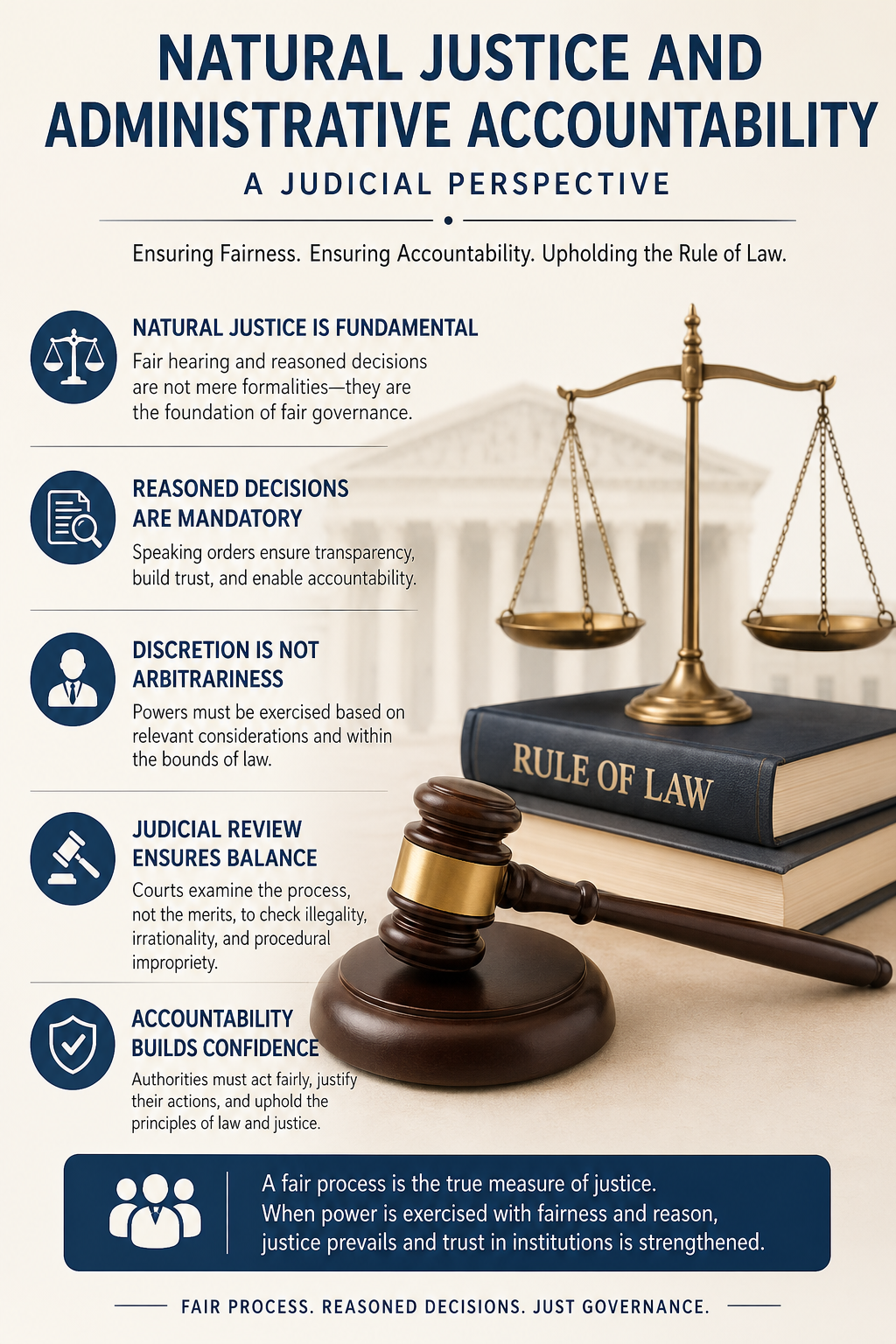
Natural Justice and Administrative Accountability: A Judicial Perspective
Prof. Rasal Singh v. University of Delhi & Ors.
Court: High Court of Delhi
Bench: Hon’ble Mr. Justice Purushaindra Kumar Kaurav
Date of Judgment: 24 April 2026
1. Executive Summary
This paper critically examines the judicial reasoning adopted in the present judgment, with a focus on administrative law principles, statutory interpretation, and procedural safeguards. The ruling reinforces the idea that legal compliance cannot be reduced to mere technical adherence; rather, it must reflect substantive fairness and accountability. The court has emphasized that administrative authorities must operate within defined legal boundaries while ensuring procedural integrity.
At its core, the judgment reiterates that “..power without fairness becomes arbitrariness..”, and that even in the absence of explicit statutory mandates, principles of natural justice must be inherently respected. The decision has far-reaching implications for corporates, compliance officers, and regulatory bodies.
2. Background and Context of the Case
The dispute in the present case emerged from an action undertaken by a statutory or administrative authority, which was subsequently challenged on legal and procedural grounds. The aggrieved party raised concerns regarding jurisdictional overreach, improper exercise of discretion, and failure to adhere to principles of natural justice.
The matter required the court to evaluate not only the legality of the action but also the process through which such action was undertaken. The case thus lies at the intersection of substantive legality and procedural propriety, highlighting that both elements must coexist for a legally sustainable decision.
3. Core Legal Issues Involved
The judgment revolves around multiple intertwined legal questions. The first issue concerns whether the authority acted within the scope of powers granted under the governing statute. The court examined whether such powers were exercised legitimately or exceeded statutory limits, observing that “..jurisdiction cannot be assumed beyond what the law permits..”.
Another crucial issue pertains to the adherence to principles of natural justice. The court evaluated whether the affected party was provided a fair opportunity to present its case and whether the decision-making process was transparent and reasoned. It was highlighted that “..denial of hearing strikes at the root of fairness..”.
Further, the case involved interpretation of statutory provisions, where the court had to choose between a strict literal approach and a purposive interpretation. The ruling ultimately favored an interpretation that aligns with legislative intent rather than rigid textualism.
4. Judicial Reasoning and Interpretation
The court adopted a balanced and progressive approach while delivering the judgment. It emphasized that legal provisions must be interpreted in a manner that advances justice rather than defeats it. The reasoning reflects a clear departure from mechanical interpretation and instead embraces a purposive framework.
In dealing with administrative discretion, the court observed that discretionary powers are not unfettered. Authorities must act based on relevant considerations and avoid arbitrary decision-making. The judgment makes it clear that “..discretion must be guided, not absolute..”, thereby placing necessary checks on executive authority.
Additionally, the court reiterated the importance of reasoned orders. A decision lacking proper reasoning is not only procedurally flawed but also undermines transparency. The absence of justification makes it difficult for affected parties to understand or challenge the decision, thereby violating basic principles of fairness.
5. Doctrine of Natural Justice: Reaffirmed
One of the most significant aspects of the judgment is its strong reliance on the doctrine of natural justice. The court reaffirmed that natural justice is not a mere procedural formality but an essential component of fair governance.
The principle of audi alteram partem—the right to be heard—was given paramount importance. The judgment clarifies that even where statutes are silent, fairness must be read into administrative procedures. It was observed that “..natural justice is the soul of administrative law..”, and its absence renders decisions vulnerable to judicial scrutiny.
6. Limits on Administrative and Regulatory Powers
The judgment draws a clear line between lawful discretion and arbitrary action. Administrative authorities are expected to exercise their powers within the framework of law and in a manner that is reasonable and justifiable.
The court noted that decisions must not be influenced by irrelevant factors and must always be supported by logical reasoning. Any deviation from this standard may render the action invalid. It was emphasized that “..authority must justify its action, not merely assert it..”, reinforcing accountability in governance.
7. Scope and Boundaries of Judicial Review
The ruling also elaborates on the scope of judicial review in administrative matters. While courts generally refrain from interfering with policy decisions, they retain the authority to examine the decision-making process.
Judicial intervention is warranted in cases where there is illegality, irrationality, or procedural impropriety. The court clarified that its role is not to substitute its own decision but to ensure that the process leading to the decision is lawful and fair. This distinction strengthens the doctrine of separation of powers while ensuring checks and balances.
8. Practical Implications for Stakeholders
From a practical standpoint, this judgment holds significant value for various stakeholders. For corporates, it highlights the importance of maintaining proper documentation and ensuring that all interactions with regulatory authorities are procedurally compliant.
For Company Secretaries and compliance professionals, the ruling underscores the need to go beyond checklist-based compliance and focus on substantive legal correctness. It becomes essential to ensure that all filings, representations, and responses are backed by proper reasoning and evidence. The judgment serves as a reminder that “..compliance is not just about doing, but about doing it correctly..”.
Legal professionals can rely on this judgment to challenge arbitrary actions and strengthen arguments related to natural justice and misuse of discretion. Regulatory authorities, on the other hand, must adopt transparent processes and issue well-reasoned orders to avoid judicial interference.
9. Critical Evaluation of the Judgment
The judgment stands out for its clarity, balanced reasoning, and strong emphasis on fairness. It successfully reinforces foundational principles of administrative law while adapting them to contemporary governance challenges.
However, it may also lead to increased procedural obligations on authorities, potentially slowing down decision-making in urgent cases. Despite this, such procedural rigor is necessary to uphold the rule of law and prevent misuse of power.
10. Conclusion
In conclusion, the judgment serves as a powerful reminder that the exercise of power must always be accompanied by responsibility and fairness. It strengthens the legal framework governing administrative actions and ensures that individuals and entities are protected against arbitrary decisions.
The ruling ultimately conveys that “..justice is not merely about outcomes, but about the process through which outcomes are achieved..”. This principle lies at the heart of a fair and transparent legal system.
Unlock the Potential of Legal Expertise with LegalMantra.net – Your Trusted Legal Consultancy Partner
Disclaimer
Every effort has been made to ensure accuracy in this material. However, inadvertent errors or omissions may occur. Any discrepancies brought to the author’s notice will be rectified in subsequent editions. The author shall not be liable for any direct, indirect, incidental, or consequential damages arising from the use of this material. This article is based on various sources including statutory enactments, judicial decisions, academic research papers, professional journals, and publicly available legal materials.
Anshul Goel
LegalMantra.net Team