
Forget Password

View News
No Provision for Deducting GST, Incentive Advance or Festival Advance from Employee's Retiral Dues: Allahabad High Court
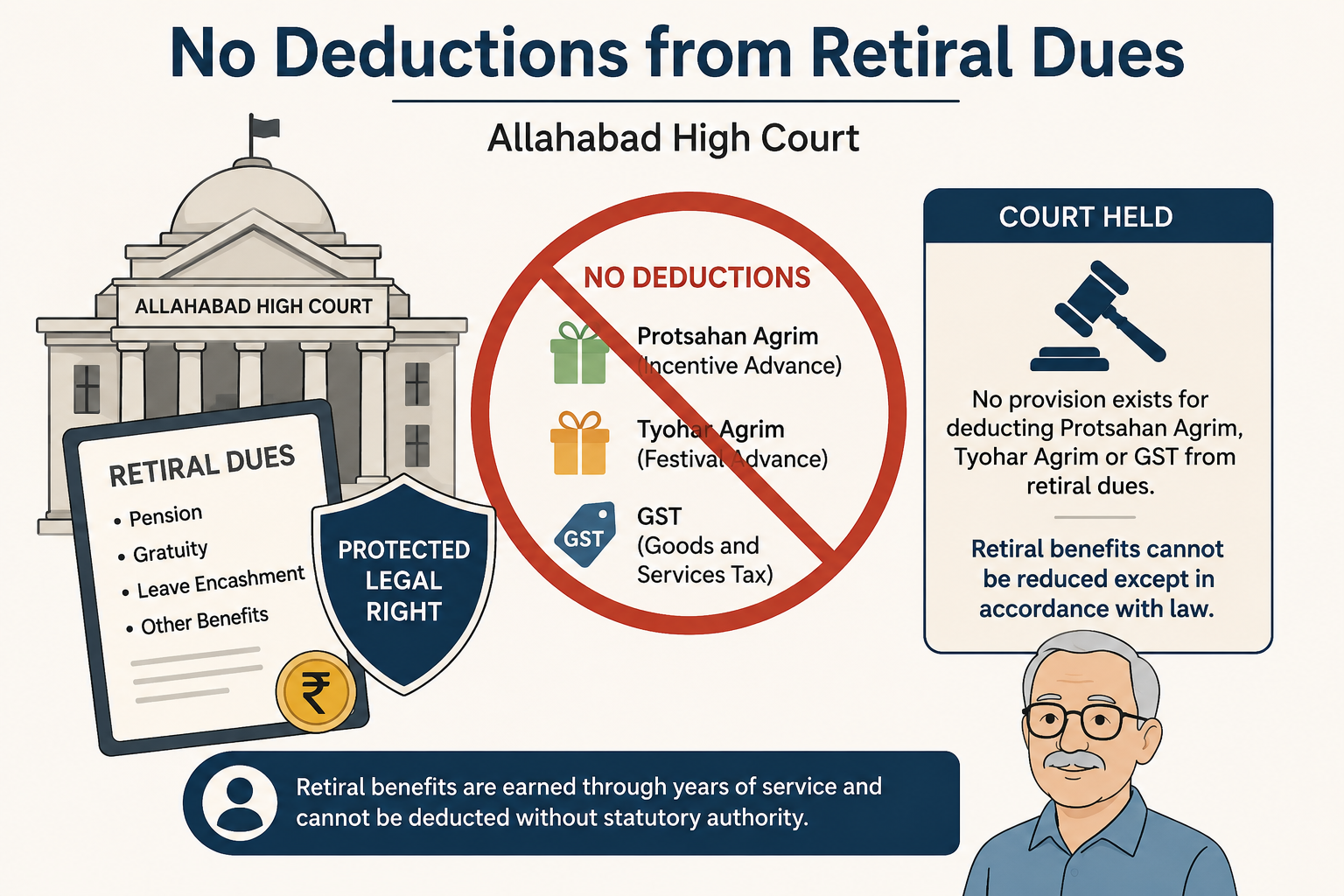
No Provision for Deducting GST, Incentive Advance or Festival Advance from Employee's Retiral Dues: Allahabad High Court
|
Particulars |
Detailed Analysis |
|
Court |
Allahabad High Court |
|
Bench |
Justice Rohit Ranjan Agarwal |
|
Subject Matter |
Legality of deduction of GST, Protsahan Agrim (Incentive Advance), and Tyohar Agrim (Festival Advance) from the retiral dues of an employee of the U.P. State Employees Welfare Corporation. |
|
Background of the Case |
The petitioner, a retired employee of the U.P. State Employees Welfare Corporation, challenged the deductions made from his retiral dues by the Corporation. At the time of settling his retirement benefits, the employer deducted amounts towards Protsahan Agrim (Incentive Advance), Tyohar Agrim (Festival Advance), and GST. The petitioner contended that these deductions were arbitrary, illegal, and unsupported by any statutory provision, service rule, or contractual condition, thereby unlawfully reducing the retirement benefits legally payable to him. |
|
Issues Before the Court |
The principal issue before the Court was whether the employer could legally deduct Incentive Advance, Festival Advance, and GST from the retiral dues of an employee in the absence of any statutory provision or service rule authorising such deductions. The Court also examined whether retirement benefits, being statutory entitlements, could be subjected to unilateral recoveries merely on the basis of administrative practice. |
|
Petitioner's Contentions |
The petitioner argued that retiral dues constitute vested legal rights accrued after years of service and cannot be diminished except in accordance with law. It was submitted that neither the applicable service rules nor any statutory provision empowered the Corporation to recover Incentive Advance, Festival Advance, or GST from retirement benefits. Consequently, the deductions violated the principles of legality and fairness in administrative action. |
|
Respondent's Stand |
The Corporation justified the deductions by asserting that the recovered amounts represented outstanding liabilities payable by the employee. However, it failed to point out any specific statutory provision, regulation, or binding service rule authorising recovery of such amounts by deducting them from retiral dues. |
|
Court's Observations |
Justice Rohit Ranjan Agarwal expressed serious concern over the deductions made by the Corporation and observed that there exists no statutory provision permitting deduction of Protsahan Agrim, Tyohar Agrim, or GST from the retiral dues of an employee of the U.P. State Employees Welfare Corporation. The Court remarked that it was surprising that such recoveries had been made despite the complete absence of legal authority. The Court reiterated that every action of a public authority must have the sanction of law and that administrative convenience or departmental practice cannot replace statutory authority. |
|
Legal Reasoning |
The Court held that retiral benefits such as pension, gratuity, leave encashment, and other terminal benefits are valuable statutory rights earned by an employee through long years of service. Such benefits cannot be withheld, reduced, or subjected to deductions unless expressly authorised by law. The employer cannot invent a mechanism for recovery merely because it considers certain amounts recoverable. In the absence of an enabling provision, any deduction from retiral benefits is arbitrary and unsustainable. |
|
Ratio Decidendi |
The Court laid down that an employer cannot deduct any amount from the retiral dues of an employee unless such deduction is expressly authorised under a statutory provision, applicable service rules, contractual stipulation, or any other legally enforceable provision. Consequently, deductions towards GST, Protsahan Agrim (Incentive Advance), and Tyohar Agrim (Festival Advance), in the absence of any enabling provision, are illegal and liable to be set aside. |
|
Decision of the Court |
The Allahabad High Court held that the deductions made by the U.P. State Employees Welfare Corporation towards Incentive Advance, Festival Advance, and GST from the retiral dues of the petitioner were without authority of law and therefore unsustainable. The Court granted relief to the employee and reaffirmed that retiral benefits cannot be subjected to arbitrary deductions in the absence of a statutory mandate. |
|
Legal Significance |
The judgment reinforces the settled principle that retiral benefits are protected statutory rights and cannot be diminished except in accordance with law. It serves as an important precedent for government departments, public sector undertakings, statutory corporations, and other public employers by emphasising that recoveries from retirement benefits must be founded upon clear statutory authority. The decision also strengthens the constitutional requirement that every administrative action affecting the rights of an employee must have legal sanction and cannot be based solely on executive practice or administrative discretion. |
Disclaimer
Every effort has been made to ensure accuracy in this material. However, inadvertent errors or omissions may occur. Any discrepancies brought to the author’s notice will be rectified in subsequent editions. The author shall not be liable for any direct, indirect, incidental, or consequential damages arising from the use of this material. This article is based on various sources including statutory enactments, judicial decisions, academic research papers, professional journals, and publicly available legal materials.
Anshul Goel