
Forget Password

View News
RIGHTS ISSUE COMPLIANCE SERIES
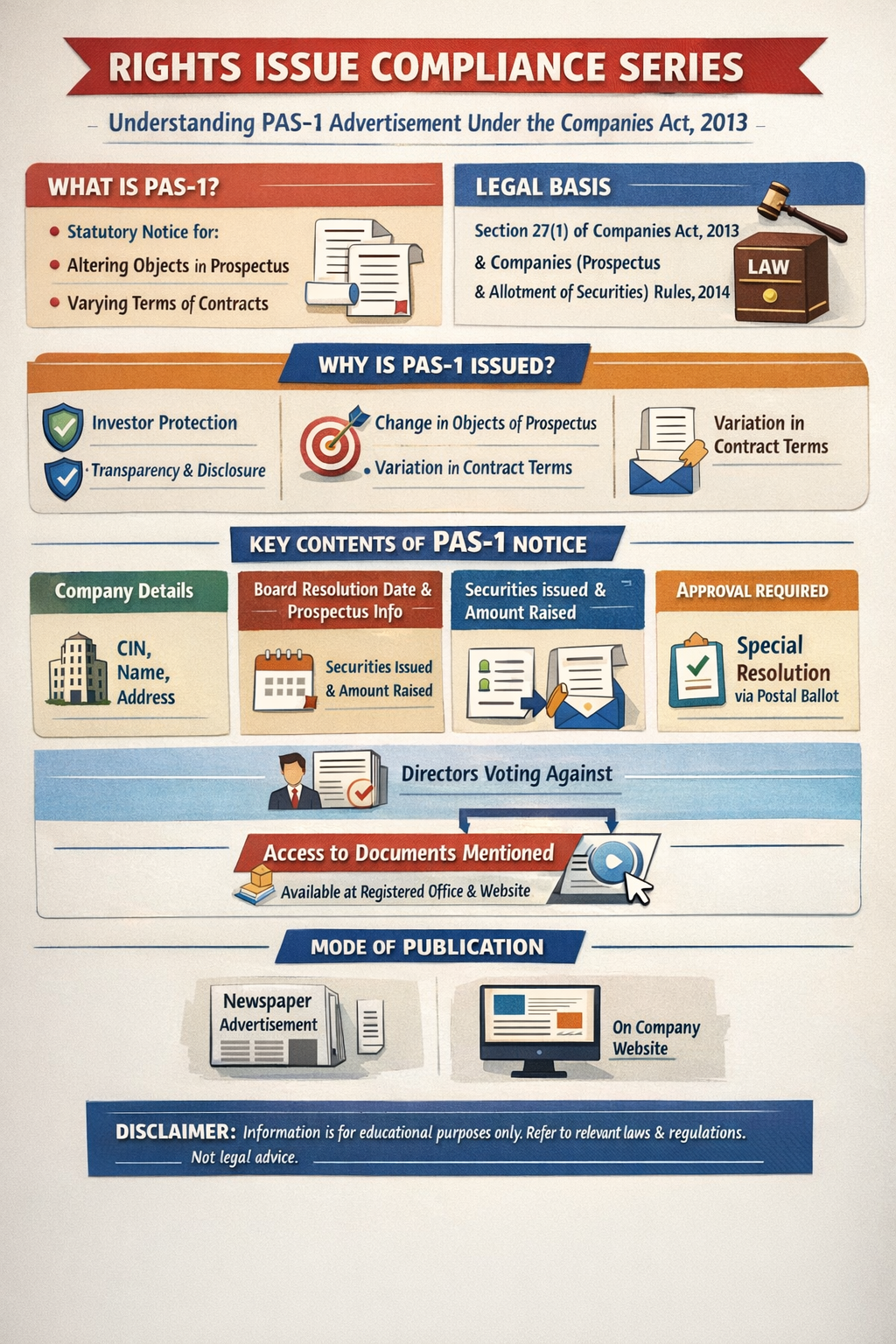
RIGHTS ISSUE COMPLIANCE SERIES
Understanding PAS-1 Advertisement under the Companies Act, 2013
In the corporate fundraising process, transparency and investor protection are key regulatory objectives. One such important but relatively less commonly used compliance requirement is the publication of Form PAS-1, which serves as a statutory public notice when a company intends to alter certain commitments made in its prospectus.
This article explains the concept, purpose, applicability, and contents of PAS-1 in a structured and comprehensive manner under the Companies Act, 2013.
1. Meaning and Legal Basis of PAS-1
1.1 Statutory Background
Form PAS-1 is a statutory advertisement issued by a company in accordance with Section 27(1) of the Companies Act, 2013, read with Rule 7 of the Companies (Prospectus and Allotment of Securities) Rules, 2014.
Section 27 regulates situations where a company proposes to modify commitments that were originally disclosed to investors through its prospectus. Since investors subscribe to securities based on representations made in the prospectus, any alteration in those commitments must follow a transparent and regulated procedure.
1.2 Situations in Which PAS-1 Is Required
A company is required to publish Form PAS-1 when it proposes to:
(a) Vary the terms of any contract referred to in the prospectus, or
(b) Alter the objects for which the prospectus was issued, particularly where funds were raised from the public.
These changes cannot be implemented unilaterally by the company. Instead, the law mandates public disclosure and shareholder approval before the variation becomes effective.
1.3 Nature of PAS-1
PAS-1 is essentially a public advertisement or notice that communicates the proposed changes to shareholders and the public at large. It ensures that investors who relied on the original prospectus are adequately informed and have the opportunity to participate in the decision-making process.
2. Purpose and Regulatory Objective of PAS-1
The requirement to issue PAS-1 serves several regulatory and governance objectives.
2.1 Investor Protection
Investors make their investment decisions based on the information disclosed in the prospectus, including the objects of the issue and contractual arrangements mentioned therein. Any subsequent modification may materially affect their investment expectations. PAS-1 ensures that investors are informed before such changes are implemented.
2.2 Transparency and Public Disclosure
Corporate governance principles require companies to maintain full transparency in financial and strategic decisions. By mandating a public advertisement, the law ensures that proposed variations are disclosed openly and not implemented without adequate notice.
2.3 Shareholder Participation and Approval
Section 27 requires that such variations must be approved through a special resolution of shareholders, generally conducted through a postal ballot. The PAS-1 advertisement informs shareholders about the proposed resolution and allows them to review the supporting explanatory statement before casting their votes.
3. Circumstances Triggering the Requirement of PAS-1
A company must publish the PAS-1 advertisement in the following circumstances:
3.1 Alteration of Objects of the Prospectus
If a company proposes to change the objects for which funds were raised through the prospectus, PAS-1 must be issued to notify shareholders of the proposed alteration.
For example, if funds were originally raised for expansion of manufacturing capacity but the company now intends to utilize those funds for acquisition of another business, such a change would require compliance under Section 27 and publication of PAS-1.
3.2 Variation of Terms of Contracts Referred in the Prospectus
If the prospectus disclosed certain material contracts or arrangements, and the company intends to modify or vary those contractual terms, PAS-1 must be published to disclose the proposed variation.
This ensures that investors are informed of changes affecting agreements that may influence the company’s financial position or operations.
4. Contents of PAS-1 Advertisement
The PAS-1 advertisement must contain detailed disclosures to ensure that investors receive sufficient information about the proposed changes.
4.1 Basic Company Information
The advertisement must first include essential identification details of the company, such as:
-
Corporate Identification Number (CIN)
-
Name of the Company
-
Registered Office Address
These details ensure clarity and allow investors to easily identify the company issuing the notice.
4.2 Public Notice of Proposed Variation or Alteration
The advertisement must clearly disclose the company’s intention to alter the terms or objects mentioned in the prospectus. This includes:
-
Date of the Board Meeting in which the proposal for variation or alteration was approved
-
Date of the Prospectus to which the proposed change relates
-
Description and number of securities issued under that prospectus
-
Issue price of the securities
-
Total amount raised through the issue
Additionally, the notice must mention that the proposal will be placed before shareholders for approval through a special resolution, typically conducted via postal ballot.
4.3 Detailed Disclosure of the Proposed Change
To enable shareholders to make an informed decision, the advertisement must contain comprehensive information about the proposed variation or alteration, including:
(a) Existing Terms or Objects
A clear description of the original terms of the contract or the original objects stated in the prospectus.
(b) Proposed Variation or Alteration
Detailed explanation of the changes proposed by the company, including how they differ from the original commitments.
(c) Reasons and Justification
The company must provide specific reasons for proposing the change, including business or strategic considerations that necessitate the variation.
(d) Financial Impact
A statement explaining the impact of the proposed change on the financial position of the company, including any expected benefits or risks.
(e) Risk Factors
Where the proposed alteration involves new business activities or projects, the advertisement must disclose major risk factors associated with the new objects.
(f) Directors’ Voting Details
The advertisement must also disclose the names of directors who voted against the proposal, if any, during the Board meeting where the proposal was approved.
5. Access to Supporting Documents
To ensure transparency and informed decision-making, the PAS-1 advertisement must also provide details regarding access to relevant documents.
The notice must specify:
-
That the special resolution and explanatory statement relating to the proposed variation are available free of cost.
-
The registered office of the company or the office of the Company Secretary where copies of these documents may be obtained.
-
The official website of the company, where the relevant documents are available for inspection or download.
This ensures that shareholders have adequate opportunity to review the proposal before voting.
6. Authentication of the Advertisement
The PAS-1 advertisement must be formally authenticated. The following details must be included:
-
Signature of the authorized signatory
-
Date of publication
-
Place of issue
This authentication confirms that the advertisement has been issued with proper authority of the company.
7. Mode of Publication
The PAS-1 advertisement must be published in accordance with the prescribed disclosure requirements. Typically, the notice is published through the following channels:
7.1 Newspaper Publication
The advertisement is generally required to be published in newspapers having wide circulation, as prescribed under the applicable rules.
7.2 Company Website
The notice must also be made available on the official website of the company, ensuring easy accessibility for investors and stakeholders.
7.3 Compliance with Disclosure Norms
Where applicable, companies must ensure compliance with statutory disclosure norms, including any additional requirements under securities laws or listing regulations.
8. Conclusion
Form PAS-1 represents an important compliance mechanism under the Companies Act, 2013, designed to ensure transparency and safeguard investor interests. By mandating public disclosure and shareholder approval before altering commitments made in a prospectus, the law reinforces accountability in corporate fundraising activities.
Although the requirement may arise infrequently in practice, it plays a critical role in maintaining trust between companies and investors by ensuring that any deviation from original representations is properly disclosed and democratically approved.
Disclaimer
The contents of this document are based on the provisions of the Companies Act, 2013 and related rules as available at the time of writing. While every effort has been made to ensure accuracy and reliability, no responsibility is assumed for any errors or omissions. Readers are advised to refer to the relevant statutory provisions, rules, and regulatory updates before taking any action. The information provided herein is for educational and informational purposes only and should not be construed as legal advice. No liability is accepted for any consequences arising from reliance on this material.
From the desk of CS Sharath