
Forget Password

View News
ROC Hyderabad’s Strict Stand on Private Placement Compliance: Analysis of the Digilogic Systems Limited Order
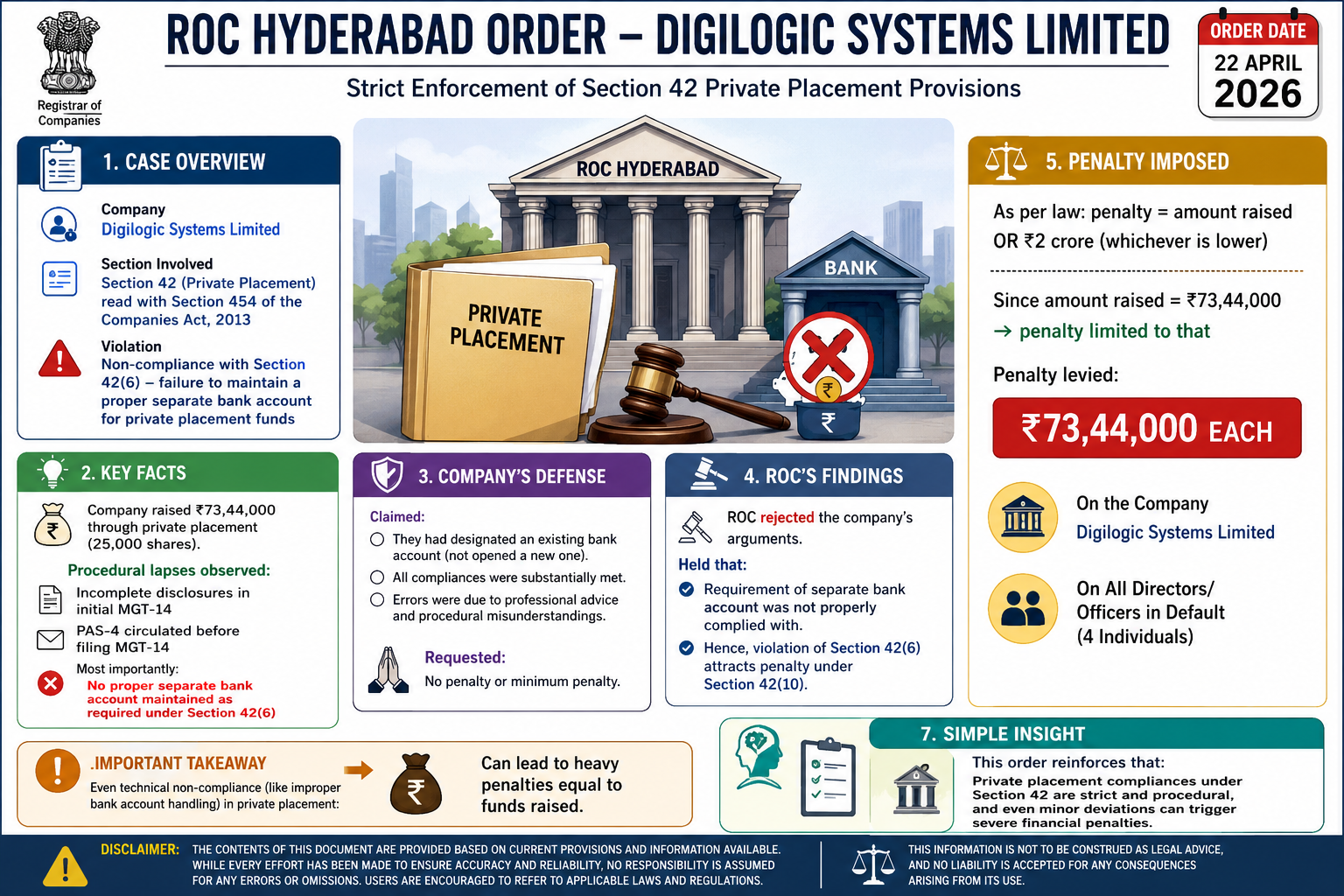
ROC Hyderabad’s Strict Stand on Private Placement Compliance: Analysis of the Digilogic Systems Limited Order
Introduction
The framework governing private placement under the Companies Act, 2013 is one of the most compliance-sensitive areas in corporate law. The provisions contained in Section 42 were introduced with the objective of ensuring transparency, preventing misuse of investor funds, and regulating the process through which companies raise capital from select investors. Over the years, regulatory authorities have consistently adopted a strict approach toward non-compliance with private placement procedures.
A significant example of this strict regulatory approach can be seen in the adjudication order passed by the Registrar of Companies (ROC), Hyderabad on 22 April 2026 in the matter of Digilogic Systems Limited. The order pertains to non-compliance with Section 42(6) of the Companies Act, 2013 relating to maintenance of a separate bank account for private placement funds.
The ROC imposed heavy penalties equivalent to the amount raised through private placement, thereby reinforcing the principle that procedural requirements under Section 42 are mandatory and not merely technical formalities.
Background of the Case
Private Placement Undertaken by the Company
Digilogic Systems Limited had raised an amount of Rs 73,44,000 through private placement by issuing 25,000 equity shares. During scrutiny of records and statutory filings, the ROC Hyderabad observed several procedural irregularities relating to the private placement process carried out by the company.
The matter was examined under the provisions of Section 42 of the Companies Act, 2013 read with Section 454 dealing with adjudication of penalties.
Procedural Lapses Observed by ROC Hyderabad
Incomplete Disclosures in Form MGT-14
One of the observations made by the ROC was that the initial Form MGT-14 filed by the company did not contain complete disclosures relating to the private placement transaction. Since MGT-14 is a statutory filing recording shareholder approval through special resolution, proper disclosure is considered essential for regulatory transparency.
The ROC viewed the incomplete filing as a procedural irregularity affecting compliance standards under the Companies Act, 2013.
Circulation of PAS-4 Before Filing MGT-14
Another irregularity identified during examination was that the private placement offer letter in Form PAS-4 had allegedly been circulated before filing Form MGT-14 with the ROC.
Under the private placement framework, sequencing of compliances is extremely important. The filing of MGT-14 evidences approval of shareholders through special resolution, and the offer letter is expected to be issued only after completion of the necessary approvals and filings.
The ROC considered this sequencing lapse as another instance of non-compliance with procedural requirements.
Failure to Maintain Proper Separate Bank Account
The most significant issue in the present matter related to Section 42(6) of the Companies Act, 2013.
The ROC observed that the company had failed to maintain a proper separate bank account for receiving private placement subscription money. This requirement is specifically mandated under Section 42(6), which states that money received on application under private placement must be kept in a separate bank account in a scheduled bank.
The authority held that the company had not complied with this statutory requirement in its true sense.
Legal Requirement under Section 42(6)
Importance of Separate Bank Account
Section 42(6) serves an important regulatory purpose. The law requires companies to keep private placement funds in a separate bank account to ensure transparency and accountability in handling investor money.
The requirement helps regulators and stakeholders verify that:
- subscription funds are properly traceable,
- investor money is not diverted,
- funds are utilized only after completion of allotment formalities, and
- there exists a clear audit trail for compliance verification.
The provision also restricts utilization of the funds until allotment is completed and return of allotment is filed with the ROC.
Company’s Defense Before the ROC
Argument of Substantial Compliance
During adjudication proceedings, Digilogic Systems Limited argued that substantial compliance with the law had been achieved.
The company submitted that although a fresh bank account was not opened specifically for the private placement, an existing bank account had been designated for the purpose. According to the company, the funds were properly recorded and there was no misuse or diversion of investor money.
The company attempted to portray the lapse as procedural rather than substantive.
Reliance on Professional Advice
The company also argued that the alleged errors occurred due to professional advice and procedural misunderstanding regarding interpretation of the statutory requirements.
It was contended that there was no mala fide intention behind the lapse and that the company acted in good faith throughout the transaction.
Request for Minimal Penalty
Considering the nature of the lapse, the company requested the ROC to either drop the proceedings or impose only a minimum penalty. The company emphasized that no investor loss or public prejudice had occurred because of the procedural deficiencies.
Findings of ROC Hyderabad
Strict Interpretation of Section 42
The ROC Hyderabad rejected the arguments advanced by the company and adopted a strict interpretation of Section 42(6).
The authority held that merely designating an existing account cannot be treated as compliance with the statutory requirement of maintaining a separate bank account. According to the ROC, the law specifically contemplates maintenance of a distinct and proper separate account for private placement proceeds.
The adjudicating authority emphasized that private placement provisions are mandatory in nature and require strict compliance.
Technical Non-Compliance Can Attract Serious Consequences
An important aspect of the order is that the ROC did not treat the lapse as a minor technical irregularity.
Instead, the authority observed that procedural safeguards under Section 42 are integral to the regulatory framework governing private placements. Therefore, even technical or procedural deviations can attract severe consequences if they undermine statutory safeguards intended to protect investor interests.
The ROC ultimately concluded that the company had violated Section 42(6) and was therefore liable for penalty under Section 42(10) of the Companies Act, 2013.
Penalty Imposed Under Section 42(10)
Statutory Penalty Framework
Section 42(10) prescribes a stringent penalty mechanism for contravention of private placement provisions. The section provides that the company, its promoters, and directors may be liable for a penalty extending to the amount involved in the offer or invitation or ?2 crore, whichever is lower.
This reflects the legislative intent to ensure strict adherence to private placement procedures.
Penalty Levied in the Present Case
Since the amount raised through private placement was Rs 73,44,000, the ROC imposed penalty equivalent to the amount raised.
The following penalties were imposed:
- Rs 73,44,000 on Digilogic Systems Limited
- Rs 73,44,000 each on all directors/officers in default
The cumulative financial exposure arising from the order therefore became extremely substantial.
Significance of the Order
Reinforcement of Strict Compliance Culture
The adjudication order clearly demonstrates that private placement compliances are not treated as mere procedural formalities by regulatory authorities.
The order reinforces the principle that companies must ensure exact compliance with every statutory requirement under Section 42, including banking formalities, filings, disclosures, and procedural sequencing.
Separate Bank Account Must Be Genuine and Distinct
One of the most important takeaways from the order is that the concept of a “separate bank account” must be interpreted strictly.
An internally earmarked or informally designated existing account may not satisfy the legal requirement. Companies undertaking private placements should therefore open and maintain a dedicated bank account exclusively for receipt of private placement funds.
Compliance Lessons for Companies and Professionals
Importance of Proper Sequencing
The case highlights the importance of following the correct compliance sequence in private placement transactions. Companies should ensure that shareholder approvals, ROC filings, circulation of offer letters, receipt of funds, allotment, and return filings are carried out in the prescribed order.
Even procedural lapses in sequencing may attract regulatory scrutiny.
Increased Responsibility of Compliance Professionals
The order also places significant responsibility on Company Secretaries, legal advisors, Chartered Accountants, and compliance officers handling private placement transactions.
Professionals advising companies must ensure strict interpretation and implementation of statutory provisions because incorrect advice or procedural oversight may expose companies and directors to massive penalties.
Broader Regulatory Implications
Growing Scrutiny of Fundraising Activities
The order reflects increasing regulatory scrutiny over corporate fundraising mechanisms. ROC authorities are now closely examining procedural compliance relating to private placement transactions, including banking arrangements and statutory filings.
This indicates a broader shift toward stronger enforcement and higher compliance expectations under corporate law.
Investor Protection Perspective
From a governance perspective, the requirement of maintaining a separate bank account serves as an important safeguard for investor protection. It ensures transparency, accountability, and traceability of funds received through private placement.
The ROC’s strict approach therefore aligns with the broader objective of strengthening corporate governance and preventing misuse of investor money.
Conclusion
The adjudication order passed by ROC Hyderabad against Digilogic Systems Limited serves as an important precedent highlighting the strict nature of private placement compliances under the Companies Act, 2013.
The case makes it clear that even technical lapses such as failure to maintain a proper separate bank account can lead to severe penalties equivalent to the amount raised through private placement.
The order also demonstrates that regulators may not accept defenses based on substantial compliance, procedural misunderstanding, or absence of mala fide intent where statutory requirements are explicit and mandatory.
For companies and compliance professionals, the lesson is clear: private placement transactions require meticulous attention to procedural requirements, careful documentation, and strict adherence to statutory provisions. In the present compliance environment, procedural discipline is no longer optional but an essential component of sound corporate governance.
Disclaimer
The contents of this article are based on the provisions of the Companies Act, 2013 and information available at the time of writing. While every effort has been made to ensure accuracy and reliability, no responsibility is assumed for any errors or omissions. Readers are advised to refer to applicable laws, rules, notifications, and professional guidance before taking any action. The article is intended solely for informational and educational purposes and should not be construed as legal advice.
From the desk of CS Sharath