
Forget Password

View News
SEBI LODR Master Circular (Updated up to 30 January 2026): A Comprehensive Legal and Compliance Analysis for Listed Entities
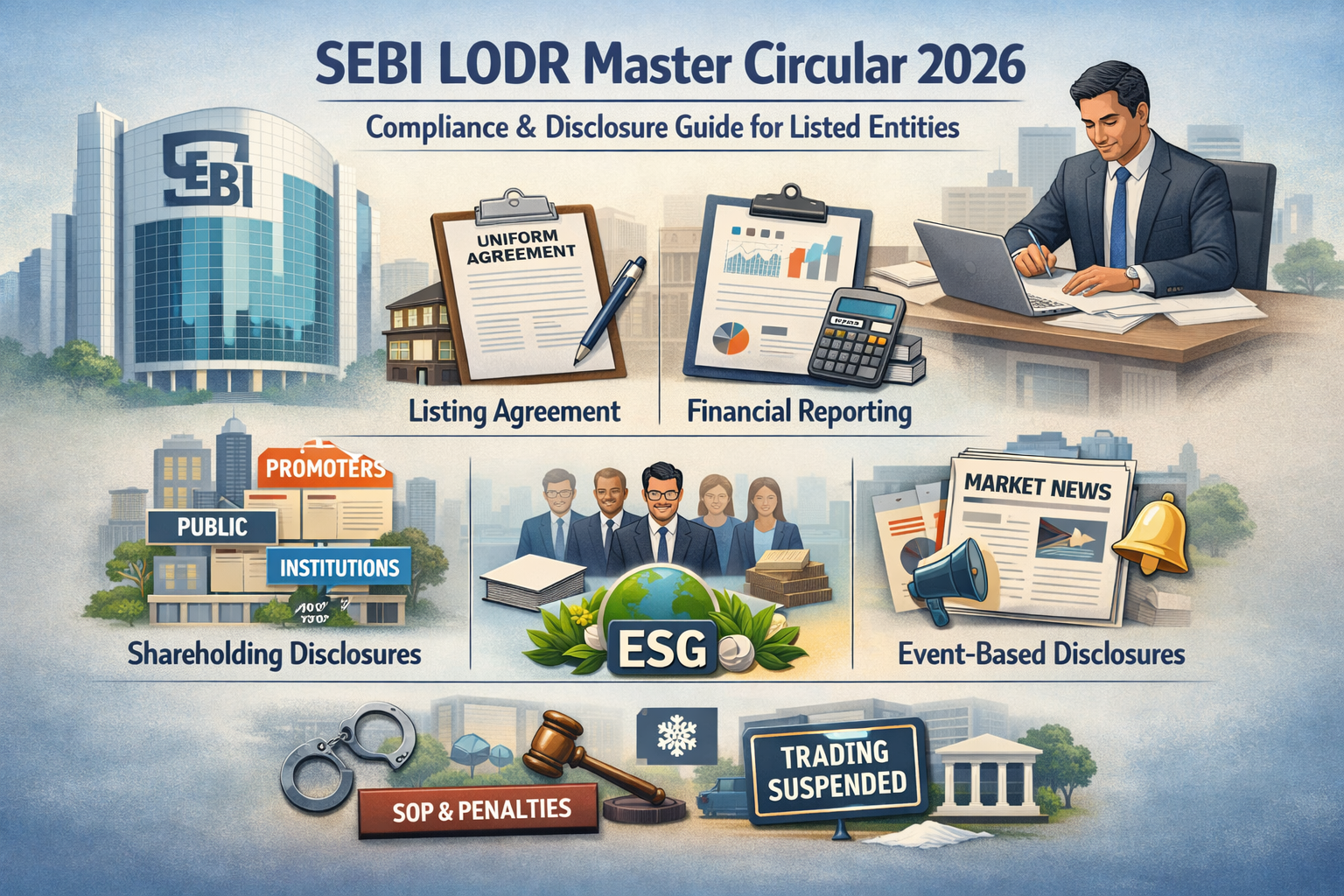
SEBI LODR Master Circular (Updated up to 30 January 2026): A Comprehensive Legal and Compliance Analysis for Listed Entities
1. Background and Regulatory Context
The Securities and Exchange Board of India (SEBI), in exercise of its powers under Section 11(1) of the SEBI Act, 1992, has issued the Master Circular for compliance with the SEBI (Listing Obligations and Disclosure Requirements) Regulations, 2015, originally dated 11 July 2023 and last updated on 30 January 2026. The Master Circular consolidates all operative circulars, clarifications, and instructions issued up to 30 December 2025, thereby providing a single-point authoritative reference for listed entities, stock exchanges, depositories, auditors, and other market intermediaries.
The issuance of this Master Circular is not merely an administrative exercise. It reflects SEBI’s broader regulatory objective of ensuring predictability, uniformity, transparency, and enforceability in the listed company compliance ecosystem. By rescinding earlier circulars and subsuming them into a consolidated framework, SEBI has significantly reduced interpretational ambiguity while simultaneously tightening enforcement through system-driven monitoring.
From a governance standpoint, the Master Circular reinforces the principle that listing is a privilege accompanied by continuous disclosure obligations, and not a one-time compliance milestone.
2. Legal Effect and Applicability
The Master Circular applies to all listed entities that have listed specified securities, unless a specific exemption is expressly provided. The scope also extends, where applicable, to material subsidiaries, statutory auditors, registrar and transfer agents, depositories, and other stakeholders who play a role in ensuring market integrity.
Importantly, the rescission of earlier circulars does not dilute past enforcement actions. Any act done, penalty incurred, investigation initiated, or proceeding pending under the rescinded circulars continues to remain valid and enforceable as if the earlier circulars were still in force. This aspect is critical because it ensures regulatory continuity and prevents entities from taking technical defences based on consolidation.
From a Company Secretary’s perspective, this underscores the need to maintain historical compliance records and not assume that older lapses lose relevance merely because a new Master Circular has been issued.
3. Uniform Listing Agreement: Standardisation of Listing Obligations
The Master Circular reiterates the requirement of a Uniform Listing Agreement, applicable across equity, convertible securities, non-convertible securities, securitised debt instruments, mutual fund units, and Indian Depository Receipts. This uniform agreement, prescribed in Annexure 1, replaces earlier fragmented listing agreements through novation.
The regulatory intent behind this move is to ensure that core listing obligations are identical in substance, irrespective of the nature of the listed security. For listed entities, this eliminates the scope for selective interpretation of obligations based on instrument type.
From a compliance standpoint, execution of the uniform listing agreement is foundational. Delays, incorrect execution, or inconsistencies in adoption are often treated by stock exchanges as indicators of weak compliance governance and can invite deeper scrutiny into other disclosure practices of the entity.
4. Periodic Non-Financial Disclosures: Shareholding and Ownership Transparency
4.1 Shareholding Pattern under Regulation 31
Regulation 31, read with Section II-A of the Master Circular, governs the disclosure of holding of specified securities, commonly referred to as the shareholding pattern. The shareholding is required to be categorised into Promoter and Promoter Group, Public, and Non-Promoter Non-Public categories, with further sub-classifications as prescribed.
A significant regulatory emphasis has been placed on PAN-based consolidation of holdings, disclosure of shareholders holding 1% or more, identification of persons acting in concert, and detailed reporting of pledges, non-disposal undertakings, other encumbrances, and shareholding on a fully diluted basis.
The requirement to disclose even promoters with nil shareholding in the prescribed format reflects SEBI’s insistence on complete transparency rather than selective reporting.
From a governance lens, misclassification of shareholding is no longer treated as a minor technical lapse. Enforcement trends indicate that SEBI and stock exchanges increasingly view incorrect categorisation as a form of misrepresentation, especially where it affects minimum public shareholding calculations or investor perception.
4.2 Dematerialisation of Shareholding
The Master Circular reinforces the obligation under Regulation 31(2) that 100% of promoter and promoter group shareholding must be held in dematerialised form on a continuous basis. Limited exemptions are permitted only in specific circumstances such as sub-judice matters or transmission issues due to death, and even these require documentary substantiation and stock exchange approval.
Additionally, at least 50% of non-promoter shareholding must be in dematerialised form. This requirement is aligned with SEBI’s long-term objective of eliminating risks associated with physical securities and strengthening audit trails.
For Company Secretaries, promoter dematerialisation must be monitored as a continuous compliance item, especially during transmission, succession planning, or restructuring exercises.
5. Financial Disclosures and Audit-Related Obligations
5.1 Periodic Financial Results under Regulation 33
Timely and accurate disclosure of financial results forms the backbone of investor protection. Regulation 33 mandates submission of quarterly and annual financial results within prescribed timelines, using Integrated Filing (Financial)formats.
The Master Circular harmonises financial reporting with Schedule III of the Companies Act, 2013, applicable accounting standards, and sectoral regulations for banks and insurance companies. It also prescribes minimum segment disclosure requirements, including segment revenue, results, assets, and liabilities.
Delays in submission of financial results are treated as serious compliance failures. The listed entity is required not only to pay penalties but also to disclose detailed reasons for delay within one working day of the due date or decision to delay.
Practically, stock exchanges and SEBI have taken the view that recurring delays often indicate deeper governance or internal control issues, and such entities are more likely to face enhanced regulatory scrutiny.
5.2 Impact of Audit Qualifications
Where audit reports contain modified opinions, the listed entity is required to submit a Statement on Impact of Audit Qualifications, quantifying the financial impact of each qualification. The Master Circular makes it clear that generic management explanations without numerical assessment defeat the purpose of the disclosure.
This requirement has transformed audit qualifications from technical accounting remarks into investor-relevant disclosures, thereby increasing the accountability of both management and audit committees.
6. Related Party Transactions: Heightened Disclosure and Oversight
Regulation 23, as elaborated in Section III-B of the Master Circular, prescribes a robust framework for approval and disclosure of Related Party Transactions (RPTs). The introduction of Industry Standards formulated by ASSOCHAM, CII, and FICCI under SEBI’s guidance has standardised the minimum information to be placed before the Audit Committee and shareholders.
The disclosure framework now requires granular information relating to transaction value, tenure, pricing rationale, source and cost of funds, end-use justification, and comparative arm’s length assessment. The regulatory philosophy is clear: shareholders must be placed in a position to independently evaluate whether a transaction is fair and in the interest of the listed entity.
For Company Secretaries, RPT compliance is no longer limited to obtaining approvals. It involves coordinating valuation reports, ensuring consistency between audit committee papers and shareholder notices, and maintaining defensible documentation to withstand regulatory review.
7. Statement of Deviation or Variation: Monitoring Use of Funds
Section III-C deals with disclosures under Regulation 32 relating to deviation or variation in utilisation of funds raised through public issues, rights issues, preferential issues, or QIPs. The listed entity must submit a quarterly statement until the funds are fully utilised or the stated object is achieved.
The Audit Committee plays a central role in reviewing these statements, and its comments form part of the public disclosure. This effectively places responsibility on the board-level committee to ensure that capital allocation decisions remain aligned with disclosures made to investors.
From a compliance governance standpoint, this requirement acts as a safeguard against post-issue diversion of funds and enhances board accountability.
8. Annual Disclosures: Governance and Sustainability Reporting
8.1 Secretarial Audit and Secretarial Compliance Report
Regulation 24A mandates both an annual secretarial audit report (Form MR-3) and an annual secretarial compliance report covering compliance with SEBI laws and circulars. While the secretarial audit under the Companies Act is broad-based, the secretarial compliance report is SEBI-specific and functions as a regulatory health check.
Adverse remarks, even if not immediately penalised, often form the basis for future regulatory monitoring. Therefore, Company Secretaries must treat these reports as early warning mechanisms rather than routine certifications.
8.2 Business Responsibility and Sustainability Reporting (BRSR)
BRSR represents a paradigm shift in disclosure philosophy, recognising that financial performance alone does not fully capture corporate value or risk. Mandatory for the top 1000 listed entities, BRSR requires disclosures aligned with the National Guidelines on Responsible Business Conduct, covering environmental, social, and governance parameters.
The introduction of BRSR Core, with mandatory assessment or assurance in a phased manner, elevates ESG disclosures to a level comparable with financial reporting. Disclosures relating to value chain partners further extend accountability beyond the legal entity.
For listed entities, inconsistencies between BRSR data and other statutory disclosures are increasingly viewed as governance lapses rather than mere reporting errors.
9. Event-Based Disclosures and Market Integrity
Regulation 30, along with provisions on verification of market rumours, requires prompt, accurate, and complete disclosure of material events. The Master Circular reinforces the need for a well-defined materiality policy and internal escalation mechanism.
In the current regulatory environment, silence or delayed response to market rumours is often interpreted as suppression of information. Listed entities are therefore expected to act with speed, clarity, and consistency in managing market communications.
10. Enforcement Framework and Standard Operating Procedures
The Master Circular consolidates SEBI’s Standard Operating Procedures for non-compliance, empowering stock exchanges to impose automatic penalties, freeze promoter shareholding, or suspend trading. These measures are largely system-driven, leaving limited scope for discretionary relief.
This enforcement architecture reflects SEBI’s shift from reactive enforcement to preventive and deterrent regulation, where repeated minor defaults can have serious cumulative consequences.
11. Conclusion
The SEBI LODR Master Circular updated up to 30 January 2026 is not merely a compilation of circulars; it is a comprehensive governance code for listed entities. It integrates disclosure, accountability, sustainability, and enforcement into a single regulatory framework.
For Company Secretaries, the Master Circular reaffirms their role as custodians of compliance culture, strategic advisors to the board, and key intermediaries between the regulator and the company. Effective compliance under this regime requires not only technical knowledge but also judgment, foresight, and robust internal coordination.
In essence, the Master Circular underscores a simple but powerful regulatory message: transparent companies earn market trust, and trust is the foundation of sustainable capital markets.
"Unlock the Potential of Legal Expertise with LegalMantra.net - Your Trusted Legal Consultancy Partner”
Disclaimer: Every effort has been made to avoid errors or omissions in this material in spite of this, errors may creep in. Any mistake, error or discrepancy noted may be brought to our notice which shall be taken care of in the next edition In no event the author shall be liable for any direct indirect, special or incidental damage resulting from or arising out of or in connection with the use of this information Many sources have been considered including Newspapers, Journals, Bare Acts, Case Materials , Charted Secretary, Research Papers etc
Mayank Garg
LegalMantra.net team