
Forget Password

View News
Solid Waste Management Rules, 2026 – A Comprehensive Legal & Practical Analysis
Solid Waste Management Rules, 2026 – A Comprehensive Legal & Practical Analysis
1. Introduction
The Ministry of Environment, Forest and Climate Change (MoEF&CC) has notified the Solid Waste Management Rules, 2026, which shall come into force with effect from 1 April 2026, thereby replacing the Solid Waste Management Rules, 2016. The new regulatory framework signifies a decisive policy shift from a municipality-driven waste management system to a responsibility-based model that places enforceable obligations on every waste generator, particularly large institutional and commercial entities.
The Solid Waste Management Rules, 2026 are designed to strengthen source segregation, decentralised processing, traceability of waste streams, and accountability of bulk waste generators. The rules align with India’s commitments towards sustainable urban development, circular economy principles, environmental protection, and public health safeguards.
This article provides a detailed and structured analysis of the Solid Waste Management Rules, 2026, covering their scope, applicability, expanded definition of bulk waste generators, statutory duties of waste generators, enhanced obligations of bulk waste generators, compliance mechanisms, and practical implications.
2. Scope and Applicability of the Solid Waste Management Rules, 2026
The Solid Waste Management Rules, 2026 apply to all forms of solid waste generated from residential premises, commercial establishments, institutional facilities, offices, markets, public spaces, and event-based activities. The rules extend their applicability across urban local bodies, rural local bodies, cantonment boards, industrial townships, and special purpose authorities.
A key feature of the 2026 Rules is the recognition that effective waste management cannot be achieved solely through municipal systems. Accordingly, the rules impose shared responsibility on individual waste generators, institutions, commercial entities, and event organisers, thereby decentralising waste management obligations and enhancing compliance outcomes.
3. Expanded Definition of Bulk Waste Generators
One of the most significant changes introduced under the Solid Waste Management Rules, 2026 is the expansion and quantification of the definition of Bulk Waste Generators. Under the new framework, an entity is classified as a Bulk Waste Generator if it meets any one of the prescribed thresholds relating to size, resource consumption, or waste generation.
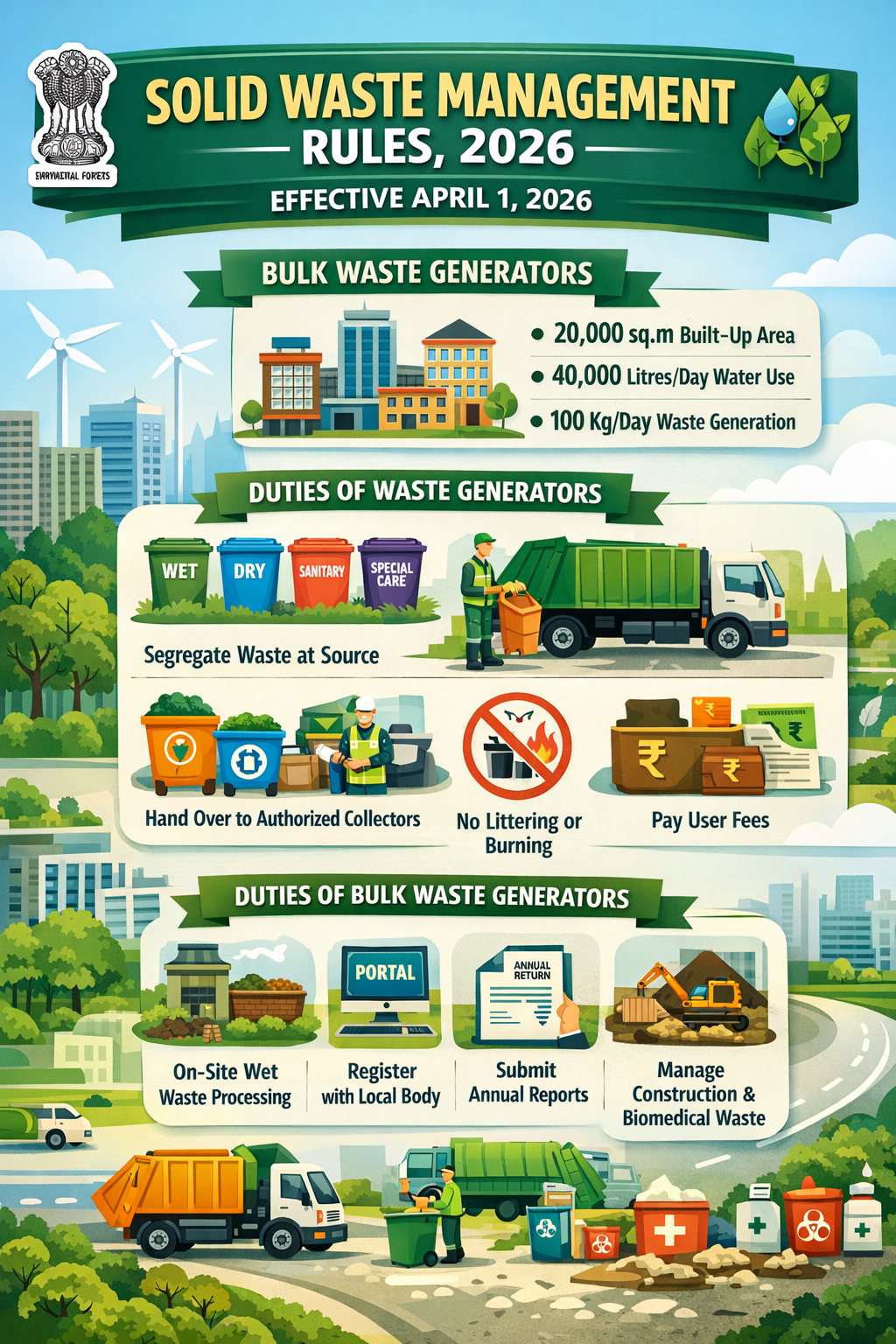
An entity qualifies as a Bulk Waste Generator if it has a built-up area of twenty thousand square metres or more, or if its daily water consumption is forty thousand litres or more, or if it generates one hundred kilograms or more of solid waste per day. The satisfaction of any one of these criteria is sufficient to attract the enhanced obligations applicable to Bulk Waste Generators.
The definition expressly covers large residential welfare associations, housing societies, commercial complexes, business parks, hotels, malls, educational institutions, universities, hospitals excluding biomedical waste streams, airports, railway stations, bus terminals, government offices, and other large public facilities. This expansion ensures that entities with a high waste footprint cannot transfer their responsibility entirely to local authorities.
4. Duties of Waste Generators under the Solid Waste Management Rules, 2026
The Solid Waste Management Rules, 2026 impose statutory duties on every waste generator, irrespective of the scale of operations or the nature of activities undertaken.
Every waste generator is required to segregate waste at source into wet waste, dry waste, sanitary waste, and special care waste. Segregation at source forms the foundation of the waste management framework under the 2026 Rules, as it enables efficient collection, recycling, processing, and disposal. Failure to segregate waste attracts penalties under the bye-laws framed by the concerned local body.
Waste generators must ensure that segregated waste is handed over only to authorised waste collectors or agencies recognised by the local authority. Informal disposal, unauthorised dumping, or mixing of segregated waste streams is expressly prohibited under the rules.
The rules further mandate separate storage of specific categories of waste, including construction and demolition waste, horticulture and garden waste, and bulky waste. Such waste must be stored in designated areas and handed over to collection systems or processing facilities notified by the local authority.
The Solid Waste Management Rules, 2026 impose a strict prohibition on littering, open burning of solid waste, and dumping of waste in public places, drains, water bodies, or vacant land. These activities are treated as environmental violations and are subject to enforcement action.
Waste generators are also required to pay user fees as prescribed under the applicable municipal or local body bye-laws. The user fee structure is typically linked to the quantity and type of waste generated and is intended to support sustainable waste management infrastructure.
In the case of events or gatherings involving one hundred or more persons, the event organiser bears direct responsibility for ensuring segregation of waste at source, proper collection, scientific disposal, and prevention of littering during and after the event.
The rules categorically prohibit the mixing of biomedical waste with solid waste. Biomedical waste must be handled, treated, and disposed of strictly in accordance with the Biomedical Waste Management Rules, 2016.
5. Duties of Bulk Waste Generators under the Solid Waste Management Rules, 2026
In recognition of their higher environmental impact, the Solid Waste Management Rules, 2026 impose enhanced and more stringent obligations on Bulk Waste Generators.
Every Bulk Waste Generator is mandatorily required to register with the concerned local body through a centralised digital portal. Registration serves as a pre-condition for lawful operation and enables monitoring, reporting, and enforcement by regulatory authorities.
Bulk Waste Generators are required to process wet waste generated by them on-site through composting, bio-methanation, or other approved technologies. Where on-site processing is not feasible, the Bulk Waste Generator must obtain an Exempted Bulk Waste Generator Registration certificate in accordance with the prescribed procedure.
For dry waste, sanitary waste, and special care waste, Bulk Waste Generators must independently arrange collection and handover to authorised and registered waste management entities. Engagement with unregistered or informal waste handlers is not permitted under the rules.
A key innovation under the 2026 framework is the introduction of Extended Bulk Waste Generator Responsibility. Under this principle, Bulk Waste Generators are responsible for the end-to-end management of all waste streams generated by them, including segregation, storage, transportation, processing, recycling, and final disposal. This concept mirrors the philosophy underlying Extended Producer Responsibility and significantly enhances accountability.
Bulk Waste Generators are required to submit annual returns to the concerned local authority on or before 30 June of every year. The annual return must disclose the quantity and category of waste generated, the mode of processing or disposal adopted, and details of authorised agencies engaged. Failure to submit accurate and timely returns may result in penalties or suspension of registration.
With respect to construction and demolition activities, Bulk Waste Generators must ensure scientific disposal of waste, prevent littering during transportation, and comply with applicable construction and demolition waste management regulations.
Bulk Waste Generators generating biomedical waste must maintain strict segregation, proper record-keeping, and reporting in accordance with the Biomedical Waste Management Rules, 2016.
6. Compliance, Monitoring and Enforcement Mechanism
The Solid Waste Management Rules, 2026 strengthen compliance and enforcement through digital registration, annual reporting, inspections by local authorities, and mandatory engagement of authorised waste processors. Local bodies are empowered to impose penalties, levy fines, suspend registrations, and initiate prosecution for repeated or serious violations.
7. Practical Implications and Compliance Readiness
The Solid Waste Management Rules, 2026 require Bulk Waste Generators and large institutions to reassess their infrastructure, contractual arrangements, and internal compliance systems. Entities must plan for on-site processing solutions, allocate budgets for waste management, formalise agreements with authorised waste handlers, and establish documentation and reporting mechanisms well before the rules come into force.
Early compliance planning will be critical to avoid operational disruptions, regulatory penalties, and reputational risks once the new regime becomes effective.
8. Conclusion
The Solid Waste Management Rules, 2026 represent a mature and enforcement-oriented evolution of India’s solid waste regulatory framework. By clearly defining responsibilities, expanding the scope of Bulk Waste Generators, and introducing extended responsibility principles, the rules aim to ensure sustainable waste management while reducing pressure on municipal systems.
For institutions, commercial establishments, residential communities, and event organisers, compliance with the 2026 Rules is not merely a statutory obligation but an opportunity to adopt environmentally responsible practices aligned with national sustainability objectives.
"Unlock the Potential of Legal Expertise with LegalMantra.net - Your Trusted Legal Consultancy Partner”
Disclaimer: Every effort has been made to avoid errors or omissions in this material in spite of this, errors may creep in. Any mistake, error or discrepancy noted may be brought to our notice which shall be taken care of in the next edition In no event the author shall be liable for any direct indirect, special or incidental damage resulting from or arising out of or in connection with the use of this information Many sources have been considered including Newspapers, Journals, Bare Acts, Case Materials , Charted Secretary, Research Papers etc
Mayank Garg
LegalMantra.net team