
Forget Password

View News
Strengthening Communication between Statutory Auditors and Those Charged with Governance
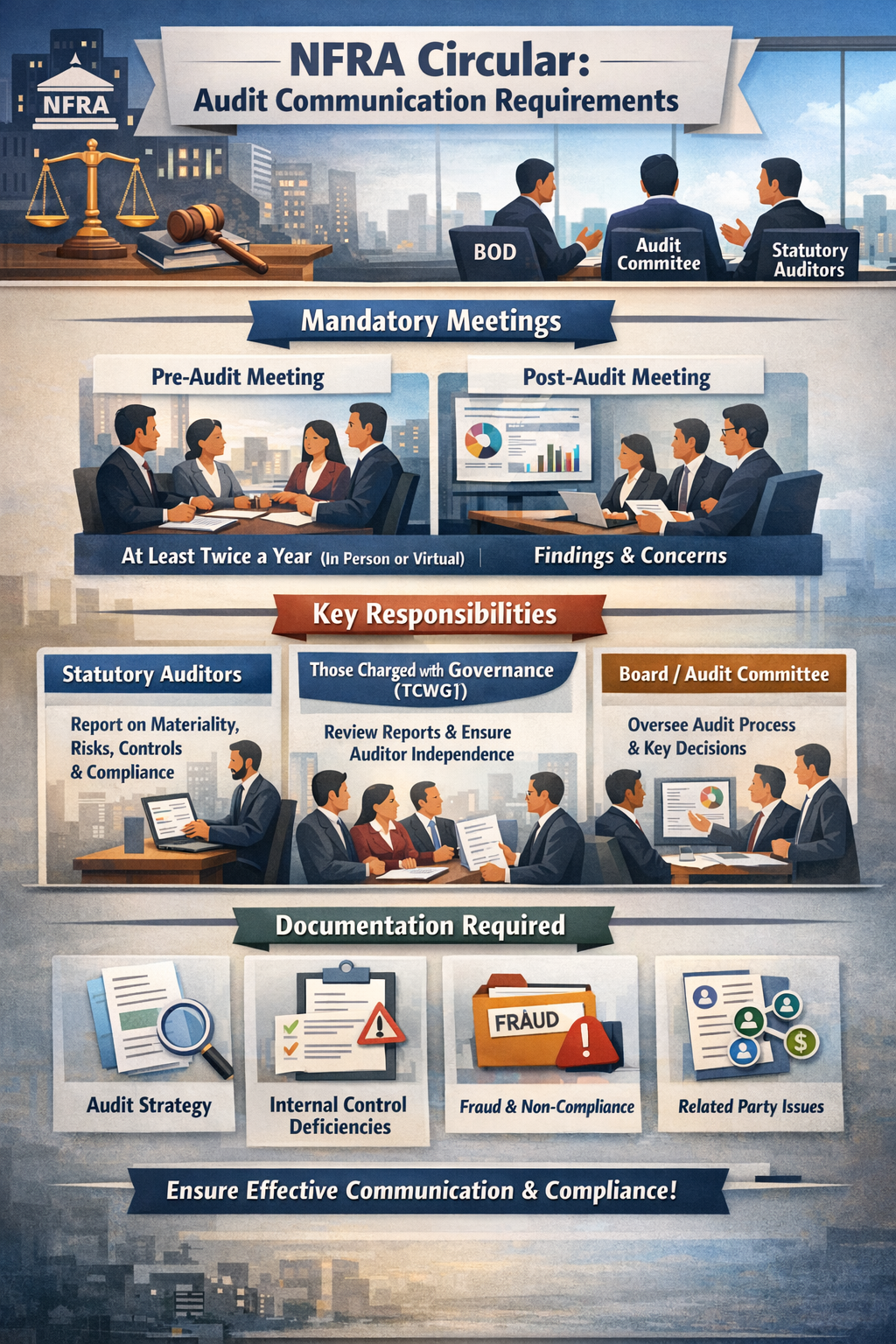
NFRA Circular dated 7 January 2026: Strengthening Communication between Statutory Auditors and Those Charged with Governance (TCWG)
1. Background and Regulatory Context
The National Financial Reporting Authority (NFRA), vide its circular dated 7 January 2026, has underscored the importance of structured, continuous and well-documented communication between statutory auditors and Those Charged with Governance (TCWG), including the Audit Committee. The circular has been addressed to Company Secretaries of listed companies, companies and bodies corporate specified under Rule 3 of the NFRA Rules, 2018, as well as statutory auditors of such entities. The core objective is to ensure that the requirements of Standard on Auditing (SA) 260 and SA 265 are complied with in both letter and spirit, so that governance bodies are fully apprised of audit planning, significant risks, judgments, deficiencies and instances of non-compliance.
Company Secretaries, being principal governance facilitators, are required to place this circular before the Board of Directors and the Audit Committee and to institutionalise processes that enable effective compliance.
2. Concept of Those Charged with Governance (TCWG)
2.1 Meaning and Scope
As defined under SA 260, Those Charged with Governance are the persons or bodies responsible for overseeing the strategic direction of the entity and for fulfilling accountability obligations, including oversight of the financial reporting process. In the Indian corporate governance framework, the Board of Directors is generally regarded as the primary TCWG, while the Audit Committee, being a committee of the Board, may discharge TCWG responsibilities for specified matters.
2.2 Determination of TCWG by the Auditor
In terms of paragraph 11 of SA 260, the statutory auditor is required to determine and document TCWG at the commencement of the audit. Even where an Audit Committee exists, auditors are expected to exercise professional judgment to assess whether certain matters warrant communication to the full Board. Communication restricted only to management or executive directors does not fulfil the requirements of communication with TCWG.
3. Mandatory Auditor–TCWG Meetings
3.1 Frequency and Timing
NFRA has reiterated that a minimum of two direct meetings between the statutory auditor and TCWG are mandatory in each financial year. One meeting should be held prior to the commencement of the audit, focusing on audit strategy, scope, materiality and identification of key risks. The second meeting should take place before the approval of the financial statements, concentrating on significant audit findings, judgments, deficiencies and unresolved concerns.
3.2 Mode and Substance
Such meetings may be conducted either physically or through virtual mode. However, the substance of communication is critical. Mere circulation of presentations or written reports, without meaningful deliberation and interaction, does not meet the expectations of the Standards.
4. Duties and Responsibilities of Statutory Auditors
4.1 Continuous Two-Way Communication
Once TCWG is identified, the auditor is obligated to maintain regular, two-way communication with TCWG throughout the audit. This obligation extends beyond one-time presentations and requires ongoing dialogue, including the documentation of responses, concerns and directions provided by TCWG.
4.2 Matters to be Communicated under SA 260
Statutory auditors are required to communicate, at appropriate stages of the audit, the overall audit strategy, the planned scope and timing of audit procedures, and the basis for determination and application of materiality. Auditors must also apprise TCWG of significant risks identified during the audit, including issues relating to going concern, unusual or complex transactions, and areas involving significant management judgment. Further, communication must cover significant accounting estimates, deficiencies in internal financial controls, matters affecting auditor independence and ethical compliance, and issues of compliance or non-compliance with applicable laws and regulations that could affect the entity’s operations or licences. Related party transactions and valuation-related concerns also fall within the scope of mandatory communication.
4.3 Communication of Internal Control Deficiencies under SA 265
In accordance with SA 265, significant deficiencies in internal control identified during the audit are required to be communicated in writing and in a timely manner to both TCWG and management. Such communication must clearly explain the nature of the deficiency and its potential impact on the financial statements or the entity’s operations.
5. Documentation Requirements
5.1 Recording of Communications
SA 260, particularly paragraphs A37 to A53 and Appendix 2, mandates that all significant matters communicated orally to TCWG must be appropriately documented. Audit documentation should record the issues discussed, the views expressed by TCWG, decisions taken and actions agreed upon.
5.2 Inadequate Practices Identified by NFRA
NFRA has observed that reliance solely on engagement letters, informal discussions or last-minute presentations prior to approval of financial statements is inadequate. In several cases, expected communications from TCWG relating to strategic decisions, suspected or identified fraud, and assessments of the integrity and competence of senior management were neither formally discussed nor documented. All significant events and deliberations are required to be recorded and retained as part of the audit documentation.
6. Common Non-Compliances Observed by NFRA
6.1 Limited Engagement with TCWG
In multiple instances, auditors treated the Audit Committee as TCWG but restricted communication to a single presentation shortly before approval of the financial statements, without maintaining adequate records of discussions, concerns raised or follow-up actions.
6.2 Non-Communication of Significant and Unusual Transactions
NFRA noted failures by auditors to communicate significant unusual transactions to TCWG, including large supplier or land advances, borrowing and lending arrangements, and circuitous transactions involving promoter or group-controlled entities that were outside the normal course of business.
6.3 Legal and Regulatory Non-Compliance
Instances were observed where auditors did not communicate non-compliance with laws and regulations, including breaches of prudential or regulatory requirements that could have an adverse impact on the entity’s licence to operate.
6.4 Related Party Transactions and Policy Weaknesses
Auditors often failed to highlight deficiencies in related party transaction policies or to raise concerns regarding sharp increases in related party transactions, doubts about whether such transactions were in the ordinary course of business, or questions regarding arm’s length pricing.
6.5 Internal Control Failures
Despite explicit requirements under law and auditing standards, certain auditors did not communicate identified weaknesses or the absence of internal controls to TCWG. Serious deficiencies noted included inadequate credit policies and the failure of the Risk Management Committee to convene meetings over multiple years.
7. Responsibilities of the Board of Directors, Audit Committee and TCWG
The Board of Directors and the Audit Committee are responsible for ensuring that they receive timely and meaningful information regarding audit planning, key risk areas and significant judgments. TCWG must actively assess the independence and objectivity of auditors and ensure that any threats to independence are appropriately addressed. Their role extends beyond passive approval of financial statements and includes challenging management assumptions, seeking explanations from auditors and ensuring that identified deficiencies are adequately remedied.
8. Role of the Company Secretary
The Company Secretary plays a pivotal role in operationalising the NFRA circular by placing the matter before the Board and the Audit Committee, structuring meeting agendas to facilitate direct auditor–TCWG interaction, ensuring proper recording of minutes and documentation of discussions, and monitoring follow-up actions arising from audit communications.
9. Conclusion
The NFRA circular dated 7 January 2026 reinforces that effective corporate governance depends on transparent, timely and well-documented communication between statutory auditors and Those Charged with Governance. Strict adherence to SA 260 and SA 265, supported by structured meetings, comprehensive documentation and proactive engagement by the Board and Audit Committee, is essential to safeguard audit quality, regulatory compliance and stakeholder confidence.
"Unlock the Potential of Legal Expertise with LegalMantra.net - Your Trusted Legal Consultancy Partner”
Disclaimer: Every effort has been made to avoid errors or omissions in this material in spite of this, errors may creep in. Any mistake, error or discrepancy noted may be brought to our notice which shall be taken care of in the next edition In no event the author shall be liable for any direct indirect, special or incidental damage resulting from or arising out of or in connection with the use of this information Many sources have been considered including Newspapers, Journals, Bare Acts, Case Materials , Charted Secretary, Research Papers etc
Anshul Goel
LegalMantra.net team