
Forget Password

View News
The Algorithmic Boss: The Legal Fight against the Classification of Platform Workers.
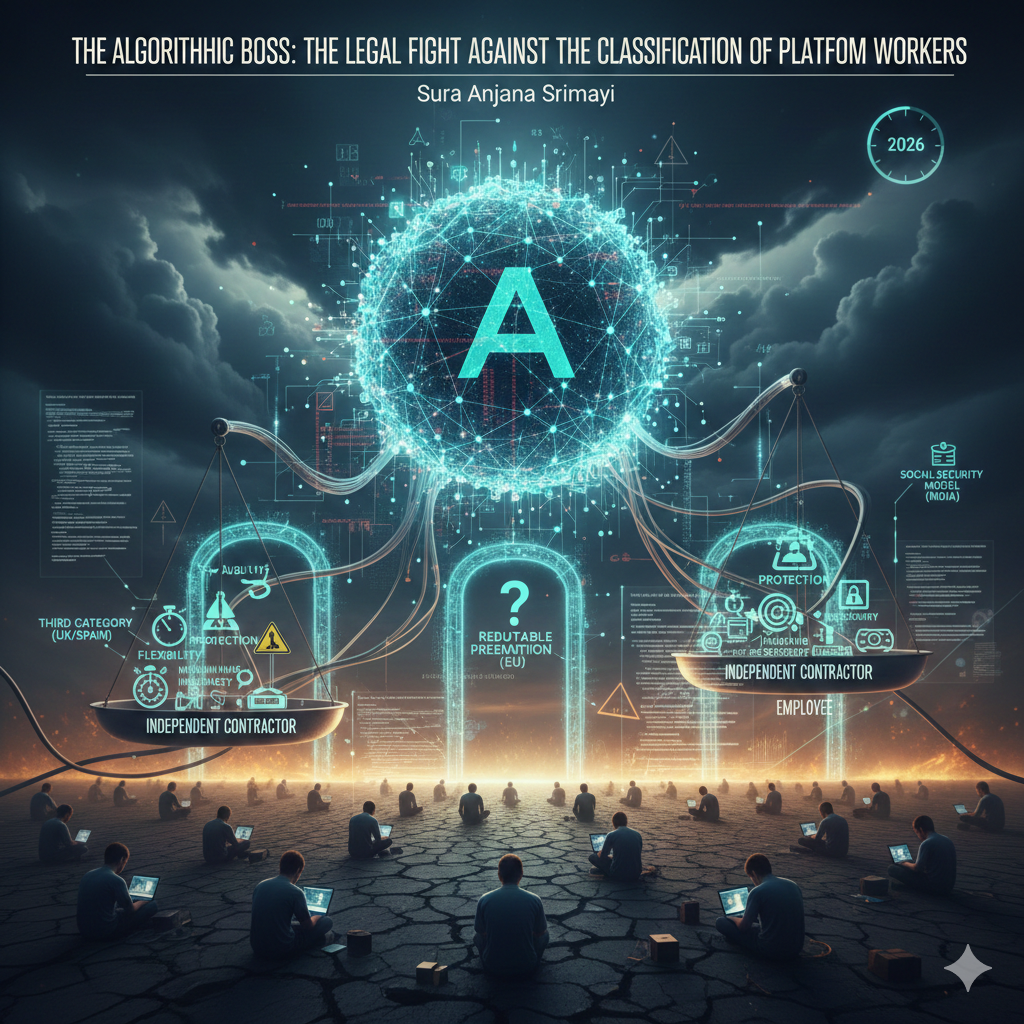
The Algorithmic Boss: The Legal Fight Against the Classification of Platform Workers
~ Sura Anjana Srimayi
INTRODUCTION
The contemporary economy is undergoing a silent structural transformation. The traditional physical workplace is increasingly being replaced by digital platforms, and the conventional human supervisor is being supplanted by algorithmic management systems. Platforms such as Upwork, Fiverr, and TaskRabbit have democratized access to global markets for skilled professionals, promising flexibility and autonomy—the opportunity to “be one’s own boss.”
However, beneath this promise of flexibility lies a deep legal tension. The foundation of the gig economy rests upon a binary system of worker classification that was developed during the industrial era. Most digital platforms classify their workforce as independent contractors, thereby avoiding statutory obligations such as minimum wages, social security contributions, paid leave, and health benefits.
As platforms increasingly rely on sophisticated systems of surveillance, automated monitoring, and algorithmic control, the traditional distinction between an employee and an independent contractor has become blurred. By 2026, this issue is no longer merely a tax or contractual question; it has evolved into one of the most significant challenges in modern labour jurisprudence, directly affecting the social protection of millions of professionals worldwide.
I. The Anatomy of Worker Classification: Traditional Legal Tests
To understand why platform workers occupy a regulatory grey area, it is essential to examine the traditional legal tests used by courts to determine whether a relationship constitutes a “contract of service” (employment) or a “contract for services” (independent contracting).
The Control Test
Historically, the “control test” served as the primary determinant of employment status. If an employer directed not only what work was to be done but also how it was to be performed, the relationship was likely to be classified as employment.
In the digital platform context, companies often argue that they exercise no direct control over the manner in which services are rendered. For instance, a freelance graphic designer on Fiverr may retain discretion over creative execution. However, when the platform determines pricing structures, communication channels, response timelines, performance ratings, and dispute resolution mechanisms, the locus of control shifts from human supervision to coded systems. Courts increasingly recognize that control need not be personal; it can be embedded within the architecture of a digital interface.
The ABC Test
A more stringent approach emerged in California through Assembly Bill 5 (AB5), which adopted the “ABC Test.” Under this framework, a worker is presumed to be an employee unless the hiring entity proves three elements:
First, the worker must be free from the control and direction of the hiring entity in performing the work.
Second, the work performed must fall outside the usual course of the hiring entity’s business.
Third, the worker must be customarily engaged in an independently established trade or business.
For digital platforms whose core business is the provision of the very services performed by gig workers—such as ride-hailing, food delivery, or software development—the second condition presents a formidable legal barrier. If the service constitutes the central business activity of the platform, classification as an independent contractor becomes increasingly difficult to sustain.
II. The Algorithmic Boss: Redefining Control in the Digital Age
The most significant jurisprudential development between 2025 and 2026 is the recognition of algorithmic management as a modern form of control. Traditional labour law contemplated direct supervision by a human manager. In contrast, platform-based work involves implicit, data-driven control mechanisms.
While platforms emphasize flexibility—allowing workers to choose their working hours—the practical reality is often shaped by algorithmic incentives and penalties. Surge pricing notifications, acceptance-rate thresholds, automated rating systems, and task allocation mechanisms influence worker behavior in subtle yet powerful ways. Refusal of assignments may lead to reduced visibility, fewer opportunities, or account deactivation.
Automated monitoring systems track working hours, keystrokes, geolocation data, and customer ratings. Automated decision-making tools can suspend or deactivate accounts without meaningful human intervention. The absence of direct managerial instruction does not negate control; rather, it redefines its form.
The European Union has directly addressed this issue through the EU Platform Work Directive, which Member States are required to transpose into national law by December 2026. The Directive introduces a rebuttable presumption of employment where a platform satisfies at least two indicators of control, including electronic monitoring of performance or restrictions on the worker’s freedom to organize work. This represents a structural shift from formal contractual labels toward functional assessment of economic reality.
III. The High Stakes: Flexibility Versus Protection
The classification debate is not merely semantic; it carries profound financial and social implications for both workers and platforms.
For workers, classification as employees ensures access to statutory protections, including minimum wages, overtime compensation, social security contributions, paid leave, and anti-discrimination safeguards. It also enables access to collective bargaining mechanisms and protection against unfair dismissal.
For platforms, recognition as employers entails significant financial obligations. Payroll taxes, insurance contributions, and benefit costs may increase operational expenses by an estimated twenty to thirty percent. Additionally, employers may incur vicarious liability for acts performed by workers during the course of employment, including accidents or misconduct.
The economic consequences of classification have led to intense legal and political contestation. In California, for example, Proposition 22 was introduced following AB5, creating a hybrid framework for app-based drivers. While it provided certain limited benefits such as healthcare stipends, it stopped short of conferring full employee status. This legislative oscillation reflects the ongoing struggle to reconcile business innovation with labour protection.
IV. Comparative Legal Responses: The 2026 Landscape
Different jurisdictions have adopted varied approaches to address the classification dilemma.
The Third Category Approach
In the United Kingdom, labour law recognizes an intermediate category known as the “Limb (b) Worker.” This status grants minimum wage and holiday pay protections without extending the full spectrum of employment rights such as protection against unfair dismissal. Spain’s “Riders Law” goes further by establishing a legal presumption of employment for delivery workers operating through digital platforms.
These models reflect a departure from strict binary classification, acknowledging that platform work may not neatly fit within traditional categories.
The Social Security Model in India
India has adopted a pragmatic alternative through the Code on Social Security, 2020. Rather than reclassifying gig workers as employees, the legislation creates a distinct legal category termed “platform workers.”
Under this framework, aggregators are required to contribute between one and two percent of their annual turnover to a social security fund. This fund provides benefits such as maternity assistance, disability coverage, and old-age protection. By sidestepping the employee-versus-contractor dispute, India’s model seeks to ensure baseline social protection while preserving operational flexibility for digital platforms.
CONCLUSION
The legal regulation of platform work represents one of the defining labour law challenges of the twenty-first century. The rigid nineteenth-century conceptualizations of employment are increasingly incompatible with digitally mediated economic relationships.
Across jurisdictions, courts and legislatures are shifting toward a functional, reality-based approach rather than relying solely on contractual labels embedded within digital terms-of-service agreements. Whether through a rebuttable presumption of employment, the creation of an intermediate worker category, or the establishment of social security funds, the law is gradually adapting to the realities of algorithmic governance.
The central objective of modern labour reform must be to reconcile flexibility with dignity. The future of work should not compel professionals to choose between autonomy and economic insecurity. Regardless of the nomenclature displayed on a screen, the individual behind the keyboard remains entitled to protection consistent with the values of a civilized and equitable society.
Unlock the Potential of Legal Expertise with LegalMantra.net – Your Trusted Legal Consultancy Partner
Disclaimer
Every effort has been made to ensure accuracy in this material. However, inadvertent errors or omissions may occur. Any discrepancies brought to the author’s notice will be rectified in subsequent editions. The author shall not be liable for any direct, indirect, incidental, or consequential damages arising from the use of this material. This article is based on various sources including statutory enactments, judicial decisions, academic research papers, professional journals, and publicly available legal materials.