
Forget Password

View News
The Benefits of Prenuptial Agreements: A Contemporary Legal and Financial Perspective
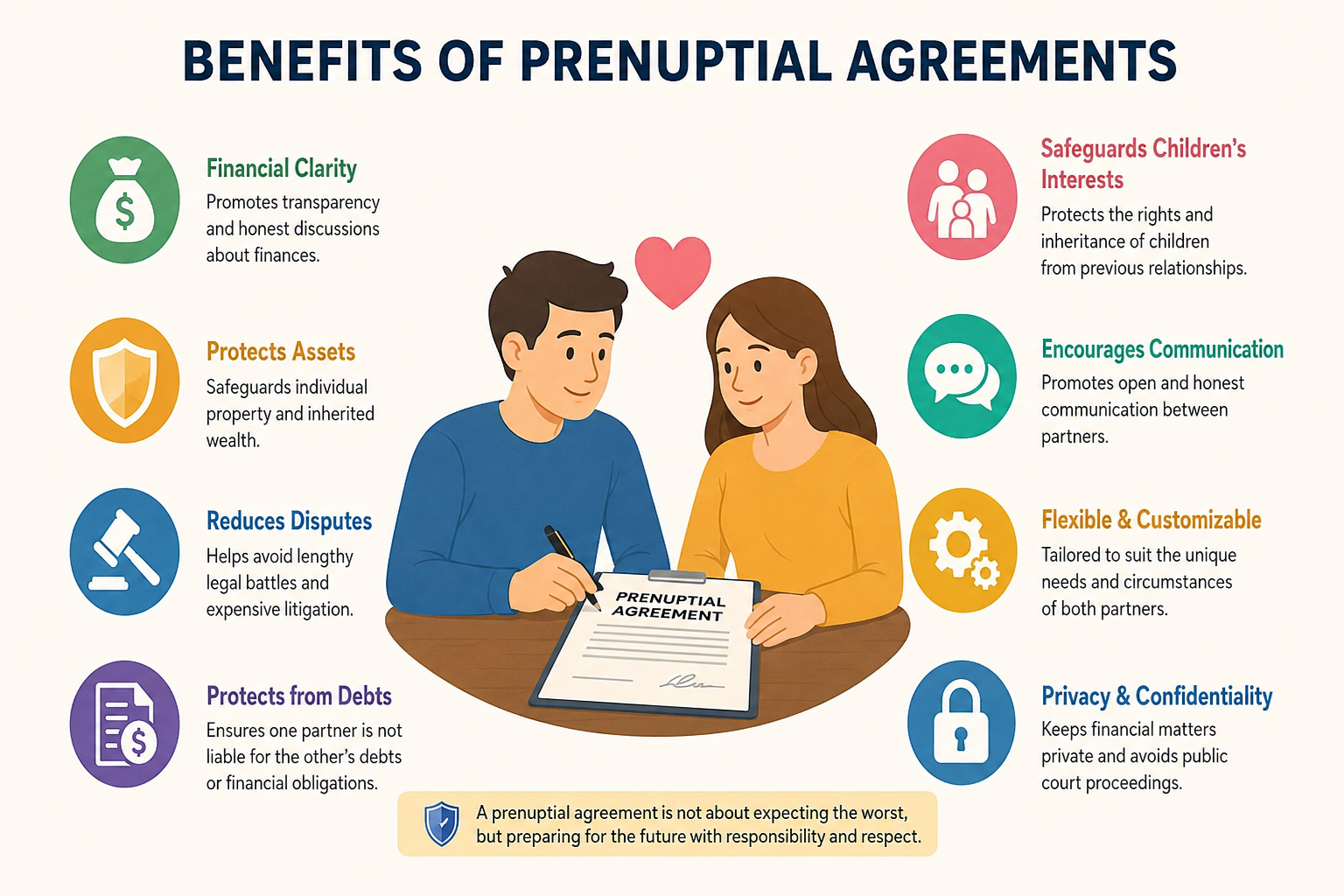
The Benefits of Prenuptial Agreements: A Contemporary Legal and Financial Perspective
Introduction
Marriage is traditionally regarded as a sacred emotional and social institution built upon love, trust, companionship, and commitment. However, in the modern era, marriage also represents an important legal and financial partnership. With increasing financial independence, growing professional aspirations, and changing family structures, couples today are becoming more conscious about financial planning and legal preparedness before marriage.
One important legal mechanism that has gained prominence in recent years is the prenuptial agreement, commonly known as a “prenup.” A prenuptial agreement is a written contract entered into by two individuals before marriage, specifying the ownership of assets, financial rights, liabilities, inheritance arrangements, and obligations in the event of divorce, separation, or death.
Although prenups were once associated mainly with wealthy individuals and celebrities, they are now increasingly used by professionals, entrepreneurs, middle-class families, and individuals entering second marriages. Rather than indicating distrust, prenuptial agreements are gradually being viewed as practical tools for financial clarity, transparency, and mutual understanding.
Meaning and Concept of Prenuptial Agreements
A prenuptial agreement is essentially a legally drafted agreement executed before marriage that defines the financial relationship between spouses. It may regulate matters such as property ownership, debt liability, maintenance, inheritance rights, and financial responsibilities during marriage.
Key Features of a Prenuptial Agreement
| Particulars | Description |
|---|---|
| Timing | Executed before marriage |
| Nature | Legal and financial agreement |
| Parties | Prospective husband and wife |
| Main Purpose | To define financial rights and obligations |
| Coverage | Assets, liabilities, maintenance, inheritance, business interests |
| Applicability | Effective upon marriage |
| Objective | Reduce future disputes and uncertainty |
Historical Evolution of Prenuptial Agreements
Marriage contracts are not entirely new concepts. Ancient civilizations often used agreements to regulate dowries, inheritance, and family property. In modern legal systems, prenups evolved as a means of protecting property rights and financial interests.
Initially, prenups were primarily used by wealthy families to preserve inherited wealth and business ownership. Over time, their scope expanded significantly due to:
| Factors Leading to Growth of Prenups | Impact |
|---|---|
| Rising divorce rates | Increased need for legal certainty |
| Financial independence of spouses | Greater awareness of property rights |
| Growth of entrepreneurship | Need to protect business interests |
| Increase in second marriages | Protection of children’s inheritance |
| Globalization and cross-border marriages | Complex financial arrangements |
Today, prenuptial agreements are considered part of modern financial planning in many countries.
Major Benefits of Prenuptial Agreements
1. Financial Transparency and Clarity
One of the most important benefits of a prenuptial agreement is that it promotes honest financial disclosure between partners before marriage.
During the drafting process, both parties generally disclose:
| Financial Information Commonly Disclosed | Purpose |
|---|---|
| Income and salary details | Financial transparency |
| Existing assets | Clarification of ownership |
| Investments and savings | Future financial planning |
| Loans and liabilities | Debt allocation |
| Business interests | Protection of commercial assets |
| Tax obligations | Financial management |
Financial conflicts are among the leading causes of marital disputes. Open discussions regarding money matters before marriage can reduce misunderstandings and help couples build mutual trust and realistic expectations.
2. Protection of Individual Assets
Prenuptial agreements allow spouses to protect assets acquired before marriage. This is especially beneficial for entrepreneurs, professionals, investors, and individuals with inherited wealth.
| Types of Assets Protected Through Prenups | Importance |
|---|---|
| Family businesses | Prevents division during divorce |
| Inherited property | Preserves ancestral wealth |
| Real estate investments | Clarifies ownership rights |
| Intellectual property | Protects future earnings |
| Family heirlooms | Maintains family legacy |
For example, an entrepreneur may wish to ensure that ownership of a family business remains unaffected in the event of marital disputes.
3. Reduction of Legal Disputes
Divorce proceedings often involve lengthy litigation regarding property division, maintenance, and financial rights. Prenuptial agreements reduce ambiguity by pre-deciding several important financial matters.
| Without Prenup | With Prenup |
|---|---|
| Lengthy litigation | Faster settlement |
| High legal expenses | Reduced legal costs |
| Emotional stress | Reduced conflict |
| Uncertainty regarding property | Financial clarity |
| Public disputes | Private resolution |
Thus, prenups help save time, money, and emotional energy.
4. Protection from Debt Liability
Modern marriages frequently involve individuals carrying student loans, personal debts, or business liabilities. A prenup can clarify responsibility for such obligations.
| Type of Debt | How Prenup Helps |
|---|---|
| Student loans | Prevents transfer of liability |
| Business debts | Protects non-business spouse |
| Credit card debt | Clarifies repayment responsibility |
| Personal loans | Limits financial exposure |
This protection ensures that one spouse does not unfairly suffer because of the financial obligations of the other.
5. Protection of Children’s Interests
Prenuptial agreements are particularly important in second marriages or blended families where children from previous relationships are involved.
| Objective | Benefit |
|---|---|
| Protect inheritance rights | Safeguards children’s future |
| Preserve family assets | Avoids succession disputes |
| Clarify financial provisions | Reduces family conflicts |
| Maintain generational wealth | Ensures stability |
Such agreements help balance the interests of spouses and children while preventing future inheritance-related disputes.
6. Encouragement of Open Communication
Contrary to popular belief, prenuptial agreements often encourage mature communication between partners.
| Topics Commonly Discussed During Prenup Negotiation | Result |
|---|---|
| Spending habits | Better financial planning |
| Career goals | Mutual understanding |
| Savings and investments | Long-term stability |
| Financial responsibilities | Reduced misunderstandings |
| Lifestyle expectations | Realistic marital expectations |
Couples who openly discuss financial matters are often better prepared to manage future marital challenges.
7. Flexibility and Customization
Prenuptial agreements are highly customizable and can be tailored according to the unique needs of the parties.
| Areas Covered | Customization Possible |
|---|---|
| Property division | Yes |
| Spousal support | Yes |
| Joint accounts | Yes |
| Business ownership | Yes |
| Inheritance arrangements | Yes |
| Investment management | Yes |
This flexibility allows couples to create arrangements suitable to their personal and financial circumstances.
8. Privacy and Confidentiality
Court proceedings relating to divorce are generally public, which may expose sensitive financial information.
| Public Litigation | Prenuptial Agreement |
|---|---|
| Financial records become public | Greater confidentiality |
| Media exposure possible | Private settlements |
| Public scrutiny | Protection of reputation |
This benefit is particularly valuable for businesspersons, celebrities, and public figures.
Interesting Facts About Prenuptial Agreements
Fascinating Facts You Should Know
| Interesting Fact | Explanation |
|---|---|
| Prenups existed centuries ago | Ancient Egyptians and Romans used marriage contracts |
| Celebrities commonly use prenups | Many Hollywood marriages involve prenuptial agreements |
| Prenups are not only for the wealthy | Middle-class professionals increasingly use them |
| Some prenups include lifestyle clauses | Clauses may address pets, vacations, or household responsibilities |
| Second marriages frequently involve prenups | To protect children and inheritance rights |
| Courts may reject unfair prenups | Agreements must generally be fair and voluntary |
| Women increasingly initiate prenups | Reflects growing financial independence |
| Prenups can strengthen communication | Couples discuss finances openly before marriage |
Legal Position of Prenuptial Agreements in India
In India, prenuptial agreements are not specifically governed by matrimonial statutes. Their enforceability depends upon general contract law principles and judicial interpretation.
The Indian Contract Act, 1872 lays down the general principles governing contracts. However, Indian courts traditionally regard marriage as a sacramental institution rather than merely a contractual relationship.
Current Legal Status in India
| Legal Aspect | Position in India |
|---|---|
| Specific legislation on prenups | Absent |
| Automatic enforceability | No |
| Considered as evidence | Yes, in certain cases |
| Requirement of free consent | Essential |
| Fairness and reasonableness | Important |
| Public policy consideration | Courts examine carefully |
Indian courts may consider prenuptial agreements if they are voluntarily executed, fair, transparent, and not opposed to public policy.
Challenges and Criticism
Despite their advantages, prenuptial agreements continue to face criticism.
| Criticism | Explanation |
|---|---|
| Perceived lack of trust | Seen as anticipating divorce |
| Emotional discomfort | Financial discussions may create tension |
| Unequal bargaining power | One spouse may dominate negotiations |
| Legal uncertainty | Limited enforceability in India |
| Cultural resistance | Marriage viewed as sacred institution |
Nevertheless, societal attitudes are gradually evolving.
Future Scope of Prenuptial Agreements in India
Several factors indicate growing acceptance of prenups in India:
| Emerging Trends | Impact |
|---|---|
| Urbanization | Increased awareness of legal rights |
| Financial independence | Greater focus on asset protection |
| Rising entrepreneurship | Need to protect business interests |
| Cross-border marriages | Complex financial arrangements |
| Increase in nuclear families | Demand for legal clarity |
As India continues to modernize economically and socially, prenups may become more widely accepted and eventually receive formal legislative recognition.
Conclusion
Prenuptial agreements are increasingly emerging as practical legal instruments in modern marriages. They promote financial transparency, protect personal assets, reduce litigation, safeguard children’s interests, and encourage open communication between partners.
In an age characterized by financial complexity, professional independence, and changing family structures, prenups provide certainty and stability by clearly defining rights and obligations. Rather than representing distrust, a well-drafted prenuptial agreement reflects maturity, responsibility, and thoughtful financial planning.
Although legal ambiguity and cultural reservations still exist in India, the growing awareness surrounding financial rights and marital planning indicates a gradual shift in societal attitudes. When prepared fairly, voluntarily, and transparently, prenuptial agreements can contribute significantly toward creating balanced, secure, and mutually respectful marital relationships.
Unlock the Potential of Legal Expertise with LegalMantra.net – Your Trusted Legal Consultancy Partner
Disclaimer
Every effort has been made to ensure accuracy in this material. However, inadvertent errors or omissions may occur. Any discrepancies brought to the author’s notice will be rectified in subsequent editions. The author shall not be liable for any direct, indirect, incidental, or consequential damages arising from the use of this material. This article is based on various sources including statutory enactments, judicial decisions, academic research papers, professional journals, and publicly available legal materials.
Prerna Yadav