
Forget Password

View News
The Collision Course: Data Localization vs. Global Financial Interoperability
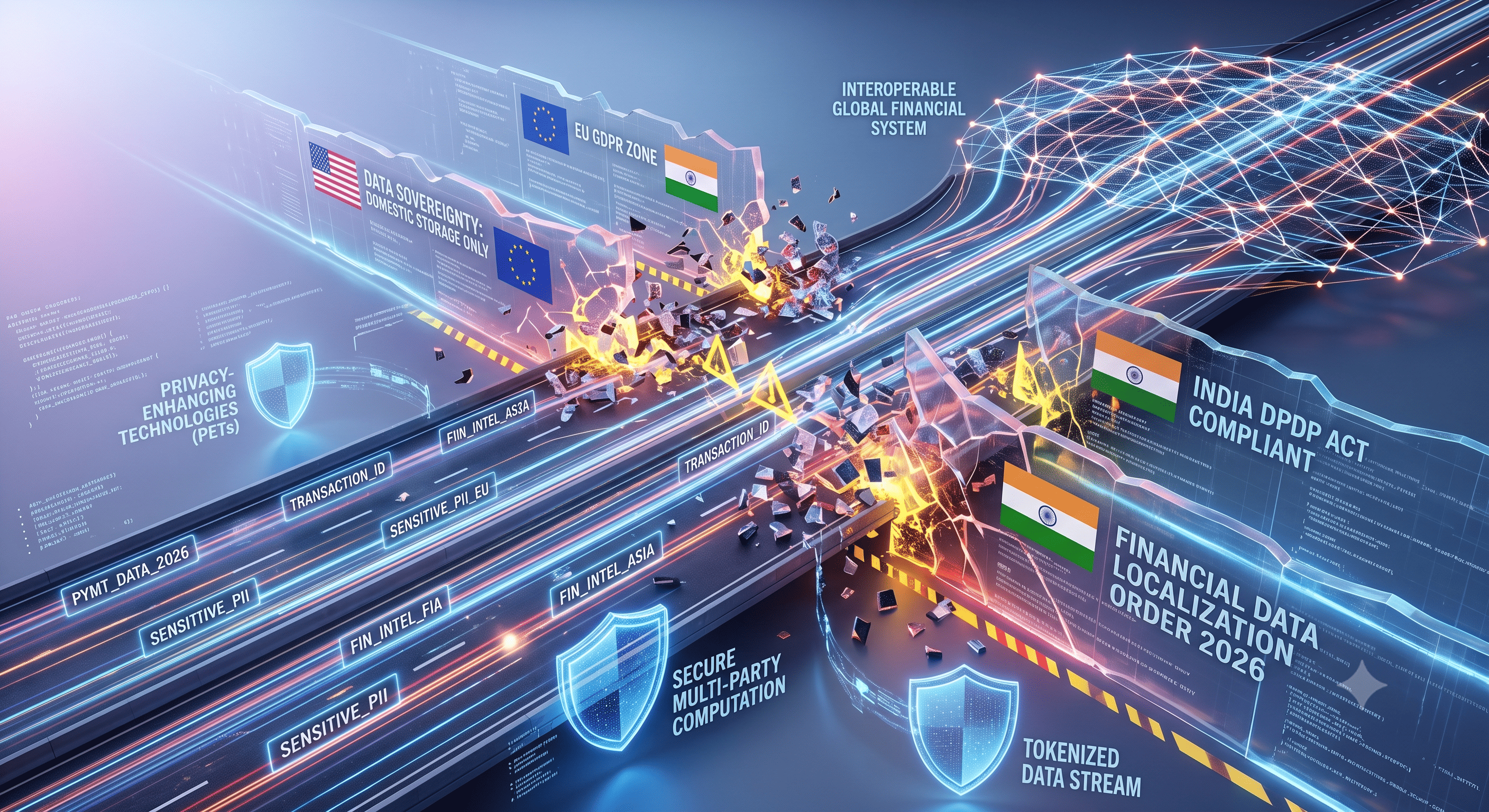
The Collision Course: Data Localization vs. Global Financial Interoperability
~Sura Anjana Srimayi
INTRODUCTION
By mid-2026, the global financial system stands at a critical crossroads. The same digital infrastructure that facilitates a $250 trillion cross-border payments market is increasingly under siege by a fragmented regulatory landscape. As nations transition from "data-open" regimes to "data-sovereign" policies, fintech companies, which rely on the seamless, instantaneous movement of data, find themselves caught in a high-stakes struggle between two competing mandates: the need for global interoperability and the demand for strict local data privacy and security.
I. The Economic Friction of "Balkanized" Data
The modern fintech model is built on the premise that data can move as freely as capital. Whether it is a real-time cross-border remittance, a global credit risk assessment, or an automated fraud detection engine, these processes require high-volume, real-time datasets.
However, the proliferation of data localization laws, mandating that personal or financial data be stored and processed within national borders, is creating significant economic friction. For startups and multinational fintechs, the impact is three-fold:
- Redundant Infrastructure: Companies are forced to duplicate data centers and localize IT stacks, drastically increasing capital expenditure and operational complexity.
- Innovation Throttling: AI and machine learning models, which thrive on vast, global datasets to identify fraud or assess risk, are starved of information when they are confined to domestic "data silos."
- Increased Latency and Cost: The requirement to route data through local "chokepoints" adds technical latency to transactions, directly impacting the speed and reliability of cross-border payments, especially for users in emerging markets.
II. The Legal Minefield: Compliance vs. Interoperability
In 2026, legal teams are no longer just interpreting privacy laws; they are navigating a "splinternet" of contradictory mandates. Regulations like the European Union’s GDPR, India’s Digital Personal Data Protection (DPDP) Act, and a wave of new sectoral financial regulations in Asia and Latin America have created a patchwork of compliance requirements that often conflict.
1. The Paradox of Sovereignty
Governments increasingly view financial data as a strategic national asset, akin to oil or gold. Localization laws are framed as a means to ensure "data sovereignty"—granting local regulators absolute oversight during financial investigations. However, this creates a legal "catch-22": authorities demand faster cross-border intelligence to fight sophisticated cybercrime and money laundering, yet the very laws they enact restrict the sharing of the data necessary to perform those investigations.
2. Extraterritoriality and Conflicts of Law
Fintechs are frequently hit by extraterritorial statutes. For instance, a cloud provider operating in India may be subject to local localization requirements while simultaneously being under the jurisdiction of US laws (like the CLOUD Act) that permit foreign access to data. This creates a compliance nightmare where a company must violate one set of laws to satisfy another, exposing them to massive regulatory fines and operational suspension.
III. Navigating the Compliance Challenge: Strategy for 2026
For fintech enterprises, 2026 has marked a shift from "checkbox compliance" to "architectural strategy." To remain interoperable in a fragmented world, industry leaders are adopting several key approaches:
- Privacy-Enhancing Technologies (PETs): Technologies such as tokenization, differential privacy, and secure multi-party computation are becoming the industry's "secret weapon." These allow fintechs to perform analytics and fraud detection on encrypted data without ever "transferring" the underlying personal information in a readable format, potentially satisfying localization mandates while maintaining global intelligence.
- Data Lifecycle Governance: Companies are moving toward automated, context-aware data classification. By knowing exactly what data is "sensitive" and what is "generic," they can keep sensitive data localized while allowing generic metadata to flow globally, maintaining system interoperability without triggering regulatory tripwires.
- Unified Governance Platforms: In 2026, compliance is no longer a legal afterthought. Successful firms have integrated GRC (Governance, Risk, and Compliance) platforms that provide real-time visibility into data flows, enabling legal teams to map exactly where data resides and ensure that cross-border transfers are backed by up-to-date Transfer Impact Assessments (TIAs).
IV. The Path Forward: Mutual Recognition
The long-term viability of the global digital economy depends on moving away from the "all-or-nothing" approach to localization. International forums and trade agreements are increasingly focusing on Mutual Recognition Agreements (MRAs). By creating "whitelisted" jurisdictions where data protection standards are deemed "adequate," regulators can allow for the secure, interoperable flow of data without requiring physical localization.
However, until such harmonized frameworks mature, fintech firms must accept that the "borderless internet" is effectively over. The new reality is a "federated" approach—where global platforms are built from local bricks, linked together by highly secure, policy-compliant protocols that prioritize both the rights of the citizen and the efficiency of the market.
CONCLUSION
The tension between data localization and global financial interoperability is the defining regulatory challenge of 2026. While the drive for data sovereignty is a legitimate response to cybersecurity and privacy concerns, if left unchecked, it threatens to balkanize the global financial system, raising costs for consumers and stifling the innovation that fintech provides. The solution lies in a shift toward compliance-by-design, where technology and law work in tandem. By leveraging privacy-preserving technical architectures and advocating for international regulatory harmonization, the financial industry can navigate this complex terrain, ensuring that the flow of global payments remains as fast and frictionless as the data that powers them, even within an increasingly fragmented world.
Disclaimer
Every effort has been made to ensure accuracy in this material. However, inadvertent errors or omissions may occur. Any discrepancies brought to the author’s notice will be rectified in subsequent editions. The author shall not be liable for any direct, indirect, incidental, or consequential damages arising from the use of this material. This article is based on various sources including statutory enactments, judicial decisions, academic research papers, professional journals, and publicly available legal materials.
~Sura Anjana Srimayi