
Forget Password

View News
THE ENERGY CRISIS: EVOLUTION OF INDIA
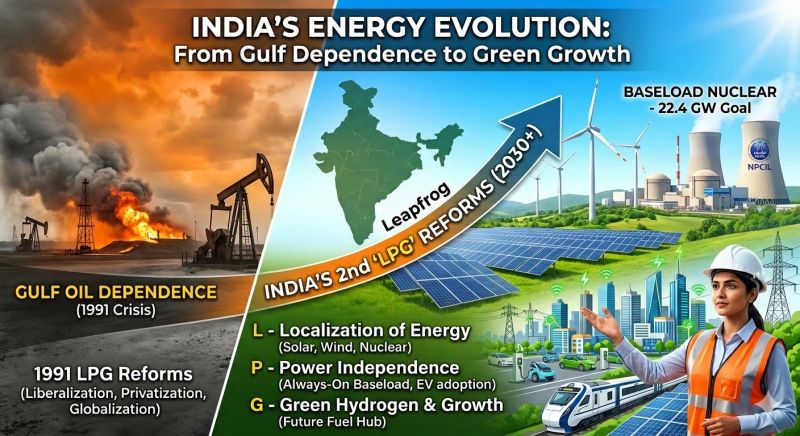
THE ENERGY CRISIS: EVOLUTION OF INDIA
~ Sura Anjana Srimayi
INTRODUCTION
India’s transformation from a chronically power-deficient nation into an emerging global energy power is not a linear success story; rather, it is a complex narrative shaped by repeated crises, geopolitical shocks, and decisive legal interventions. From the oil embargo of the 1970s to the ongoing March 2026 Mid Asian Crisis, each disruption has exposed structural vulnerabilities in India’s energy framework. However, what distinguishes India’s journey is not merely its resilience, but its consistent reliance on law as an instrument of survival and reform.
Unlike many economies that depended primarily on diplomatic alignments or market adjustments, India responded to energy insecurity through what may be termed a “Statutory Armor”—a layered legal and policy framework designed to absorb shocks, correct inefficiencies, and gradually build sovereignty. Over time, this approach has evolved from state-controlled protectionism to a hybrid regime of liberalization, transparency, and technological governance, reflecting India’s broader economic maturation.
I. THE 1973 & 1979 OIL SHOCKS: THE ERA OF NATIONALIZATION
The twin oil shocks of 1973 and 1979 marked India’s first major confrontation with global energy volatility. The Yom Kippur War (1973) triggered an embargo by oil-producing nations, while the Iranian Revolution (1979) severely disrupted supply chains. At that time, India’s petroleum sector was dominated by foreign corporations such as Shell and Exxon, leaving the country strategically vulnerable.
The Indian state responded with decisive legal intervention through a series of nationalization statutes between 1974 and 1976. These laws enabled the government to take over assets of multinational oil companies, leading to the formation of public sector giants like Hindustan Petroleum Corporation Limited (HPCL) and Bharat Petroleum Corporation Limited (BPCL). This marked a fundamental shift—energy was no longer treated as a commercial commodity alone, but as a strategic national asset.
Simultaneously, enforcement under the Petroleum Act, 1934 was significantly strengthened to regulate storage, distribution, and pricing mechanisms. More importantly, the government initiated a policy thrust toward domestic exploration, empowering Oil and Natural Gas Corporation (ONGC) to expand operations. This period laid the foundation for India’s long-term objective of energy self-reliance, embedding it within statutory and institutional frameworks.
II. THE 1990–91 GULF WAR: THE CATALYST FOR LIBERALIZATION
The Gulf War (1990–91) brought India to the brink of economic collapse. With oil prices surging and foreign exchange reserves dwindling to critical levels, the crisis evolved into a severe Balance of Payments (BoP) emergency. This moment forced India to rethink not just its energy policy, but its entire economic structure.
The legal response was transformative. The New Power Policy of 1991, introduced through amendments to the Electricity (Supply) Act, 1948, opened the power generation sector to private and foreign investment. This marked the beginning of India’s transition from a state-dominated energy regime to a market-oriented framework.
Additionally, the introduction of the Liberalized Exchange Rate Management System (LERMS) ensured that oil-importing entities could access foreign exchange through a regulated dual-rate system, thereby stabilizing imports during volatility. The seeds of competitive hydrocarbon exploration were also sown during this period, eventually leading to policies like NELP and HELP. This phase redefined energy security as not just resource availability, but also financial and institutional capacity.
III. THE 2003 STRUCTURAL OVERHAUL: FIXING THE BROKEN GRID
By the early 2000s, India’s energy crisis had shifted from external dependency to internal inefficiency. State Electricity Boards were financially insolvent, transmission losses were rampant, and frequent blackouts reflected systemic failure. The fragmented legal regime governing electricity further exacerbated these issues.
The enactment of the Electricity Act, 2003 marked a watershed moment in India’s energy jurisprudence. This comprehensive legislation consolidated previous laws and introduced sweeping reforms. Generation was de-licensed, allowing private players to establish power plants without bureaucratic hurdles (except in sensitive sectors like hydro and nuclear energy). The unbundling of State Electricity Boards into separate entities for generation, transmission, and distribution enhanced operational accountability and transparency.
The Act also introduced the concept of Open Access, enabling large consumers to procure electricity directly from producers, thereby fostering competition and efficiency. To ensure swift dispute resolution, the Appellate Tribunal for Electricity (APTEL) was established as a specialized judicial body. This reform phase signaled India’s shift toward a regulated market model, balancing state oversight with private participation.
IV. THE 2012–2015 COAL CRISIS: “COALGATE” AND LEGAL PURGE
India’s energy vulnerabilities resurfaced dramatically during the coal crisis of the early 2010s, culminating in the infamous “Coalgate” scandal. The situation was aggravated by the 2012 blackout, one of the largest in history, affecting over 600 million people. The crisis stemmed from arbitrary coal block allocations and acute supply shortages.
In a landmark decision, the Supreme Court of India invalidated 214 coal block allocations, exposing deep-rooted governance failures. In response, Parliament enacted the Coal Mines (Special Provisions) Act, 2015, which replaced discretionary allocation with a transparent, auction-based system.
Complementing this, the SHAKTI policy institutionalized coal linkage allocation through competitive mechanisms, ensuring efficiency and fairness. The National Tariff Policy, 2016 further mandated competitive bidding for power procurement, effectively dismantling opaque cost-plus regimes. This phase represented a legal cleansing of the sector, prioritizing transparency and accountability.
V. THE 2021–2023 GLOBAL VOLATILITY: THE GREEN PIVOT
The post-pandemic global recovery, coupled with geopolitical tensions such as the Russia-Ukraine conflict, triggered unprecedented volatility in fossil fuel markets. India responded not by deepening fossil fuel dependence, but by accelerating its transition toward renewable energy.
The Energy Conservation (Amendment) Act, 2022 marked a paradigm shift by introducing a Carbon Credit Trading Scheme and mandating non-fossil energy usage across sectors. This transformed green energy from a voluntary initiative into a statutory obligation.
The National Green Hydrogen Mission (2023) provided a robust policy framework with financial incentives and streamlined approvals, positioning India as a future leader in green fuel technologies. Furthermore, the Electricity (Promoting Renewable Energy Through Green Energy Open Access) Rules, 2022 democratized access to renewable energy by empowering even small consumers to demand green power. This era reflects India’s transition toward sustainable energy sovereignty, integrating environmental goals with legal mandates.
VI. THE 2026 MID ASIAN CRISIS: EMERGENCY ENERGY JURISPRUDENCE
The ongoing March 2026 Mid Asian Crisis, marked by crude prices exceeding $117 per barrel and disruptions in critical supply routes such as the Strait of Hormuz, has tested India’s energy resilience once again. However, unlike earlier crises, the response has been swift, technologically advanced, and legally sophisticated.
The government invoked the Essential Commodities Act, 1955, enabling it to regulate production, supply, and distribution of essential fuels, thereby prioritizing domestic consumption. Strategic Petroleum Reserves located in Visakhapatnam, Mangalore, and Padur were released under national security protocols to bridge supply gaps.
In a novel move, the government introduced Digital Fuel Control Orders, mandating smart-cylinder authentication systems to curb black marketing and ensure equitable distribution. This represents the emergence of “digital jurisprudence” in energy governance, where law intersects with technology to enforce compliance in real time.
CONCLUSION
India’s experience with energy crises demonstrates a fundamental truth: while energy resources may be geological, energy security is inherently legal and institutional. Each crisis has prompted not just policy adjustments, but structural legal reforms that have progressively strengthened the system.
From the nationalization drives of the 1970s to the market reforms of the 1990s, from structural overhauls in the 2000s to transparency-driven corrections in the 2010s, and finally to sustainability-focused and tech-enabled governance in the 2020s, India’s journey reflects a continuous process of legal evolution.
Today, as India withstands one of the most volatile energy environments in recent history, it does so not merely on the strength of its resources, but on the cumulative power of its legal framework. The shift from a nation once dependent on external goodwill to one capable of legislating its own energy destiny stands as a testament to its economic and institutional maturity.
Unlock the Potential of Legal Expertise with LegalMantra.net – Your Trusted Legal Consultancy Partner
Disclaimer
Every effort has been made to ensure accuracy in this material. However, inadvertent errors or omissions may occur. Any discrepancies brought to the author’s notice will be rectified in subsequent editions. The author shall not be liable for any direct, indirect, incidental, or consequential damages arising from the use of this material. This article is based on various sources including statutory enactments, judicial decisions, academic research papers, professional journals, and publicly available legal materials.
Sura Anjana Srimayi
LegalMantra.net Team