
Forget Password

View News
The Internet of Things in 2026 Ecosystems, Security, and Governance
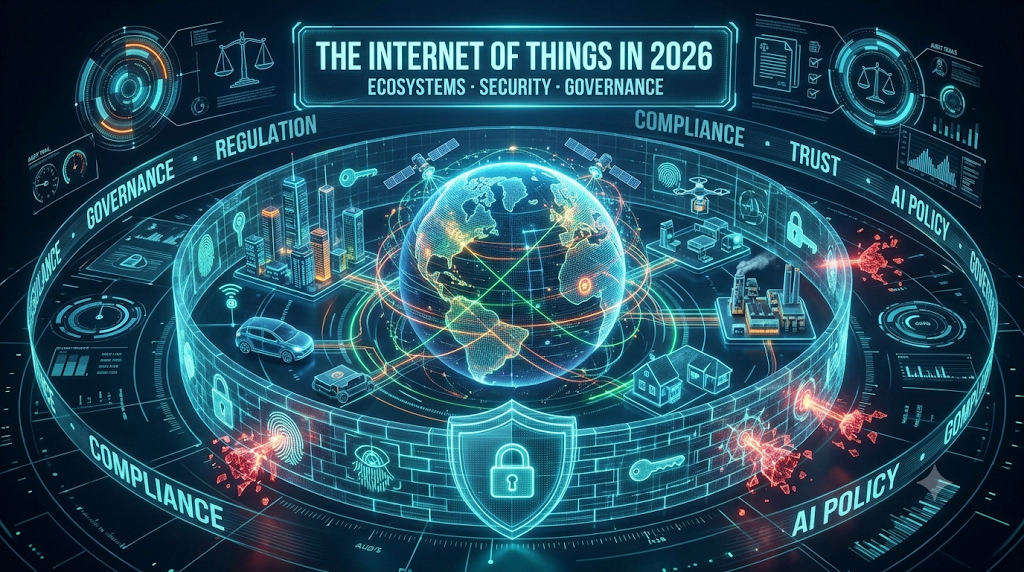
The Internet of Things (IoT) in 2026: Ecosystems, Security, and Governance
~Sura Anjana Srimayi
INTRODUCTION
As of 2026, the Internet of Things (IoT) has evolved far beyond a collection of isolated "smart" gadgets. It now represents a sophisticated integration of large-scale systems that bridge physical operations with digital intelligence, automation, and real-time analytics. By interlinking sensors, industrial machines, and environmental monitors, IoT ecosystems provide organizations with actionable insights, effectively transforming raw data into operational value.
Defining the Modern IoT Ecosystem
In the current landscape, IoT is defined by "system-level thinking". Rather than focusing on a single device, modern IoT environments support operational ecosystems. These systems operate by:
- Collecting Data: Sensors gather environmental or operational information.
- Transmitting & Processing: Data is sent over secure networks and processed either at the "edge" (close to the source) or in the cloud.
- Executing Decisions: Advanced software and AI identify trends, trigger alerts, or automate actions without human intervention.
This shift is crucial for businesses, where IoT is used for remote supervision, predictive maintenance, and real-time process optimization.
The Regulatory and Legal Landscape
With the rapid scaling of interconnected devices, the governance of IoT has become a priority for global regulators. In 2026, IoT security and privacy are no longer optional but are governed by evolving frameworks that emphasize "security-by-design".
Key Legal Frameworks and Compliance
- Data Protection and Privacy: The Digital Personal Data Protection (DPDP) Act, 2023 and its associated 2025 Rules form the regulatory backbone for data processing in India. Globally, standards such as GDPR continue to influence how IoT ecosystems handle personal identifiers, location data, and health records.
- Cybersecurity Standards: Enterprises are increasingly aligning with frameworks like the NIST Cybersecurity Framework (CSF 2.0) and ISO/IEC 27001, which have been updated to address cloud-native and IoT-specific threats. The European ETSI EN 303 645 standard remains a benchmark for essential IoT controls, mandating the removal of default passwords and requiring secure firmware update mechanisms.
- Operational Resilience: Regulations like the Digital Operational Resilience Act (DORA) in the EU now mandate strict incident reporting, third-party risk visibility, and active testing of system availability for financial institutions and their IT service providers.
- AI and Synthetic Data Regulation: Recent amendments, such as India's IT Rules Amendment, 2026, have introduced compliance obligations for synthetic digital content, ensuring transparency and traceability in environments where IoT might interact with AI-generated data.
Security Priorities for Connected Ecosystems
Because a single vulnerable endpoint can compromise an entire network, organizations in 2026 are focusing on five key security priorities:
- Zero Trust Architecture: Moving away from default credentials by verifying every device and connection before granting access.
- Lifecycle Security: Integrating security from the design stage through deployment, maintenance, and decommissioning.
- Advanced Encryption & Segmentation: Using end-to-end encryption for data at rest and in transit, while segmenting IoT networks to isolate critical infrastructure.
- AI-Driven Monitoring: Employing real-time, AI-based anomaly detection to identify suspicious behavior that traditional firewalls might miss.
- Supply Chain Transparency: Ensuring that third-party vendors and shared libraries meet the same rigorous security standards as internal systems.
CONCLUSION
The Internet of Things in 2026 is a cornerstone of modern digital infrastructure, essential for automation and data-driven decision-making. However, its massive scale brings significant security and privacy challenges. Compliance is no longer reactive; it requires a proactive, "security-by-design" approach that embeds governance into every layer of the digital ecosystem. As regulatory frameworks tighten, organizations that prioritize resilient IoT security will not only mitigate operational risks but also build the foundational trust necessary for a hyperconnected future.
Disclaimer
Every effort has been made to ensure accuracy in this material. However, inadvertent errors or omissions may occur. Any discrepancies brought to the author’s notice will be rectified in subsequent editions. The author shall not be liable for any direct, indirect, incidental, or consequential damages arising from the use of this material. This article is based on various sources including statutory enactments, judicial decisions, academic research papers, professional journals, and publicly available legal materials.