
Forget Password

View News
The Law of the Seas: A Reflection on the Maritime Law
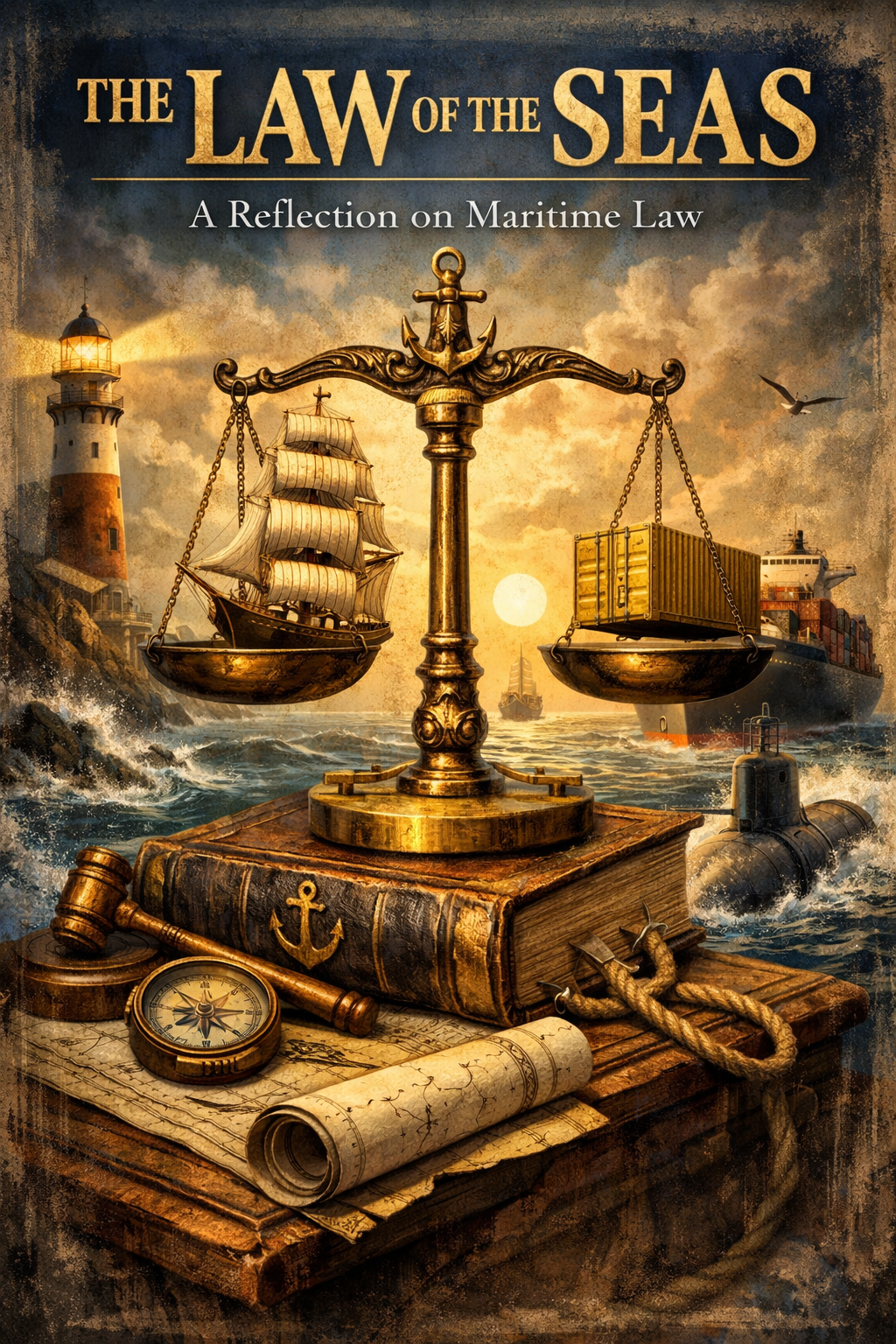
The Law of the Seas: A Reflection on the Maritime Law
~Sura Anjana Srimayi
INTRODUCTION
Maritime Law or Admiralty Law is a special body of law that controls all activities, accidents, and legal relationships involving the sea. It is one of the oldest and most widely known branches of law that has developed from ancient seafaring states into an intricate framework of national laws and international treaties. Maritime Law is really the legal system supporting world commerce, delimiting jurisdiction in seas, managing environmental protection, and offering remedies for navigational, shipping, and sea resources exploitation disputes. As more than 90% of world trade moves by sea, this legal sphere is unavoidable in today's world economy, reconciling shipowners', insurers', crews', ports', and coastal states' interests. Body: Central Pillars of Maritime Law
Maritime law is a system operating in two channels, both deriving its authority from national domestic legislation and an extensive network of international treaties.
1. Sources and Jurisdiction
The roots of Maritime Law are traced back to ancient codes such as the Rhodian Sea Law and medieval codes such as the Laws of Oléron and the Consulate of the Sea. Its authority now flows from two principal sources:
- National Admiralty Law: In every state, there are particular courts (usually referred to as Admiralty Courts) and national statutes that regulate internal maritime activity, including territorial waters disputes or national enforcement of maritime liens and contracts.
- International Conventions: International law is the most powerful and uniting influence. The International Maritime Organization (IMO), a UN specialized agency, is the main international body charged with developing and adopting the majority of international conventions. Major treaties include:
- The United Nations Convention on the Law of the Sea (UNCLOS) : Famously referred to as the "Constitution of the Oceans," UNCLOS is the constitutive treaty that establishes coastal state rights, jurisdiction over different zones (territorial sea, contiguous zone, Exclusive Economic Zone (EEZ), and the high seas), and the system of regulating deep seabed mining.
- Safety Conventions: The International Convention for the Safety of Life at Sea (SOLAS) sets minimum standards for the construction, equipment, and operation of ships to ensure safety.
- Environmental Conventions: The International Convention for the Prevention of Pollution from Ships (MARPOL) is the key treaty covering pollution by oil, noxious liquid substances, harmful packaged substances, sewage, garbage, and air emissions from ships.
Jurisdiction in matters of the sea can be complicated. Generally speaking, a vessel is subject to the law of the state whose flag it flies—its Flag State. Coastal states possess sovereign rights in their territorial sea (up to 12 nautical miles) and jurisdictional rights in resources and environmental protection in their EEZ (up to 200 nautical miles).
2. Specific Areas of Regulation
Maritime Law involves some specialized and important areas:
- Carriage of Goods by Sea: This is the commercial center of the law, dealing with the legal relationship between shipper (cargo owner) and carrier (shipowner or charterer). Key conventions such as the Hague-Visby Rules (and their contemporary equivalents, the Rotterdam Rules) establish the carrier's rights, liabilities, and immunities in regard to loss or damage to cargo. One key document in such a relationship is the Bill of Lading, which performs three roles: a receipt for the cargo, proof of the contract of carriage, and a document of title. Shipping and Navigation: This sector involves the technical and operational aspects of ships. It encompasses regulations on the registration and nationality of ships, rules of collision avoidance (regulated by the International Regulations for Preventing Collisions at Sea, or COLREGs), and laws on piloting, towing, and salvage.
- Marine Insurance: Virtually every vessel and cargo on the high seas are insured by marine insurance. The law regulates marine insurance contracts, such as rules like insurable interest and utmost good faith. The most distinctive notion here is General Average, a principle of maritime law whereby all the parties to a sea adventure (shipowner and cargo owners) share proportionally the monetary loss arising from any voluntary loss of part of the ship or cargo in order to salvage the entire venture from an imminent danger. Seafarers and Crew: This regulates the relationship between the shipowner and the seafarers. The Maritime Labour Convention (MLC, 2006) is commonly referred to as the "seafarers' bill of rights," a consolidation of a multitude of conventions regarding minimum working and living conditions, employment terms, health, and social security protection for global seafarers.
- Vessel Financing and Security: Shipping law enables ship financing through instruments such as the maritime mortgage or lien, which enable financiers to take a loan against a valuable, movable asset such as a ship. The ranking of maritime liens (charges against a vessel for services such as salvage, wages of crew, or collision damage) governs whose creditors have preference when a ship is arrested or sold.
3. Environmental Protection and Modern Challenges
The financial crisis of 2008 pinpointed the need for firm, internationally linked regulatory systems, a belief that holds true in contemporary Maritime Law. The rise in ship size, the greater danger of piracy, and the need to tackle climate change have driven this body of law into new areas:
- Liability and Pollution: The law imposes strict liability on shipowners for pollution damage, especially oil spills. Conventions such as the Civil Liability Convention (CLC) and the Fund Convention provide for compensation of victims of pollution.
- Piracy and Security: Increased maritime piracy, especially off Somalia's coast and in the region of Southeast Asia, has prompted nations to make their laws relating to armed guards, self-protection on the high seas, and international naval collaborations for safeguarding shipping lanes.
- Climate Change and Decarbonization: The IMO is also busy working on regulations for reducing the shipping sector's greenhouse gas emissions. Future Maritime Law will increasingly be influenced by regulations on ship energy efficiency, alternative fuels, and carbon reduction targets, fundamentally transforming ship design and operating practices.
CONCLUSION
Maritime Law is a testament to humanity's continuing dependence on the sea.
From the ancient regulations of cargo jettisoning to the contemporary international conventions tackling the global issue of climate change, this body of law remains dynamic and keeps pace with global trade and environmental needs. It is an expert, complex, and cross-border legal regime that provides commercial certainty, enables the safe passage of goods over the seas, and serves as the legal trustee of the world's most vital global common, the sea. Its dual character, based in national admiralty courts but aligned by such international agreements as UNCLOS and MARPOL is what makes it such a strong and effective force for the preservation of order and justice on the earth's surface.
"Unlock the Potential of Legal Expertise with LegalMantra.net - Your Trusted Legal Consultancy Partner”
Disclaimer: Every effort has been made to avoid errors or omissions in this material in spite of this, errors may creep in. Any mistake, error or discrepancy noted may be brought to our notice which shall be taken care of in the next edition In no event the author shall be liable for any direct indirect, special or incidental damage resulting from or arising out of or in connection with the use of this information Many sources have been considered including Newspapers, Journals, Bare Acts, Case Materials , Charted Secretary, Research Papers etc
LegalMantra.net team