
Forget Password

View News
The Legal and Regulatory Tracks: Accelerating India’s High-Speed Rail Ambitions
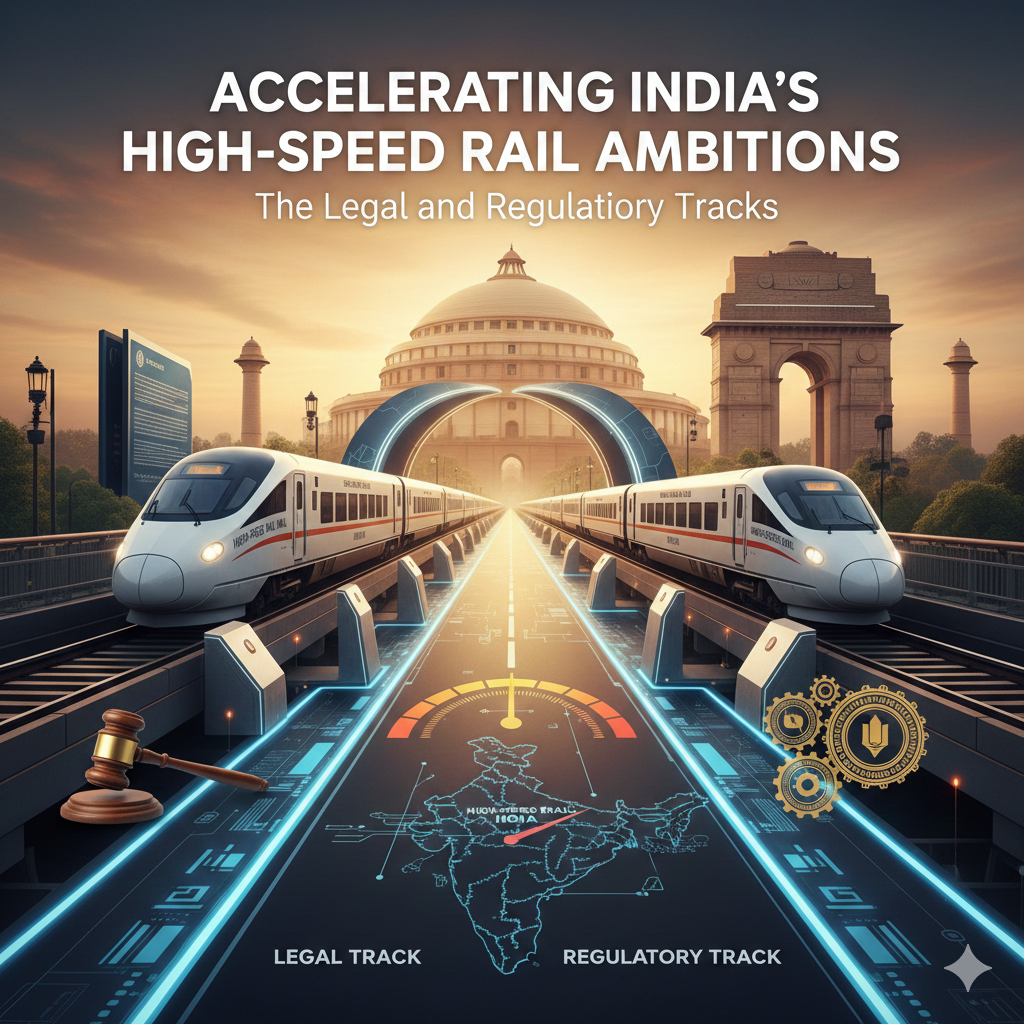
The Legal and Regulatory Tracks: Accelerating India’s High-Speed Rail Ambitions
~ Sura Anjana Srimayi
INTRODUCTION
India’s aspiration to join the league of nations operating High-Speed Rail (HSR) systems represents a transformative leap in both technological capability and economic integration. The Mumbai–Ahmedabad High-Speed Rail (MAHSR) corridor, popularly known as the bullet train project, stands as the flagship initiative of this ambition. Designed to drastically reduce travel time, enhance inter-city mobility, and stimulate regional economic development, the project signifies far more than a transportation upgrade. It reflects India’s intent to modernize its infrastructure in line with global standards.
However, the realization of HSR infrastructure is not merely an engineering or financial undertaking. Unlike conventional railway projects governed largely by the Railways Act, 1989, high-speed rail involves a dense matrix of legal, regulatory, constitutional, and international law considerations. From large-scale land acquisition and stringent environmental clearances to international financing arrangements and specialized safety regulations, the HSR journey is equally legal in nature as it is technical. An understanding of this legal ecosystem is essential to appreciate the institutional complexity and governance challenges embedded in India’s high-speed rail ambitions.
LEGISLATIVE AND INSTITUTIONAL FRAMEWORK
A critical prerequisite for implementing high-speed rail in India lies in establishing an appropriate legislative and institutional framework capable of addressing the scale, speed, and sophistication of such projects.
1. Creation of a Specialized Statutory and Corporate Authority
The National High-Speed Rail Corporation Limited (NHSRCL) was incorporated as a Special Purpose Vehicle (SPV) under the Companies Act, 2013, specifically to plan, finance, construct, and operate the MAHSR project. The adoption of an SPV structure marks a significant legal departure from traditional Indian Railways administration. Unlike departmental execution, an SPV provides functional autonomy, streamlined decision-making, professional financial management, and the ability to enter into complex international contracts.
From a legal standpoint, such a structure becomes indispensable for multi-state projects involving central and state governments, foreign lenders, and technology partners. NHSRCL operates as a corporate entity with defined rights and obligations, enabling it to manage procurement, land acquisition coordination, and long-term operational responsibilities while remaining insulated from routine bureaucratic constraints.
2. Bilateral and International Legal Arrangements
The MAHSR project is heavily reliant on foreign financial and technological collaboration, particularly from Japan through the Japan International Cooperation Agency (JICA). This collaboration is governed by a network of bilateral agreements and inter-governmental understandings, which form the backbone of the project’s legal legitimacy.
These agreements address critical issues such as loan conditions, interest rates, technology transfer, intellectual property rights, procurement norms, and compliance with international environmental and social safeguards. Such treaties also impose binding obligations on India to adhere to specific quality, safety, and governance standards throughout the project lifecycle.
An important legal feature of these contracts is the incorporation of international arbitration clauses. Given the participation of foreign lenders and technology suppliers, disputes are often contractually agreed to be resolved through international arbitration forums such as Singapore or London. This approach enhances investor confidence by offering neutrality, predictability, and enforceability of awards, thereby reducing reliance on domestic judicial processes.
THE MAJOR LEGAL ROADBLOCK: LAND ACQUISITION
Among all legal challenges confronting high-speed rail projects in India, land acquisition remains the most contentious and time-consuming. HSR corridors require long, continuous, and geometrically straight alignments, which inevitably cut through private land holdings, agricultural fields, and densely populated regions.
1. Applicability of the RFCTLARR Act, 2013
Land acquisition for HSR projects is governed by the Right to Fair Compensation and Transparency in Land Acquisition, Rehabilitation and Resettlement Act, 2013 (RFCTLARR Act). This legislation was enacted to address historical injustices associated with compulsory land acquisition and introduces a rights-based approach for affected landowners and families.
The Act mandates compensation significantly above market value—up to four times the market value in rural areas and twice the market value in urban areas. In addition to monetary compensation, it imposes legally binding obligations on project authorities to provide comprehensive rehabilitation and resettlement (R&R) packages, including housing, livelihood support, and infrastructural amenities.
A distinctive legal safeguard under the Act is the requirement of a Social Impact Assessment (SIA). The SIA evaluates the social, economic, and cultural impact of the proposed acquisition and serves as a precondition for governmental approval. In the context of MAHSR, disputes relating to adequacy of compensation, procedural compliance, and public purpose have resulted in prolonged litigation before High Courts and the Supreme Court, significantly affecting project timelines.
2. Environmental and Forest Clearances
High-speed rail corridors traverse diverse ecological zones, necessitating strict compliance with environmental and forest conservation laws. The diversion of forest land attracts mandatory clearances under the Forest (Conservation) Act, 1980, while broader ecological concerns fall within the ambit of the Environmental (Protection) Act, 1986.
A detailed Environmental Impact Assessment (EIA) is legally required to evaluate potential damage to ecosystems, wildlife habitats, and local communities. Additionally, the law mandates compensatory afforestation, requiring project proponents to plant trees on non-forest land equivalent to the forest area diverted.
Environmental compliance remains particularly vulnerable to judicial scrutiny. Public Interest Litigations (PILs) challenging environmental clearances can stall construction until courts are satisfied with adherence to statutory and constitutional environmental principles, thereby underscoring the centrality of environmental law in infrastructure governance.
OPERATIONAL AND SAFETY REGULATORY REGIME
Once constructed, high-speed rail systems demand a distinct legal framework for operation and safety, given their technological sophistication and risk profile.
1. Safety Standards and Certification
HSR safety norms differ fundamentally from those applicable to conventional railways. Safety standards are largely dictated by international technology transfer agreements and specialized technical protocols. Legal compliance requires alignment with standards prescribed by institutions such as the Research Designs and Standards Organisation (RDSO), as well as internationally accepted safety benchmarks.
Rolling stock certification constitutes a critical legal process, ensuring that trains meet prescribed safety norms related to braking systems, aerodynamics, structural integrity, and crashworthiness. Furthermore, the legal framework must provide for dedicated safety regulations, including complete fencing of corridors, strict trespass prevention measures, and penal provisions for any interference with the alignment. Unlike conventional railways, HSR systems cannot accommodate level crossings or encroachments due to extreme operational speeds.
2. Tariff Fixation and Economic Regulation
As NHSRCL functions as a corporate operator rather than a government department, the legal mechanism for tariff fixation assumes special significance. Tariffs must be structured to ensure financial viability, enabling the servicing of long-term international debt and covering operational and maintenance costs.
Simultaneously, tariff policy must remain consistent with public interest considerations, ensuring affordability and equitable access. Achieving this balance may necessitate specific legislation or the extension of regulatory oversight by an independent statutory authority, potentially on the lines of the Railways Regulatory Authority of India (RRAI), with a clearly defined mandate over high-speed rail services.
3. Liability and Compensation Regime
The issue of liability in the event of accidents or system failures requires careful legal articulation. While the Railways Act, 1989 governs compensation for conventional railway accidents, the unique risk profile of HSR systems may warrant enhanced statutory compensation limits for death or injury.
Additionally, the involvement of foreign technology suppliers introduces complex questions of product liability and contractual indemnities. In cases where accidents arise due to defects in rolling stock or signaling systems, liability may extend beyond the operator to manufacturers, subject to the terms of international contracts and applicable conflict-of-law principles.
CONCLUSION
India’s high-speed rail ambitions are as much a test of legal and regulatory capacity as they are of engineering prowess. The success of projects such as the Mumbai–Ahmedabad High-Speed Rail corridor hinges upon the effective resolution of intricate legal challenges relating to land acquisition under the RFCTLARR Act, environmental and forest clearances, and the governance of international financing and technology transfer arrangements.
Institutional innovations like the establishment of NHSRCL and the strategic use of international arbitration mechanisms represent conscious legal adaptations aimed at expediting implementation while safeguarding investor confidence. Ultimately, the long-term safety, financial sustainability, and public acceptance of high-speed rail in India will depend on the creation of a robust and distinct regulatory regime—one that harmonizes global best practices with domestic legal principles. In laying the foundations for high-speed rail, India must ensure that its legal tracks are engineered with the same precision and foresight as its physical ones.
"Unlock the Potential of Legal Expertise with LegalMantra.net - Your Trusted Legal Consultancy Partner”
Disclaimer: Every effort has been made to avoid errors or omissions in this material in spite of this, errors may creep in. Any mistake, error or discrepancy noted may be brought to our notice which shall be taken care of in the next edition In no event the author shall be liable for any direct indirect, special or incidental damage resulting from or arising out of or in connection with the use of this information Many sources have been considered including Newspapers, Journals, Bare Acts, Case Materials , Charted Secretary, Research Papers etc