
Forget Password

View News
The Reliability of Witness Testimony in the Justice Delivery System
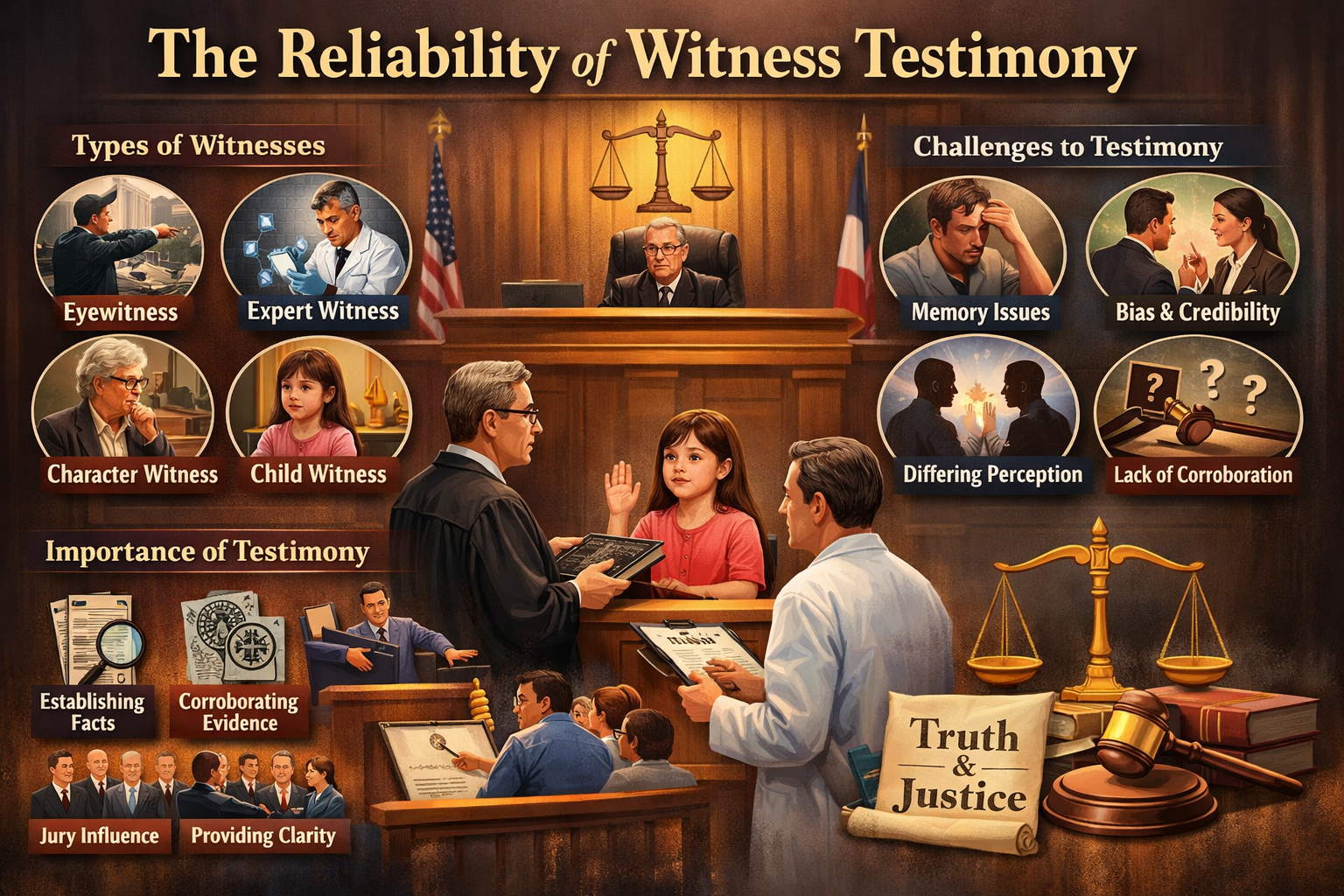
The Reliability of Witness Testimony in the Justice Delivery System
1. Introduction
Witness testimony forms one of the most crucial pillars of the justice delivery system. In both civil and criminal trials, courts rely extensively on the statements of individuals who have either directly observed an incident or possess relevant knowledge regarding the facts in dispute. Witness evidence helps reconstruct events that have already occurred and enables judges to determine the truth behind competing narratives presented by parties to a dispute.
The reliability and credibility of witness testimony often determine the outcome of legal proceedings. A compelling and trustworthy witness can strengthen the case of a party, while inconsistent or unreliable testimony may weaken it significantly. In criminal cases especially, where the liberty of an accused person is at stake, courts carefully evaluate witness statements to ensure that justice is delivered based on credible and legally admissible evidence.
A recent illustration of the importance of witness testimony can be seen in the decision of the Supreme Court of India in State of Madhya Pradesh v. Balveer Singh. In this case, the Court overturned the acquittal granted by the Madhya Pradesh High Court and sentenced the accused to life imprisonment for the murder of his wife. The conviction was significantly based on the testimony of the couple’s seven-year-old daughter who appeared as a child witness.
A bench comprising Justices J.B. Pardiwala and Manoj Misra held that the testimony of a child witness cannot be disregarded merely on account of age. The Court emphasized that a child witness stands on the same footing as any other witness, provided the testimony appears trustworthy and reliable. However, courts must exercise caution because children are more susceptible to tutoring or influence. Therefore, the primary safeguard lies in carefully assessing the credibility and spontaneity of the child’s testimony.
This judgment highlights the broader principle that witness testimony, irrespective of the witness’s age, must be evaluated on the basis of credibility, consistency, and corroboration.
2. Concept and Meaning of Witness Testimony
Witness testimony refers to statements made by individuals before a court regarding facts that are relevant to a case. Such statements may be given orally during examination in court or recorded in written form during investigation or affidavits.
Under the principles of evidence law, a witness is a person who provides information based on their personal knowledge, perception, or expertise. Before giving testimony, witnesses are typically required to take an oath or affirmation to speak the truth, thereby attaching legal responsibility to their statements.
The primary objective of witness testimony is to assist the court in determining disputed facts. By narrating events, clarifying circumstances, and explaining observations, witnesses help judges reconstruct the sequence of events leading to the dispute or crime.
Witness testimony generally involves three stages in court proceedings:
2.1 Examination-in-Chief
This is the stage where the witness is first examined by the party that called them. The purpose is to establish the facts that support that party’s case. Questions during this stage are generally structured to allow the witness to narrate events clearly without being influenced.
2.2 Cross-Examination
Cross-examination is conducted by the opposing party to test the credibility, reliability, and accuracy of the witness’s testimony. Lawyers often use this stage to highlight contradictions, biases, inconsistencies, or weaknesses in the witness’s statement.
2.3 Re-Examination
Re-examination may occur after cross-examination to clarify matters that were raised during questioning. It allows the party who called the witness to address ambiguities or explain contradictions that arose during cross-examination.
3. Types of Witnesses in Legal Proceedings
Witnesses may be categorized into several types depending on the nature of their testimony and their relationship with the facts of the case.
3.1 Eyewitnesses
Eyewitnesses are individuals who directly observe an event or incident and later testify about what they saw. Their testimony is considered particularly valuable because it is based on direct perception rather than secondary information.
For example, in a criminal trial involving assault or murder, an eyewitness may testify that they saw the accused at the crime scene or witnessed the act being committed. Such testimony can significantly influence the court’s understanding of the sequence of events.
However, psychological studies have demonstrated that eyewitness testimony may sometimes be affected by factors such as stress, poor visibility, memory distortion, or personal bias. Therefore, courts generally seek corroboration before relying solely on eyewitness accounts.
3.2 Expert Witnesses
Expert witnesses are individuals who possess specialized knowledge, skills, training, or professional experience in a particular field. Their role is to assist the court in understanding complex technical or scientific issues that fall beyond ordinary knowledge.
Common examples of expert witnesses include:
-
Forensic experts who analyze DNA or fingerprint evidence
-
Medical professionals who provide opinions regarding injuries or cause of death
-
Financial experts who examine complex financial transactions
-
Technical specialists who interpret digital or technological evidence
Expert testimony does not typically involve direct observation of the event but rather professional interpretation of evidence.
3.3 Character Witnesses
Character witnesses provide information regarding the moral character, reputation, or behavior of a person involved in the case. They do not testify about the events in dispute but instead provide insight into the personality and conduct of the accused or a party.
For instance, in criminal proceedings, a character witness may testify about the accused’s reputation for honesty, peaceful conduct, or integrity within the community. Such testimony may influence sentencing or credibility assessments.
3.4 Lay Witnesses
Lay witnesses are ordinary individuals who testify based on their personal observations or experiences. Unlike expert witnesses, they do not rely on specialized knowledge or professional expertise.
A lay witness might testify about what they heard, saw, or experienced in relation to a particular incident. For example, a neighbor who heard a loud argument before a crime occurred could serve as a lay witness.
4. Importance of Witness Testimony in Legal Proceedings
Witness testimony plays a vital role in judicial proceedings for several reasons.
4.1 Establishing the Facts of the Case
One of the primary functions of witness testimony is to help establish the factual circumstances surrounding an incident. Through firsthand accounts, witnesses provide crucial details about the events leading to the dispute or crime.
Such information helps the court reconstruct the sequence of events and determine the responsibilities of the parties involved.
4.2 Corroborating Documentary or Physical Evidence
Witness testimony often supports or corroborates physical and documentary evidence such as medical reports, photographs, contracts, or forensic findings.
For instance, if forensic evidence indicates that an accused person was present at a location, the testimony of a witness who saw the accused at the same location can strengthen the prosecution’s case.
Conversely, contradictory testimony may weaken the reliability of physical evidence.
4.3 Influencing the Judge or Jury
The demeanor, confidence, and clarity of a witness can significantly affect how their testimony is perceived by the court. A witness who appears honest, consistent, and composed may be regarded as credible.
In contrast, evasive answers, inconsistencies, or visible nervousness may raise doubts regarding the truthfulness of the testimony.
4.4 Providing Clarity in Complex Situations
Legal disputes often involve complicated factual situations that may not be easily understood through documents alone. Witnesses can provide explanations and context that help the court interpret evidence correctly.
A well-prepared witness can simplify technical or confusing aspects of the case and assist judges and juries in making informed decisions.
5. Challenges Associated with Witness Testimony
Despite its importance, witness testimony is not always reliable and may be affected by several challenges.
5.1 Memory Limitations and Inaccuracies
Human memory is inherently imperfect. Witnesses may forget details, confuse events, or reconstruct memories based on assumptions. Factors such as stress, trauma, or the passage of time can further distort recollection.
As a result, courts must carefully evaluate the consistency and reliability of witness statements.
5.2 Bias and Credibility Issues
Witnesses may consciously or unconsciously exhibit bias due to personal relationships, emotional involvement, or preconceived notions about the parties involved in the case.
For example, a witness who is closely related to a party may be perceived as partial. Lawyers often attempt to expose such biases during cross-examination.
5.3 Differences in Perception
Different individuals may perceive the same event in different ways. Factors such as vantage point, lighting conditions, psychological state, and prior experiences may influence how a person interprets an incident.
Consequently, two witnesses may provide different versions of the same event even though both believe they are telling the truth.
5.4 Lack of Corroboration
In certain situations, witness testimony may stand alone without supporting evidence. Courts generally exercise caution when relying solely on the testimony of a single witness, especially if the testimony is contradicted by other evidence.
However, in some circumstances, the testimony of a single credible witness may still be sufficient to establish a fact.
6. Judicial Approach Toward Evaluating Witness Testimony
Courts adopt a careful and systematic approach while assessing the reliability of witness testimony. Judges typically consider factors such as:
-
Consistency of the witness’s statement
-
Probability and logical coherence of the testimony
-
Corroboration with other evidence
-
Conduct and demeanor of the witness
-
Absence of motives for false implication
The objective is to determine whether the testimony inspires confidence and supports the overall narrative presented in the case.
7. Conclusion
Witness testimony remains one of the most vital sources of evidence in the legal system. It plays a crucial role in helping courts reconstruct past events, establish disputed facts, and determine the truth behind conflicting claims.
Through eyewitness accounts, expert opinions, and character evidence, witnesses contribute significant pieces to the evidentiary puzzle that courts must assemble in order to deliver justice. At the same time, the legal system recognizes the potential limitations of human perception, memory, and bias.
Therefore, judges and legal practitioners must carefully evaluate the credibility, consistency, and reliability of witness testimony in conjunction with other forms of evidence. When properly assessed, witness testimony continues to serve as a powerful instrument for uncovering the truth and ensuring fairness in judicial proceedings.
Unlock the Potential of Legal Expertise with LegalMantra.net – Your Trusted Legal Consultancy Partner
Disclaimer
Every effort has been made to ensure accuracy in this material. However, inadvertent errors or omissions may occur. Any discrepancies brought to the author’s notice will be rectified in subsequent editions. The author shall not be liable for any direct, indirect, incidental, or consequential damages arising from the use of this material. This article is based on various sources including statutory enactments, judicial decisions, academic research papers, professional journals, and publicly available legal materials.
Prerna Yadav
LegalMantra.net