
Forget Password

View News
The Right to Die with Dignity under Article 21: Expanding the Contours of the Right to Life in Light of Harish Rana v. Union of India
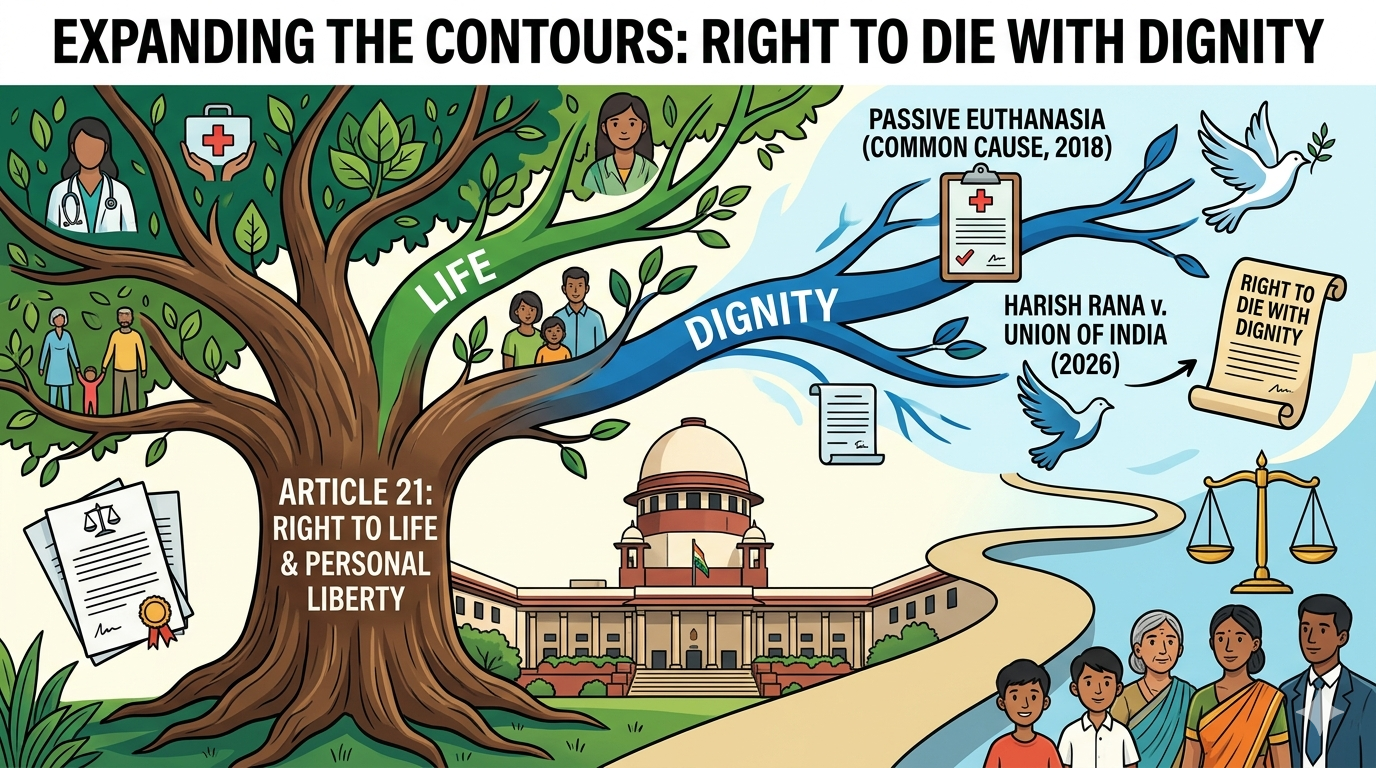
The Right to Die with Dignity under Article 21: Expanding the Contours of the Right to Life in Light of Harish Rana v. Union of India (2026)
Introduction
Article 21 of the Constitution of India, which guarantees the right to life and personal liberty, has been transformed through judicial interpretation into one of the most expansive and dynamic fundamental rights. The Supreme Court has consistently interpreted this provision not in a narrow, literal sense, but as a living guarantee encompassing dignity, autonomy, and the meaningful quality of human existence. Over time, the Court has clarified that the right to life is not merely a right to animal existence but a right to live with dignity.
Within this evolving constitutional framework, the question of whether the right to life includes the right to die with dignity has generated profound legal, ethical, and philosophical debate. The recent decision in Harish Rana v. Union of India (2026) marks a crucial moment in this jurisprudential journey, reinforcing the principle that dignity must extend to the final stages of life. By permitting passive euthanasia in a case involving prolonged vegetative existence, the Court has reaffirmed that Article 21 protects not only the sanctity of life but also the dignity of death.
Judicial Evolution of the Right to Die with Dignity
The trajectory of Indian constitutional jurisprudence on euthanasia reflects a gradual and nuanced shift from rigid interpretations toward a dignity-centric approach. The debate first took constitutional shape in P. Rathinam v. Union of India (1994), where the Supreme Court controversially held that the right to life under Article 21 included the right not to live, thereby decriminalizing an attempt to suicide. This interpretation, however, was short-lived.
In Gian Kaur v. State of Punjab (1996), a Constitution Bench overruled Rathinam, holding that the right to life does not include the right to die. Yet, significantly, the Court introduced an important distinction by recognizing that the right to die with dignity in cases of terminal illness or natural death could fall within the ambit of Article 21. This observation laid the conceptual foundation for later developments.
A major breakthrough came with Aruna Ramachandra Shanbaug v. Union of India (2011), where the Court, for the first time, permitted passive euthanasia under strict judicial supervision. The judgment acknowledged that in certain circumstances, withdrawal of life-sustaining treatment may be justified where recovery is impossible. This position was further strengthened in Common Cause v. Union of India (2018), where the Court explicitly recognized the right to die with dignity as a fundamental right under Article 21 and legalized advance directives or “living wills.”
Thus, prior to Harish Rana, the Court had already established a doctrinal framework that balanced the sanctity of life with respect for human dignity, autonomy, and medical realities.
The Harish Rana Case: Facts and Judicial Determination
The case of Harish Rana v. Union of India (2026) represents the practical crystallization of the principles laid down in earlier judgments. Harish Rana, a young man from Ghaziabad, had been in a persistent vegetative state for nearly thirteen years following a severe accident. Medical evidence presented before the Court established that he had no realistic chance of recovery and was entirely dependent on artificial life support systems.
Faced with prolonged suffering and the absence of any therapeutic benefit, Rana’s parents approached the Supreme Court seeking permission to withdraw life-sustaining treatment. The Court, after consulting expert medical boards and scrutinizing the factual matrix, allowed the withdrawal of artificial feeding and life support under strict procedural safeguards.
In its reasoning, the Court emphasized that continuation of life support in such circumstances did not serve any meaningful purpose other than prolonging biological existence. It invoked the “best interest principle,” concluding that allowing the patient to die peacefully would better respect his dignity than subjecting him to indefinite artificial maintenance. The judgment underscored that dignity cannot be divorced from the quality of life and that medical intervention should not become a tool for prolonging suffering.
Constitutional Significance and Doctrinal Expansion
The constitutional significance of the Harish Rana judgment lies in its reaffirmation and expansion of dignity as the core of Article 21. The Court clarified that the right to live with dignity necessarily includes the right to refuse medical treatment in cases where recovery is medically impossible. This interpretation strengthens the autonomy of individuals and their families in making deeply personal end-of-life decisions.
Importantly, the judgment reinforces the distinction between passive and active euthanasia. While passive euthanasia—withdrawal or withholding of life-sustaining treatment—is now firmly recognized within constitutional boundaries, active euthanasia continues to remain unlawful. This distinction reflects the Court’s cautious attempt to balance ethical concerns with humanitarian considerations.
The ruling also highlights the role of judicial oversight in safeguarding against misuse. By mandating medical board evaluations and procedural checks, the Court ensured that such decisions are made transparently and in the genuine interest of the patient. Furthermore, the judgment acknowledges the emotional and financial burdens borne by families, thereby incorporating a compassionate dimension into constitutional interpretation.
Interplay of Autonomy, Ethics, and State Responsibility
A critical aspect of the evolving jurisprudence is the balance between individual autonomy and the State’s obligation to protect life. The recognition of the right to die with dignity does not signify abandonment of the State’s duty; rather, it reflects a more nuanced understanding of that duty. The State must ensure that life is protected, but it must also ensure that dignity is not sacrificed in the process.
Medical ethics also play a central role in this discourse. The principle of beneficence—acting in the best interest of the patient—aligns with the Court’s reasoning in cases of irreversible medical conditions. The withdrawal of futile treatment is increasingly recognized globally as consistent with ethical medical practice. The Harish Rana judgment brings Indian constitutional law in closer alignment with these global ethical standards while retaining necessary safeguards.
The Imperative for Legislative Intervention
Despite significant judicial advancements, India continues to lack a comprehensive statutory framework governing euthanasia and end-of-life care. The absence of clear legislation creates uncertainty for patients, families, and medical practitioners alike. The Supreme Court, including in the Harish Rana case, has repeatedly urged the legislature to enact a detailed law addressing procedures, safeguards, and institutional mechanisms.
A robust legislative framework would standardize the process for executing living wills, define the role and constitution of medical boards, and establish accountability mechanisms to prevent misuse. It would also reduce the need for prolonged litigation, which often exacerbates the suffering of families already dealing with emotionally taxing situations.
Conclusion
The decision in Harish Rana v. Union of India (2026) marks a decisive step in the constitutional recognition of the right to die with dignity under Article 21. By permitting passive euthanasia in a case of irreversible vegetative existence, the Supreme Court has reaffirmed that dignity is not confined to life alone but extends to the process of dying.
This judgment reflects a mature and humane constitutional philosophy—one that acknowledges the complexities of human suffering and respects individual autonomy while maintaining necessary safeguards. As India continues to grapple with ethical and medical challenges at the end of life, the recognition of dignity as a guiding principle ensures that constitutional rights remain responsive to lived realities.
Key Takeaways
The jurisprudence on the right to die with dignity has evolved from initial rejection to conditional recognition under Article 21, culminating in a structured legal framework through judicial decisions. The Harish Rana case represents the practical application of this framework, emphasizing dignity, autonomy, and compassion in end-of-life decisions. While passive euthanasia is now constitutionally permissible under safeguards, the absence of comprehensive legislation remains a critical gap that requires urgent attention.
Unlock the Potential of Legal Expertise with LegalMantra.net – Your Trusted Legal Consultancy Partner
Disclaimer
Every effort has been made to ensure accuracy in this material. However, inadvertent errors or omissions may occur. Any discrepancies brought to the author’s notice will be rectified in subsequent editions. The author shall not be liable for any direct, indirect, incidental, or consequential damages arising from the use of this material. This article is based on various sources including statutory enactments, judicial decisions, academic research papers, professional journals, and publicly available legal materials.
Prerna Yadav
LegalMantra.net Team