
Forget Password

View News
The Separation of Powers Doctrine and Its Modern Relevance in India
The Separation of Powers Doctrine and Its Modern Relevance in India
1. Introduction
The doctrine of separation of powers is a foundational principle of constitutional governance, designed to prevent the concentration of authority in a single organ of the State. Rooted in the philosophy of limited government, it ensures that legislative, executive, and judicial powers are distributed among distinct institutions.
Although the Indian Constitution does not explicitly codify the doctrine in rigid terms, its structural design reflects a clear demarcation of functions among the three organs. In contemporary India, this doctrine has acquired renewed relevance due to increasing debates surrounding judicial activism, executive dominance, and the declining deliberative role of the legislature.
Thus, separation of powers in India operates not merely as a theoretical construct but as a practical mechanism for maintaining constitutional equilibrium.
2. Conceptual Foundations and Constitutional Design
2.1 Theoretical Basis
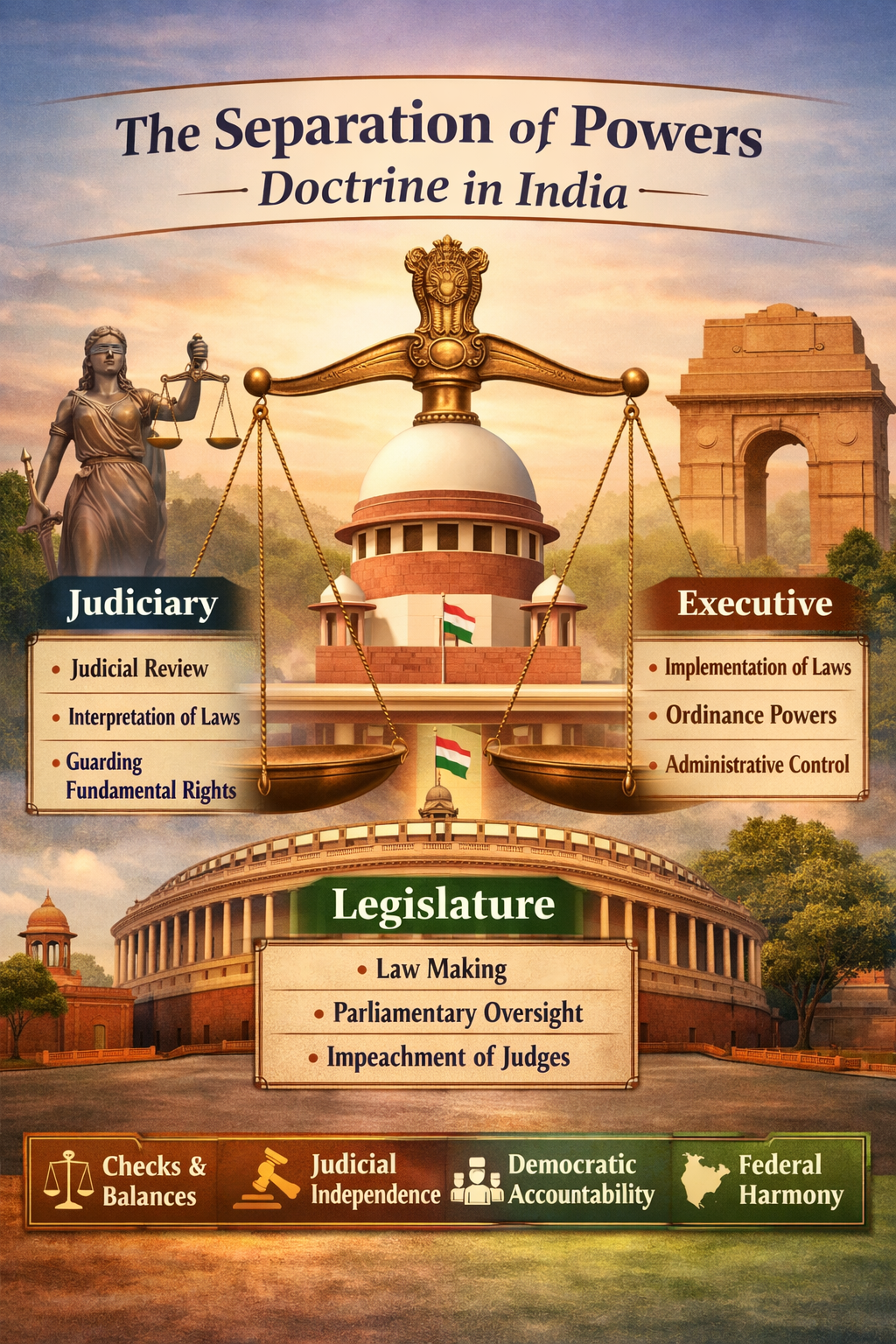
The modern articulation of separation of powers is attributed to the French political philosopher Montesquieu, who proposed a tripartite division of governmental authority to safeguard liberty. According to this model:
-
The Legislature is entrusted with law-making functions,
-
The Executive is responsible for implementation of laws, and
-
The Judiciary interprets laws and adjudicates disputes.
The essence of this doctrine lies in preventing the abuse of power by ensuring that no single authority exercises unchecked control.
2.2 Indian Constitutional Scheme
Unlike the rigid separation observed in the United States, India adopts a flexible and functional separation characterized by checks and balances. The Constitution distributes powers across different provisions:
-
Articles 79–122 govern Parliament and legislative functions,
-
Articles 52–78 deal with the Union Executive, and
-
Articles 124–147 establish the judiciary, particularly the Supreme Court.
India follows a parliamentary system, wherein the executive is drawn from the legislature. This structural overlap does not negate separation but rather reflects a system of controlled interdependence, ensuring coordination without compromising institutional independence.
3. Judicial Recognition: Separation as a Basic Structure
3.1 Evolution Through Case Law
The Indian judiciary has played a pivotal role in elevating the doctrine of separation of powers to a constitutional principle. In the landmark case of Kesavananda Bharati v. State of Kerala, the Supreme Court propounded the Basic Structure Doctrine, holding that Parliament’s amending power under Article 368 is limited.
The judgment recognized that essential features such as judicial review, rule of law, and institutional balance cannot be altered or destroyed.
3.2 Reinforcement Through Subsequent Judgments
The doctrine was further strengthened in Indira Nehru Gandhi v. Raj Narain, where the Court invalidated a constitutional amendment that sought to exclude judicial review of the Prime Minister’s election. The ruling underscored that legislative encroachment into judicial functions violates constitutional principles.
Similarly, in Minerva Mills v. Union of India, the Court reaffirmed that limited amending power itself forms part of the basic structure, thereby preserving the balance among constitutional organs.
3.3 Substantive Limitation on State Power
Through these decisions, separation of powers evolved beyond a procedural doctrine into a substantive limitation on State authority, ensuring that no organ transgresses its constitutional boundaries.
4. Functional Overlap in the Indian System
4.1 Executive–Legislative Interdependence
India’s parliamentary framework inherently blends executive and legislative functions. The Council of Ministers is collectively responsible to the Lok Sabha, and ministers actively participate in legislative processes. Additionally, the executive exercises legislative power through ordinance-making under Article 123.
4.2 Judicial Review
The judiciary exercises the power of judicial review under Articles 13, 32, and 226, enabling courts to invalidate unconstitutional laws and executive actions. This power acts as a crucial check on potential abuse by other branches.
4.3 Legislative Checks on Judiciary
Parliament retains oversight over the judiciary through mechanisms such as impeachment of judges under Articles 124(4) and 217, ensuring accountability within the judicial system.
4.4 Judicial Appointments and Independence
In Supreme Court Advocates-on-Record Association v. Union of India, the Supreme Court struck down the National Judicial Appointments Commission (NJAC), asserting judicial primacy in appointments. This decision emphasized that judicial independence is integral to separation of powers.
Thus, the Indian model reflects cooperative constitutionalism, where functional overlap exists alongside institutional autonomy.
5. Contemporary Challenges and Debates
5.1 Judicial Activism and Overreach
The expansion of Public Interest Litigation (PIL) has enabled courts to intervene in areas such as environmental governance, police reforms, and administrative functioning. While such activism enhances accountability, it raises concerns regarding judicial encroachment into policy domains traditionally reserved for the executive and legislature.
5.2 Ordinance-Making and Executive Excess
The frequent use and re-promulgation of ordinances have been criticized as undermining legislative authority. In D.C. Wadhwa v. State of Bihar, the Supreme Court condemned repetitive re-promulgation as a “fraud on the Constitution,” highlighting the misuse of executive power.
5.3 Tribunalization of Justice
The growing reliance on tribunals exercising quasi-judicial functions blurs traditional institutional boundaries. However, in L. Chandra Kumar v. Union of India, the Court reaffirmed that judicial review by High Courts and the Supreme Court remains part of the basic structure.
5.4 Decline of Parliamentary Deliberation
Strong political majorities and the operation of anti-defection laws have, at times, weakened the deliberative role of Parliament. This has led to increased executive dominance, necessitating a more active role for the judiciary in maintaining constitutional balance.
6. Modern Relevance in the Indian Context
In the 21st century, the doctrine of separation of powers remains indispensable for several reasons:
-
Preservation of Constitutional Supremacy: It ensures that no organ acquires absolute power.
-
Protection of Fundamental Rights: Judicial independence safeguards individual liberties against majoritarian excesses.
-
Democratic Accountability: Institutional checks prevent arbitrariness and abuse of power.
-
Federal Balance: The judiciary acts as an arbiter in Centre-State disputes, maintaining structural harmony.
Moreover, during periods of crisis—such as emergencies, political instability, or public health challenges—the doctrine serves as a constitutional compass, guiding institutional conduct within defined limits.
7. A Dynamic Constitutional Principle
The Indian experience demonstrates that separation of powers is not a rigid doctrine but a dynamic and evolving principle. It adapts to changing governance needs while preserving core constitutional values.
The judiciary has been instrumental in shaping and reinforcing this doctrine, particularly through the Basic Structure framework. However, the effectiveness of this principle ultimately depends on institutional restraint, mutual respect, and constitutional morality among all branches of government.
8. Conclusion
The doctrine of separation of powers in India operates as a structural safeguard embedded within the Constitution’s basic framework. While functional overlaps exist due to the parliamentary system, mechanisms such as judicial review and institutional accountability ensure that power remains limited and controlled.
In an era marked by judicial assertiveness, executive expansion, and evolving governance challenges, the doctrine continues to play a vital role in preserving democratic governance and the rule of law.
Ultimately, separation of powers is not merely a theoretical ideal but a constitutional necessity that protects liberty by preventing the concentration of power and ensuring that governance remains accountable, balanced, and just.
Unlock the Potential of Legal Expertise with LegalMantra.net – Your Trusted Legal Consultancy Partner
Disclaimer
Every effort has been made to ensure accuracy in this material. However, inadvertent errors or omissions may occur. Any discrepancies brought to the author’s notice will be rectified in subsequent editions. The author shall not be liable for any direct, indirect, incidental, or consequential damages arising from the use of this material. This article is based on various sources including statutory enactments, judicial decisions, academic research papers, professional journals, and publicly available legal materials.
Prerna Yadav