
Forget Password

View News
Understanding Deposits under the Companies Act, 2013
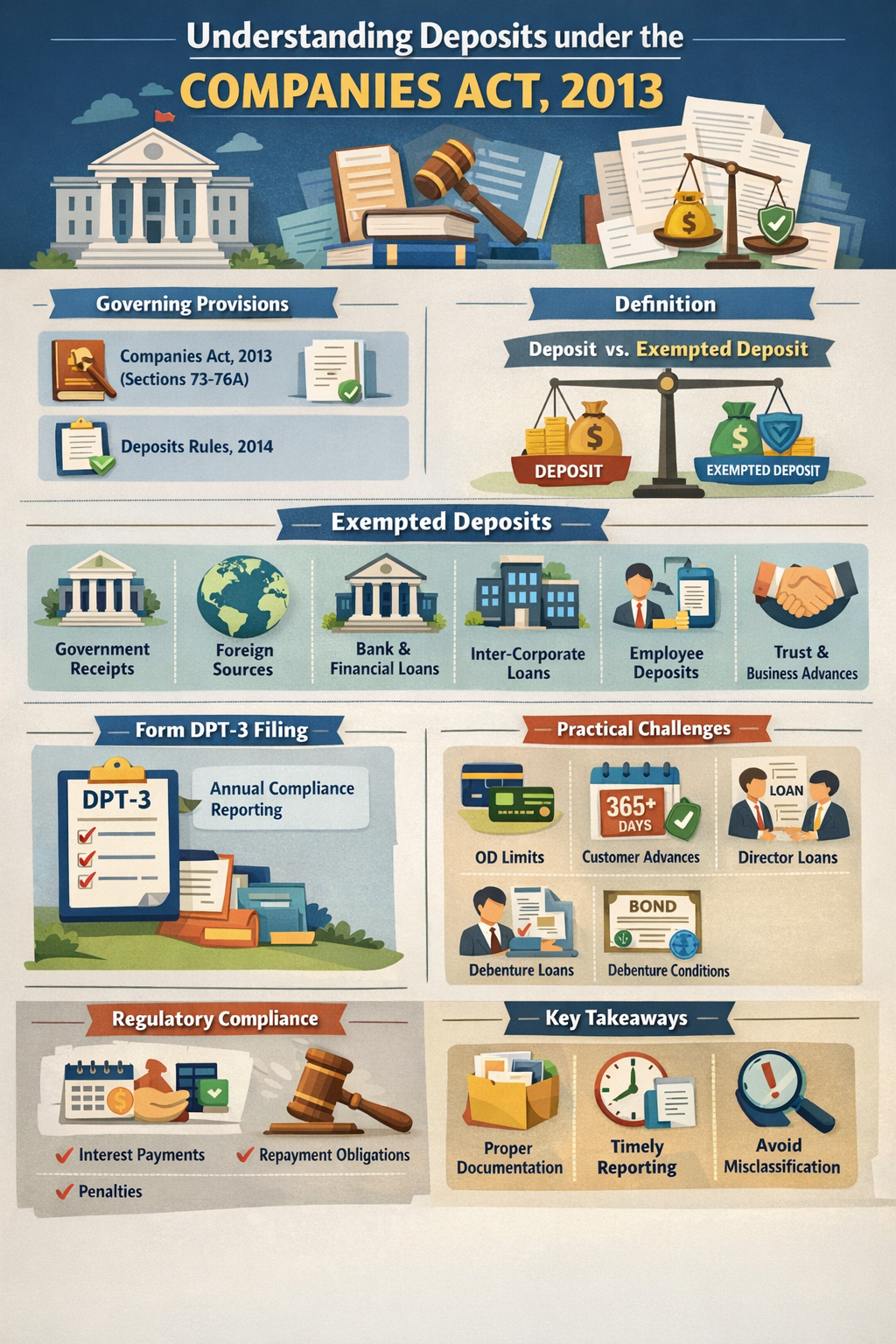
Understanding Deposits under the Companies Act, 2013
Deposits constitute a significant source of funding for companies, but they are also subject to strict regulatory oversight due to the risks involved. The Companies Act, 2013, along with the Companies (Acceptance of Deposits) Rules, 2014, governs the acceptance, classification, and reporting of deposits. It is essential for companies, auditors, and compliance professionals to understand what constitutes a deposit, what is exempted, and how to report them accurately.
1. Applicable Provisions
The regulatory framework for deposits is primarily contained in the following:
1.1 Companies Act, 2013 – Sections 73 to 76A specifically deal with deposits. These sections outline conditions under which companies may accept deposits from members and others, restrictions on acceptance, repayment obligations, and penalties for non-compliance.
1.2 Companies (Acceptance of Deposits) Rules, 2014 – Rules 1 to 21 provide detailed guidance on deposits, including exemptions, procedures for acceptance, treatment of advances, reporting requirements, and procedural compliance. These rules ensure that companies maintain transparency and financial discipline while raising funds from external sources.
2. Definition of Deposits
Under the Act and Rules, any amount received by a company, other than share capital, may be treated as a deposit. However, not all amounts received are treated as deposits; certain categories are exempted. A clear distinction between exempted deposits and deposits is therefore necessary.
3. Exempted Deposits
Section 2(1)(c) of the Companies (Acceptance of Deposits) Rules, 2014, lists amounts that are exempted from the regulatory requirements applicable to deposits. These include amounts received from government authorities, banks, financial institutions, employees, customers, promoters, and through certain types of debt instruments.
3.1 Deposits from Government or Statutory Authorities
Amounts received by a company from the Central or State Government, statutory authorities, or local authorities, or any amount whose repayment is guaranteed by the Government, are considered exempted deposits.
3.2 Foreign Sources
Amounts received from foreign governments, banks, multilateral financial institutions, government-owned development financial institutions, export credit agencies, collaborators, corporate bodies, or foreign residents are exempted, provided the receipt is in accordance with applicable laws.
3.3 Loans from Banks and Financial Institutions
Loans received from banking companies, the State Bank of India or its subsidiaries, cooperative banks, or any other banking institution notified under the Banking Regulation Act are exempt. Similarly, loans or financial assistance from public financial institutions, regional financial institutions, insurance companies, and scheduled banks are considered exempted deposits.
3.4 Amounts Raised by Issue of Debt Instruments
Amounts received by companies through commercial papers or instruments issued in accordance with RBI guidelines are exempt. Similarly, amounts raised through bonds or debentures may be exempted if they meet certain conditions: secured by first charge or pari passu charge on assets (excluding intangible assets), compulsorily convertible debentures (CCDs) convertible within ten years, or listed non-convertible debentures (NCDs).
3.5 Inter-Corporate Loans
Amounts received from another company are generally considered exempted, provided proper documentation is maintained.
3.6 Advances for Subscription to Securities
Amounts received as application money for shares or other securities are exempted if appropriated against allotment. However, if allotment is not completed within 60 days or the refund is not made within 15 days of 60 days, such amounts become deposits under the Act.
3.7 Loans from Directors or Relatives
Amounts received from directors or their relatives in a private company, and from directors in a public company, are exempted, provided a declaration regarding the source and purpose of the funds is obtained.
3.8 Employee Deposits
Non-interest-bearing amounts received from employees, not exceeding their annual salary, are exempted. These are typically security deposits under the employment contract.
3.9 Amounts Held in Trust
Non-interest-bearing amounts received and held in trust for specific purposes are exempted from deposit regulations.
3.10 Advances Received in the Course of Business
Advances received from customers for the supply of goods or provision of services are exempted if adjusted within 365 days. This includes:
- Advances for supply of goods or services accounted in any manner.
- Advances for immovable property under an agreement or arrangement.
- Security deposits for contract performance.
- Advances under long-term projects for capital goods.???????
- Advance for warranty or maintenance contracts, limited to common business practice or five years, whichever is shorter.???????
- Advances allowed by sectoral regulators or government directions.???????
- Advances for subscriptions towards publications (print or electronic).
3.11 Promoter Loans
Loans brought in by promoters to comply with stipulations imposed by lending institutions are exempted until the repayment of the financial institution or bank loans.
3.12 Nidhi Companies
Amounts accepted by Nidhi companies in accordance with rules under Section 406 are exempted.
4. Deposits
Any amount received by a company that does not fall under the category of exempted deposits is considered a deposit. Unlike exempted deposits, deposits are subject to strict regulatory compliance, including filing of Form DPT-3, adherence to repayment schedules, maintenance of deposit registers, and payment of interest. Failure to comply can result in severe penalties under Sections 73 to 76A of the Companies Act, 2013.
5. Filing Form DPT-3
Form DPT-3 must be filed annually by every company to report all deposits or exempted deposits. The form requires classification of all liabilities (excluding share capital) as either deposits or exempted deposits.
5.1 Practical Challenges in Filing Form DPT-3
5.1.1 Loan Facility via Overdraft (OD) Limit
OD limits fluctuate during the year, making it difficult to report exact withdrawals and repayments. Typically, companies reconcile based on closing balance, adjusting opening balance, additions, repayments, and other adjustments.
5.1.2 Opening Balance Reporting
Form DPT-3 is filed before June 30 based on provisional accounts. These may differ from audited figures due to post-closing adjustments. Audited closing balances of the previous year are used as opening balances.
5.1.3 Customer Advances
Advances from customers exceeding 365 days must be reported as deposits. Proper adjustment against goods or services supplied is necessary to maintain exemption.
5.1.4 Loans from Directors
Private companies can classify loans from directors or relatives as exempted, provided a declaration is obtained. Public companies can exempt loans from directors similarly.
5.1.5 Ageing of Loans
Loans must be categorized based on duration outstanding:
- Less than or equal to 1 year???????
- More than 1 year and less than or equal to 3 years???????
- More than 3 years
5.1.6 Amounts from NBFCs
Loans from Non-Banking Financial Companies (NBFCs) are treated as intercorporate deposits.
5.1.7 Debenture Proceeds
Debenture proceeds are exempted if:
- Secured by charge as per Schedule III of the Act.
- CCDs convertible within 10 years.
- Listed NCDs on recognized stock exchanges.
6. Key Takeaways
Understanding the distinction between deposits and exempted deposits is crucial for compliance and financial planning. Proper documentation, timely filing of Form DPT-3, and classification of advances, intercorporate loans, and debenture proceeds reduce compliance risks. Misclassification or delay in reporting can attract penalties, scrutiny from regulators, and impact the company’s credibility.
"Unlock the Potential of Legal Expertise with LegalMantra.net - Your Trusted Legal Consultancy Partner”
Disclaimer: Every effort has been made to avoid errors or omissions in this material in spite of this, errors may creep in. Any mistake, error or discrepancy noted may be brought to our notice which shall be taken care of in the next edition In no event the author shall be liable for any direct indirect, special or incidental damage resulting from or arising out of or in connection with the use of this information Many sources have been considered including Newspapers, Journals, Bare Acts, Case Materials , Charted Secretary, Research Papers etc
LegalMantra.net team
Anshul Goel