
Forget Password

View News
Weighing the Pros and Cons: The Advantages and Disadvantages of Litigation
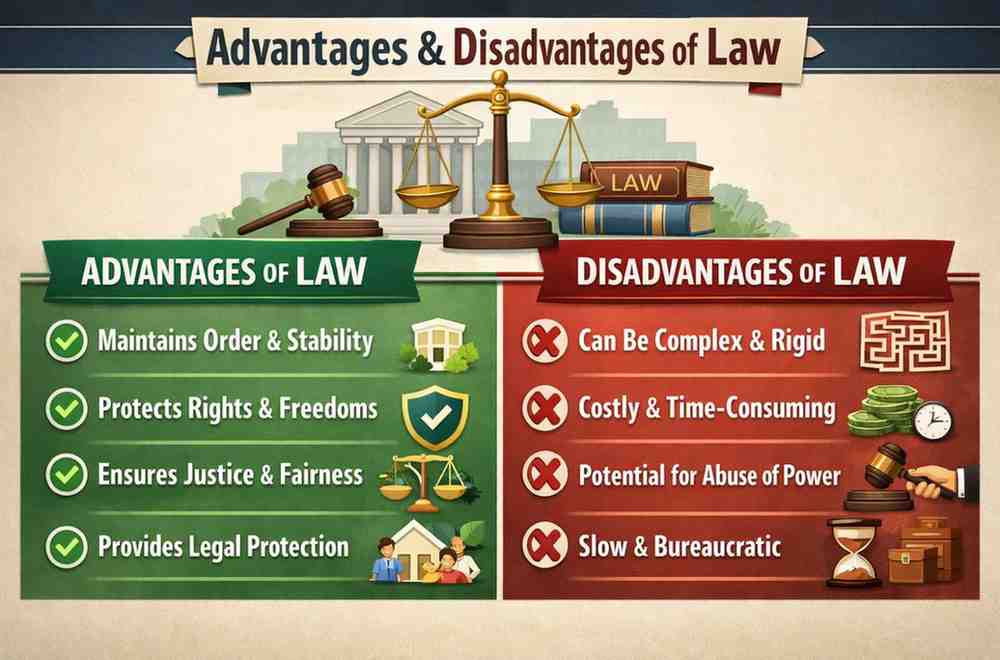
Weighing the Pros and Cons: The Advantages and Disadvantages of Litigation
Introduction
Litigation is one of the most widely used methods for resolving disputes through courts of law. It refers to the formal legal process in which parties present their claims, evidence, and arguments before a judge or jury, who then delivers a legally binding decision. Litigation plays a fundamental role in maintaining law and order, protecting rights, and ensuring justice in society. It is commonly used in disputes relating to contracts, property, employment, constitutional rights, family matters, taxation, business transactions, and criminal offences.
In a democratic country like India, litigation acts as a safeguard against injustice and unlawful actions. Courts function as protectors of legal and constitutional rights and ensure that laws are interpreted and applied fairly. For example, when a citizen’s fundamental rights are violated, they may approach the Supreme Court or High Courts under Articles 32 and 226 of the Constitution of India for legal remedies.
Although litigation is an essential component of the legal system, it is often criticized for being expensive, time-consuming, and emotionally exhausting. Therefore, before initiating legal proceedings, parties must carefully understand both the advantages and disadvantages of litigation.
Advantages of Litigation
1. Legally Binding and Enforceable Decisions
One of the most important advantages of litigation is that court judgments are legally binding and enforceable. Once a court passes an order or decree, the parties are legally required to obey it. If a party fails to comply, the successful party can seek enforcement through legal mechanisms such as execution proceedings, attachment of property, or contempt of court.
Example:
If a court orders a tenant to vacate a property and the tenant refuses to comply, the landlord can approach the court for enforcement of the decree through legal authorities.
This enforceability gives litigation authority, certainty, and finality.
2. Protection of Legal and Constitutional Rights
Litigation enables individuals to protect and enforce their legal and constitutional rights. Courts act as guardians of justice and ensure that no person is deprived of their rights unlawfully.
In India, constitutional remedies empower citizens to challenge unlawful government actions and violations of fundamental rights.
Example:
A person whose freedom of speech is unfairly restricted may approach the High Court or Supreme Court seeking protection of their constitutional rights.
A landmark example is Kesavananda Bharati v. State of Kerala, where the Supreme Court established the Basic Structure Doctrine and protected the essential features of the Indian Constitution.
3. Fair and Structured Procedure
Litigation follows a well-structured legal procedure governed by statutes such as:
- The Code of Civil Procedure, 1908
- The Code of Criminal Procedure, 1973
- The Indian Evidence Act, 1872
These laws ensure fairness, transparency, and equal opportunity for both parties to present evidence and arguments.
Example:
In a civil property dispute, both parties are given equal opportunity to submit documents, examine witnesses, and cross-examine the opposing side before the court delivers judgment.
This structured process minimizes arbitrary decision-making and promotes justice.
4. Availability of Appeals
Another major advantage of litigation is the right to appeal. If a party believes that the trial court made an error, they can challenge the decision before a higher court.
The appellate system helps in correcting mistakes and reducing the possibility of injustice.
Example:
If a District Court passes an incorrect judgment in a contract dispute, the aggrieved party may file an appeal before the High Court.
This multi-level judicial review strengthens public confidence in the judiciary.
5. Creation of Legal Precedents
Court decisions often become precedents that guide future cases. Under the doctrine of stare decisis, lower courts are bound to follow decisions of higher courts.
This ensures consistency and uniformity in the legal system.
Example:
The Supreme Court’s judgment in Kesavananda Bharati v. State of Kerala continues to guide constitutional interpretation in India even today.
Similarly, important judgments relating to privacy, environmental protection, and human rights shape future legal developments.
6. Suitable for Complex Disputes
Litigation is highly effective in disputes involving:
- Constitutional interpretation
- Criminal liability
- Public interest matters
- Complex commercial transactions
- Taxation and regulatory disputes
Courts possess the authority and expertise required to resolve complicated legal issues comprehensively.
Example:
Large corporate fraud cases involving multiple parties and extensive evidence are generally resolved through courts because they require judicial supervision and authoritative rulings.
Disadvantages of Litigation
1. Expensive Process
One of the biggest disadvantages of litigation is the high financial cost involved. Litigation may require payment of:
- Court fees
- Advocate fees
- Documentation expenses
- Administrative charges
- Expert witness costs
Long-running cases can become financially burdensome.
Example:
A commercial dispute between two companies may continue for several years, resulting in substantial legal expenses for both parties.
This makes litigation difficult for economically weaker sections of society.
2. Time-Consuming Nature
Litigation is often criticized for delays and backlog of cases. Courts in India face millions of pending matters, causing disputes to continue for years or even decades.
Example:
Property inheritance disputes frequently continue across generations before reaching final settlement.
Such delays reduce the efficiency of the justice system and support the popular saying:
“Justice delayed is justice denied.”
3. Emotional and Mental Stress
Court proceedings can be emotionally exhausting. Repeated hearings, uncertainty of outcomes, and adversarial arguments often create anxiety and stress.
Example:
In divorce or child custody disputes, prolonged litigation may emotionally affect not only the parties but also their children and families.
Litigation can therefore negatively impact mental well-being and personal relationships.
4. Lack of Privacy and Public Exposure
Most court proceedings are conducted publicly, meaning sensitive information may become accessible to others.
Businesses may suffer reputational damage if confidential disputes become public, while personal matters may expose private details.
Example:
A defamation case involving celebrities or corporations may attract media attention and harm public reputation.
This lack of confidentiality is a major disadvantage in sensitive matters.
5. Adversarial Nature of Litigation
Litigation follows an adversarial system where each party attempts to prove the other wrong. This often damages relationships permanently.
Example:
Business partners involved in litigation may never restore their professional relationship after the dispute concludes.
Similarly, family disputes involving inheritance or matrimonial conflicts may create long-term hostility.
6. Uncertain Outcomes
Even strong legal cases do not guarantee success. Judicial decisions depend on evidence, interpretation of law, procedural compliance, and judicial discretion.
Example:
Two courts may interpret the same contractual clause differently, leading to uncertainty in outcomes.
Appeals may further prolong disputes and increase costs.
Litigation Versus Alternative Dispute Resolution (ADR)
Due to the disadvantages of litigation, Alternative Dispute Resolution (ADR) methods such as:
- Arbitration
- Mediation
- Conciliation
- Negotiation
have gained popularity.
ADR methods are generally:
- Faster
- Less expensive
- More confidential
- Less adversarial
Section 89 of the Code of Civil Procedure also encourages courts to promote ADR mechanisms.
Example:
Commercial companies often prefer arbitration because disputes can be resolved privately and efficiently without lengthy court proceedings.
However, ADR may not be suitable in every case. Matters involving constitutional rights, criminal offences, or significant public interest generally require judicial determination through litigation.
Conclusion
Litigation remains one of the most important pillars of the legal system and an essential mechanism for delivering justice. Its advantages include legally enforceable decisions, protection of rights, procedural fairness, appellate review, and development of legal precedents. Courts are particularly effective in resolving complex legal and constitutional disputes requiring authoritative interpretation of law.
At the same time, litigation has several disadvantages, including high costs, procedural delays, emotional stress, lack of confidentiality, and adversarial hostility. These limitations have encouraged the growth of alternative dispute resolution mechanisms such as arbitration and mediation.
Therefore, the decision between litigation and ADR should depend on factors such as the nature of the dispute, urgency, financial capability, confidentiality concerns, and desired outcome. While litigation may be unavoidable in certain cases, reforms are necessary to make the judicial process faster, more affordable, and more accessible so that justice can truly be delivered effectively and efficiently
Unlock the Potential of Legal Expertise with LegalMantra.net – Your Trusted Legal Consultancy Partner
Disclaimer
Every effort has been made to ensure accuracy in this material. However, inadvertent errors or omissions may occur. Any discrepancies brought to the author’s notice will be rectified in subsequent editions. The author shall not be liable for any direct, indirect, incidental, or consequential damages arising from the use of this material. This article is based on various sources including statutory enactments, judicial decisions, academic research papers, professional journals, and publicly available legal materials.
Prerna Yadav