
Forget Password

View News
When the Price Went Below Zero: Bombay High Court Settles the Negative Crude Oil Saga
When the Price Went Below Zero: Bombay High Court Settles the Negative Crude Oil Saga
Dhanera Diamonds v. SEBI & Ors. - Bombay High Court, Writ Petition No. 4930 of 2024 (with companion matters)
Pronounced on 24 June 2026 | Coram: Justice R.I. Chagla & Justice Advait M. Sethna
Can the price of a barrel of oil really be less than nothing? In April 2020, it was - and a group of Indian traders spent the next six years asking the courts to pretend it wasn’t.
On 24 June 2026, the Bombay High Court drew a line under one of the most fascinating market-structure disputes to reach an Indian court. The verdict is a masterclass on the limits of writ jurisdiction in commercial bargains - and a sobering reminder that sophisticated traders cannot ask the State to underwrite their bets.
The Day Oil Turned Negative
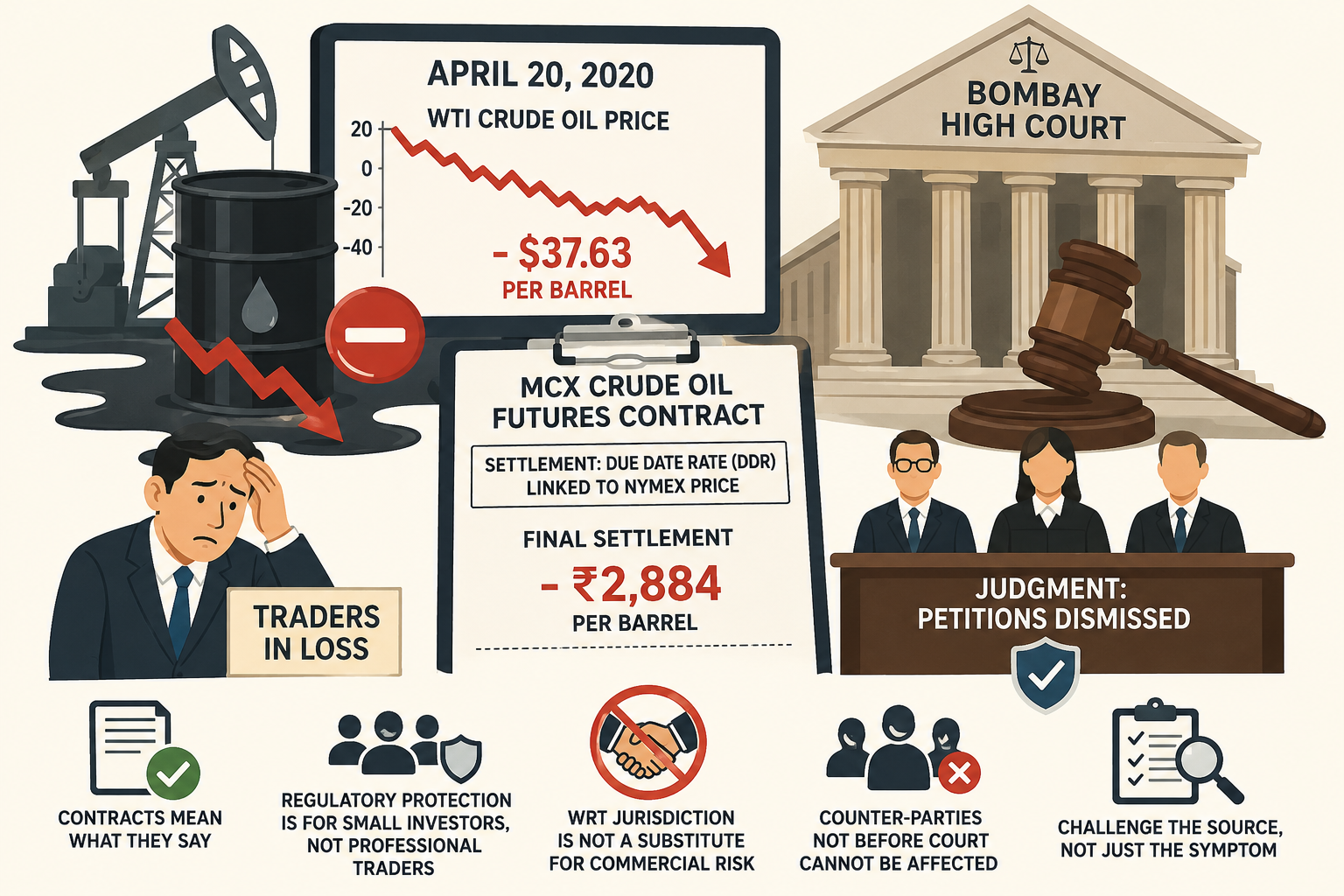
On 20 April 2020, with the world in COVID lockdown and storage tanks brimming, the May contract for West Texas Intermediate on NYMEX collapsed to minus USD 37.63 per barrel. Sellers were effectively paying buyers to take crude off their hands.
On Indian shores, the Multi Commodity Exchange (MCX) ran a crude oil futures contract whose settlement - the “Due Date Rate” (DDR) - was pegged to that very NYMEX front-month price. Through Circular No. 282 dated 21 April 2020 (the “impugned Circular”), MCX fixed the final settlement at minus Rs. 2,884 per barrel, the rupee equivalent of the negative NYMEX print.
The petitioner, Dhanera Diamonds - a partnership firm trading commodities through its broker - held 2,965 lots at expiry. Having already committed roughly Rs. 60.75 crore to buy the position, it was now asked to pay a further Rs. 85.51 crore to exit. Across the country, a wave of similarly placed traders filed writ petitions, eventually transferred to the Bombay High Court by the Supreme Court for a consolidated hearing.
The Heart of the Dispute
Stripped to essentials, the petitioners’ case rested on a single, elegant word: “price.”
Led by Senior Counsel Mr. Darius Khambata, they argued that the contract specification consciously described the DDR as a “price.” In law and common parlance, a “price” is the money consideration that moves from buyer to seller - never the reverse. Relying on Supreme Court authority
- (Dharmarth Trust v. Dinesh Chander Nanda; Moriroku India Pvt. Ltd. v. State of Uttar Pradesh)
the petitioners contended that a “negative price” is a contradiction in terms. A reverse payment, they said, is no consideration at all, rendering the impugned Circular void under Section 25 of the Indian Contract Act, 1872, and ultra vires the contract MCX itself had drafted.
They went further: MCX, they argued, had retrospectively rewritten the bargain - altering a 9% daily circuit-breaker and a fixed 30-minute settlement window — to the traders’ ruin, and SEBI, as market regulator and investor-protector, ought to have stepped in to annul the trades.
What SEBI and MCX Said
The Respondents - SEBI, MCX and the MCX Clearing Corporation — answered that the DDR was always and only a mirror of the NYMEX settlement price. It was the international benchmark, not the domestic price, that turned negative. The contract did exactly what it said it would. The traders, fully aware of the structure, chose not to square off and consciously carried a net long position into expiry. Crucially, the Rules, Bye-laws and Regulations underpinning the Circular were never challenged.
The Verdict: Petitions Dismissed
In a detailed judgment authored by Justice R.I. Chagla, with a concurring opinion by Justice Advait M. Sethna, the Court dismissed every petition with no order as to costs. The reasoning repays close reading:
1. The “price” argument, though attractive, fails
The Court accepted that at first blush the negative-price submission “may sound attractive,” but held it “pales into insignificance” on the facts. The DDR was tied to the NYMEX price, and it was that benchmark which went negative - not the price of crude traded on MCX in isolation. The petitioners produced no material showing that an internationally referenced price must, as a matter of law, always remain positive.
2. No retrospective alteration of the contract
The impugned Circular, the Court found, was neither retrospective nor an alteration of pre-existing contractual terms. Settlement was carried out exactly per the contract specifications the petitioners were bound by. Tellingly, the crude price on NYMEX turned negative only around 11:45 p.m. - after the 11:30 p.m. trading close - so even an extended window would have changed nothing.
3. Writs are not a shield against trading losses
The Court drew a sharp distinction between small investors and sophisticated, experienced traders. SEBI’s investor-protection mandate, it held, exists to safeguard “common men who are small investors” - not to rescue professional speculators from the consequences of a volatile bet they knowingly made. The petitioners had, in their own words, made a “bet” on crude oil.
4. The absent counter-parties
In his concurrence, Justice Sethna underscored a decisive practical point: annulling the trades - the petitioners’ preferred relief - would directly harm counter-parties who were not before the Court. Granting relief in their absence would be “unfair, inequitable and unjust.” Invoking the maxim quando aliquid prohibetur ex directo, prohibetur et per obliquum (what cannot be done directly cannot be done indirectly), he declined to direct SEBI to annul trades through the back door of writ jurisdiction.
5. The conscience of the Court
Justice Sethna closed with a striking observation: the petitioners had failed to satisfy the Court’s conscience that justice lay on their side - a sine qua non for entertaining a writ. “It is not logic alone that people exclusively thrive on,” he wrote; “it is in fact, very often the narratives that influence minds … and hope is the silver lining, the polestar.” But hope, the Court made clear, is not a ground for relief under Article 226.
Why This Judgment Matters
- Contracts mean what they say. When a settlement mechanism is expressly pegged to an external benchmark, parties take that benchmark - in good times and bad. Courts will not rewrite a commercial bargain to relieve one side of an unexpected outcome.
- “Price” is contextual, not dogmatic. The ordinary-parlance meaning of a word yields where the contract’s structure plainly contemplates a benchmark-linked settlement that can swing either way.
- Regulatory protection has limits. SEBI’s shield is for the small investor, not the sophisticated speculator. The regulator is not an insurer of last resort for professional risk-takers.
- Writ jurisdiction is no substitute for commercial risk. Article 226 cannot be deployed to undo settled trades, especially where affected counter-parties are unrepresented.
- Challenge the source, not just the symptom. The petitioners’ failure to assail the underlying Rules, Bye-laws and Regulations - the very source of the Circular - left their challenge structurally weak.
For anyone working in capital markets, commodities, or financial regulation, Dhanera Diamonds is essential reading. It is a clear-eyed affirmation that the market’s sharpest players must live with the market’s sharpest turns — even when the price falls below zero.
What’s your view - should regulators ever intervene to annul trades in a “black swan” pricing event, or does that undermine the very certainty markets depend on? I’d love to hear your thoughts in the comments.
#SecuritiesLaw #SEBI #CommodityDerivatives #CorporateLaw #CompanySecretary #CapitalMarkets #BombayHighCourt #CrudeOil
© 2026 CS Sharath. All rights reserved.
This article is the original work of CS Sharath. No part of it may be reproduced, republished, or circulated, in whole or in part, in any form or by any means, without prior written permission and due attribution to the author.
Disclaimer
The contents of this article are intended solely for general information and academic discussion. They do not constitute legal, financial, or professional advice and should not be relied upon as such. While every effort has been made to ensure accuracy, the author accepts no liability for any error, omission, or for any action taken or not taken on the basis of this article. The views expressed are personal to the author and do not represent those of any organisation. Readers are advised to refer to the full text of the judgment and to seek independent professional advice before acting on any matter discussed herein.